




How Website Translation Improves AI Search Visibility: The New SEO Strategy for 2026
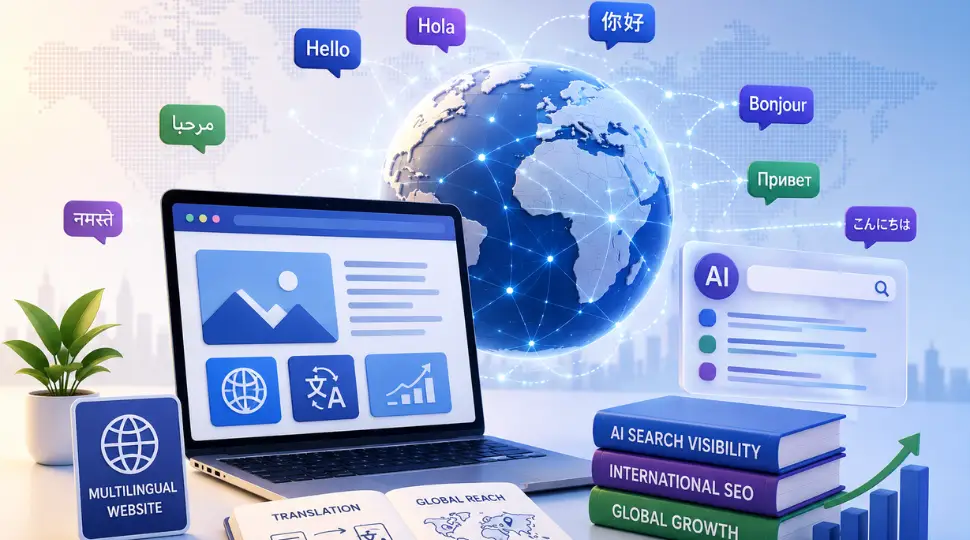
Why AI Search Is Changing SEO
Traditional SEO focused primarily on achieving higher rankings on Google's search engine results pages (SERPs). While rankings still matter, AI-powered search introduces an entirely new layer of visibility.
Today's AI search engines:
- Generate direct answers
- Summarize multiple sources
- Recommend authoritative websites
- Cite trusted content instead of showing only blue links
- Understand user intent across multiple languages
As a result, businesses must optimize their websites for AI citations in addition to traditional rankings.
This evolution has given rise to new optimization strategies such as:
- Generative Engine Optimization (GEO)
- Answer Engine Optimization (AEO)
- Entity SEO
- AI Citation Optimization
- Semantic Search Optimization
Websites that adapt early are more likely to become trusted sources for AI-generated responses.
Understanding AI Search Visibility
What Is AI Search Visibility?
AI search visibility refers to how frequently your content appears within AI-generated answers rather than only in traditional search listings.
Instead of simply displaying ten blue links, AI platforms analyze multiple trusted sources and generate summarized responses. The websites referenced within these summaries receive valuable exposure, brand recognition, and referral traffic.
Examples include:
- Google AI Overviews
- ChatGPT Search
- Microsoft Copilot
- Perplexity AI
- Gemini
- Claude
Appearing within these responses increases your chances of attracting users even when they never click through traditional search results.
Why AI Citations Matter
AI systems evaluate:
- Content quality
- Website authority
- Freshness
- Expertise
- Trustworthiness
- Context
- Language relevance
The more signals your website provides, the greater its potential to be selected as a citation source.
This makes multilingual content an increasingly valuable asset because AI systems naturally attempt to answer users in their preferred language.
Why Website Translation Matters More Than Ever
International businesses often focus on translating their websites to improve user experience.
However, translation now offers another strategic advantage: It increases the likelihood that AI systems can discover, understand, and reference your content across multiple languages.
Imagine a company that publishes excellent technical articles only in English. If someone searches in Spanish, German, or French, the AI model is less likely to reference that content because language alignment is one of the strongest relevance signals.
By offering professionally translated versions, businesses create more opportunities for AI engines to recognize and surface their content.
Beyond Traditional International SEO
For years, international SEO emphasized:
- hreflang implementation
- Country targeting
- Localized keywords
- Regional domains
- Language-specific URLs
These remain important, but AI-powered search introduces additional considerations.
Modern multilingual SEO now focuses on:
- Language Matching: AI prioritizes content written in the same language as the user's query whenever possible.
- Semantic Understanding: Translated content expands the range of concepts and entities AI associates with your brand.
- Content Accessibility: Multiple language versions make information easier for AI systems to interpret and cite.
- Global Brand Authority: Publishing valuable content in several languages demonstrates expertise across markets.
How AI Uses Multilingual Content
Large Language Models (LLMs) process enormous amounts of multilingual information.
When users submit queries, AI systems attempt to find sources that best satisfy several criteria simultaneously:
- Relevance
- Accuracy
- Authority
- Language compatibility
- Freshness
- Context
Language plays a surprisingly important role in this decision-making process.
For example: A user searching in Spanish expects an answer written naturally in Spanish. Even if an English article contains excellent information, the AI may prioritize a comparable Spanish-language source because it better matches the user's intent.
This explains why multilingual websites often enjoy broader AI visibility.
AI Rewards Localized User Experiences
Translation is no longer just about converting words. High-performing multilingual websites also adapt:
- Currency
- Examples
- Measurements
- Cultural references
- Local terminology
- Regional spelling
- Search intent
This localization improves user satisfaction and sends stronger quality signals to AI systems.
Professional Translation vs Machine Translation
Businesses often wonder whether automated translation is sufficient. While machine translation has improved dramatically, professional localization generally provides stronger long-term SEO value because it:
- Preserves brand voice
- Maintains accuracy
- Improves readability
- Reduces translation errors
- Creates better user engagement
AI systems increasingly evaluate user experience alongside textual accuracy, making high-quality translations more valuable than ever.
Research Insights on AI Visibility
Recent industry research has highlighted a growing relationship between multilingual websites and AI search performance.
One widely discussed study analyzing more than 1.3 million AI citations compared websites available in only one language with those offering professionally translated versions.
The findings suggested several important trends:
- Multilingual websites received significantly more visibility within AI-generated search experiences.
- Translated websites earned more citations per search query than single-language websites.
- Language alignment improved the likelihood of appearing in AI-generated answers.
- Businesses offering content in multiple languages strengthened their visibility across international markets.
Although results vary by industry, competition, and content quality, the research reinforces a broader principle: making content available in the user's language increases the chances of being discovered by AI-powered search systems.
For SEO professionals, this signals that multilingual publishing is evolving from a user experience enhancement into a strategic visibility advantage.
Benefits of Translating Your Website
Translating your website is no longer just a way to reach international customers — it has become a strategic advantage for improving AI search visibility. As AI-powered search engines evolve, multilingual content helps brands appear in more searches, earn more citations, and build stronger authority across regions.
1. Expand Your Global Reach
Publishing content in multiple languages allows your website to serve users where they are, in the language they prefer. This expands your potential audience and creates more opportunities for discovery.
Benefits include:
- Increased international traffic
- Better engagement from local audiences
- Improved brand recognition across markets
- Higher chances of being cited in AI-generated answers
2. Improve AI Citation Opportunities
AI search platforms prioritize content that closely matches a user's language and search intent. When your content is available in multiple languages, AI systems have more relevant resources to reference.
A multilingual website can help you:
- Appear in AI-generated summaries
- Increase visibility across different language searches
- Strengthen topical authority
- Reach users beyond your primary market
3. Enhance User Experience
Visitors are more likely to trust and engage with content presented in their native language. Localized experiences often result in:
- Lower bounce rates
- Longer session durations
- Higher conversion rates
- Greater customer satisfaction
These engagement signals also contribute to stronger overall SEO performance.
4. Strengthen International SEO
Website translation complements traditional international SEO practices by making localized content easier to discover and understand.
Best practices include:
- Dedicated URLs for each language
- Proper hreflang implementation
- Localized metadata
- Region-specific keywords
- Optimized internal linking
Together, these elements improve discoverability for both users and AI systems.
Common Mistakes to Avoid
Simply translating text is not enough. Poor implementation can limit your visibility and reduce user trust.
Relying Only on Automatic Translation
Machine translation tools are useful for drafting content, but publishing unreviewed translations may introduce errors, awkward phrasing, or inaccurate terminology.
Instead:
- Review AI-generated translations
- Use native-language editors where possible
- Maintain your brand voice across languages
Ignoring Local Search Intent
People in different countries often search differently, even when looking for the same product or service.
For example: An American user might search for "digital marketing certification", while a UK audience may search for "digital marketing qualification."
Research region-specific keywords rather than translating keywords word for word.
Missing hreflang Tags
Without hreflang implementation, search engines may struggle to determine which language version should be shown to users.
Correct hreflang usage helps:
- Prevent duplicate content issues
- Deliver the appropriate language version
- Improve international SEO performance
Translating Without Localization
Localization adapts content for cultural and regional preferences. Consider localizing:
- Currency
- Date formats
- Units of measurement
- Images
- Examples
- Testimonials
- Calls-to-action
Localized content feels more authentic and increases user engagement.
Best Practices for AI-Ready Multilingual SEO
As AI search becomes more sophisticated, businesses should align their translation strategy with modern SEO best practices.
Create High-Quality Original Content
AI systems reward content that demonstrates Experience, Expertise, Authoritativeness, and Trustworthiness (E-E-A-T). Rather than simply translating existing pages, create valuable localized content that addresses the needs of each audience.
Maintain Consistent Brand Messaging
Every language version should reflect the same:
- Tone of voice
- Brand identity
- Product information
- Customer experience
Consistency builds trust among users and AI systems alike.
Optimize Technical SEO
Ensure every translated page includes:
- Optimized title tags
- Meta descriptions
- Structured headings
- Schema markup
- Canonical tags
- Internal links
- Mobile responsiveness
- Fast loading speed
Technical optimization supports both search engine indexing and AI content retrieval.
Build Regional Authority
Increase credibility in each target market by:
- Earning backlinks from local websites
- Publishing region-specific content
- Collaborating with local industry experts
- Showcasing customer success stories
Regional authority strengthens both traditional rankings and AI visibility.
Monitor Performance
Track multilingual SEO performance using tools such as:
- Google Search Console
- Google Analytics 4
- Bing Webmaster Tools
- Ahrefs
- Semrush
Key metrics include:
- Organic traffic by language
- AI referral traffic (where measurable)
- Keyword rankings
- Click-through rate (CTR)
- Conversion rate
- User engagement
Continuous monitoring helps identify opportunities for improvement.
Future of AI Search and International SEO
Search is rapidly evolving from a list of links to an intelligent conversation. Businesses that embrace multilingual strategies today will be better positioned for tomorrow's AI-driven search landscape.
Emerging trends include:
- AI-Powered Search Experiences: Platforms increasingly generate direct answers instead of displaying traditional search results.
- Greater Emphasis on Entities: AI understands brands, products, people, and topics through entities rather than isolated keywords.
- Personalized Search Results: Responses will continue to become more personalized based on language, location, and user behavior.
- Increased Demand for High-Quality Content: Original, trustworthy, and well-structured content will remain the foundation of long-term visibility.
Website translation is no longer just a localization initiative — it is a strategic investment in global discoverability.
Key Takeaways
Essential Points to Remember
- AI search is reshaping SEO. Visibility now depends on AI citations as much as traditional rankings.
- Language alignment matters. AI systems prefer content in the same language as the user's query.
- Translation expands AI visibility. Multilingual content creates more opportunities for AI engines to discover and cite your brand.
- Localization beats translation. Adapting currency, examples, and cultural references improves both UX and AI signals.
- E-E-A-T applies globally. High-quality, authoritative content in any language earns trust from both users and AI.
- Technical SEO is critical. hreflang, schema, and fast loading speed support multilingual discoverability.
- Monitor and optimize continuously. Track performance by language and refine based on data.
Conclusion
AI-powered search is transforming how users discover information online. Success is no longer determined solely by traditional rankings; it's increasingly influenced by whether AI systems recognise your content as relevant, trustworthy, and useful.
A well-executed multilingual strategy helps businesses expand their reach, improve international SEO, and create more opportunities to be surfaced in AI-generated search experiences. By combining quality translations with strong technical SEO, localised content, and E-E-A-T principles, organisations can build lasting visibility in an increasingly AI-driven digital landscape.
Whether you're exploring a digital marketing course in Thane or comparing digital marketing classes in Pune, choosing an affordable digital marketing course in PCMC can help you build strong fundamentals without overextending your budget.
As AI continues to reshape search, investing in multilingual, user-focused content today can position your brand for sustainable growth across global markets.
Frequently Asked Questions
1. Does translating a website improve SEO?
Yes. High-quality translated content can help your website reach international audiences, improve user experience, and strengthen international SEO when combined with proper technical implementation.
2. Can multilingual content improve AI search visibility?
Publishing content in multiple languages increases the likelihood that AI-powered search platforms can identify and reference your content for users searching in those languages.
3. Is machine translation enough for SEO?
Machine translation can accelerate workflows, but human review and localization are recommended to ensure accuracy, readability, and cultural relevance.
4. What is the difference between translation and localization?
Translation converts text into another language, while localization adapts content for the cultural, linguistic, and regional preferences of the target audience.
5. Which industries benefit most from multilingual SEO?
Industries such as e-commerce, SaaS, education, travel, healthcare, finance, and technology often gain significant value from multilingual SEO due to their global customer base.