




AI Email Personalization: The Complete Guide to Smarter Email Marketing
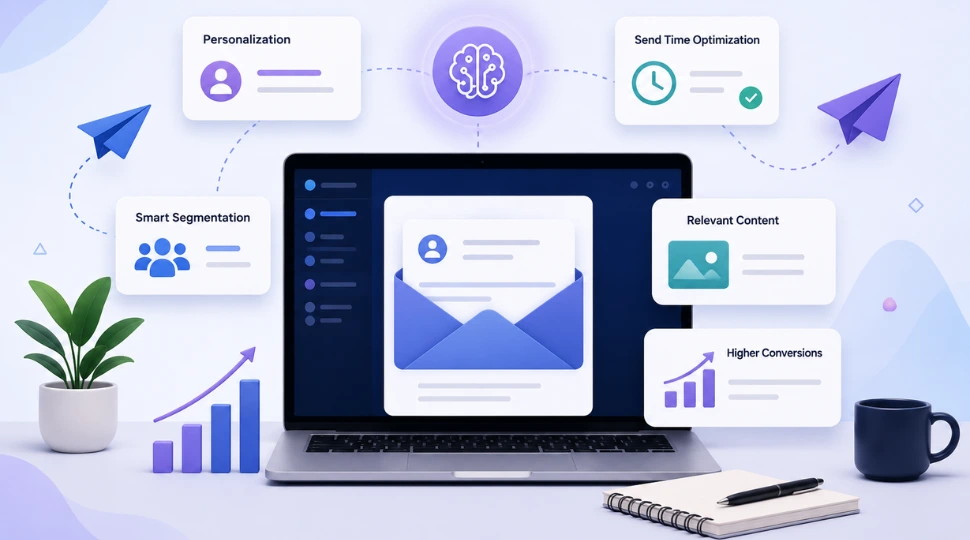
Email marketing has always been one of the highest ROI digital marketing channels. However, customer expectations have changed significantly over the last few years. Today's audience expects businesses to understand their preferences, recommend relevant products, and communicate at the right time—not send the same message to everyone.
This is where AI Email Personalization is transforming modern marketing. Instead of relying on basic customer segmentation, artificial intelligence analyzes user behavior, purchase history, browsing activity, engagement patterns, and predictive insights to create highly personalized email experiences.
Businesses using AI-powered personalization are seeing improvements in open rates, click-through rates, customer satisfaction, and overall revenue because every email feels more relevant to the recipient.
Whether you're an eCommerce business, SaaS company, healthcare provider, educational institute, or B2B organization, AI can help you deliver the right message to the right person at exactly the right moment.
To better understand the ideas discussed in AI Email Personalization, consider strengthening your skills with a practical digital marketing course in Pune designed for real-world application.
In this guide, you'll learn how AI Email Personalization works, why it has become essential for modern marketers, the technologies behind it, and how businesses can successfully implement it to improve email campaign performance.
What is AI Email Personalization?
AI Email Personalization is the process of using Artificial Intelligence and Machine Learning to automatically customize email content based on each customer's behavior, interests, demographics, browsing history, previous purchases, engagement level, and predicted future actions.
Traditional personalization often stops at using the recipient's first name:
Hi John,
Modern AI goes much further.
It can automatically determine:
- Which products a customer is most likely to purchase
- The ideal time to send an email
- Which subject line will generate the highest open rate
- What content each customer prefers
- Which offer will produce the best conversion
- Whether the customer is likely to unsubscribe
- Which customers are about to become inactive
Instead of marketers making every decision manually, AI continuously analyzes thousands of customer data points to optimize campaigns automatically.
Traditional Personalization vs AI Personalization
| Traditional Email Personalization | AI Email Personalization |
|---|---|
| Uses First Name | Understands Customer Intent |
| Manual Segmentation | Automatic Smart Segmentation |
| Same Content for Groups | Unique Content for Individuals |
| Fixed Send Time | Personalized Send Time |
| Manual Product Suggestions | AI Product Recommendations |
| Limited Customer Data | Real-Time Behavioral Analysis |
| Rule-Based Automation | Predictive Intelligence |
Businesses moving from traditional personalization to AI often experience significant improvements in customer engagement because every email becomes more relevant to individual recipients.
Why Traditional Email Marketing Is No Longer Enough
Imagine receiving five promotional emails in a day, all recommending products you've never searched for.
Most people simply ignore them.
Now imagine receiving an email recommending exactly the product you viewed yesterday, with a helpful buying guide and a limited-time discount.
Which email are you more likely to open?
This simple example highlights why personalization has become essential rather than optional.
Modern customers expect businesses to remember their preferences and provide relevant recommendations. AI makes this possible at scale—even when communicating with millions of subscribers.
Why AI Email Personalization Matters
Customer expectations are changing rapidly.
People no longer compare your emails only with competitors—they compare them with the highly personalized experiences offered by companies like Amazon, Netflix, Spotify, and Google.
These platforms have trained customers to expect personalized recommendations everywhere.
Email marketing is no exception.
AI helps businesses meet these expectations by delivering emails that feel individually crafted rather than mass-produced.
Higher Customer Expectations
Today's consumers expect businesses to:
- Remember previous purchases
- Recommend relevant products
- Send useful content
- Avoid irrelevant promotions
- Understand buying preferences
- Communicate at convenient times
AI enables marketers to meet these expectations without manually creating thousands of different email versions.
Better Engagement
Personalized emails naturally attract more attention because recipients see information that matches their interests.
AI helps improve:
- Email open rates
- Click-through rates
- Website visits
- Repeat purchases
- Customer retention
- Average order value
Instead of sending generic newsletters, businesses can create meaningful conversations with customers.
Improved Customer Experience
People appreciate brands that save them time.
AI filters unnecessary information and presents only what is relevant.
Examples include:
- Product recommendations
- Personalized educational content
- Renewal reminders
- Birthday offers
- Abandoned cart recovery
- Subscription updates
- Location-specific promotions
This creates a smoother customer journey and strengthens long-term relationships.
Better Marketing ROI
One of the biggest advantages of AI Email Personalization is its ability to maximize marketing efficiency.
Instead of increasing advertising budgets, businesses often achieve better results simply by improving email relevance.
Benefits include:
- Higher conversions
- Lower unsubscribe rates
- Better customer lifetime value
- Reduced spam complaints
- Increased revenue from existing customers
For many businesses, email marketing already delivers one of the highest returns among digital marketing channels. AI helps amplify these results by ensuring each campaign is optimized for individual recipients.
How AI Email Personalization Works
Many marketers assume AI is simply writing email content.
In reality, AI analyzes vast amounts of customer data to make intelligent decisions before an email is even sent.
The process typically involves four key stages:
Step 1: Collect Customer Data
AI gathers information from multiple sources, including:
- Website browsing behavior
- Product page visits
- Previous purchases
- Cart activity
- Mobile app usage
- Email engagement
- Customer support interactions
- CRM systems
- Social media engagement
- Loyalty program activity
The more relevant data available, the more accurately AI can personalize each email.
Step 2: Analyze Customer Behavior
Machine learning algorithms identify patterns that humans might overlook.
For example, AI can detect:
- Customers likely to make another purchase soon
- Users at risk of unsubscribing
- High-value customers
- Seasonal buying habits
- Frequently purchased product categories
- Preferred communication times
These insights help marketers deliver more relevant content.
Step 3: Create Personalized Experiences
Based on its analysis, AI can automatically customize:
Subject Lines
Each recipient may receive a different subject line designed to maximize open rates.
Example:
Customer A:
Still thinking about those running shoes?
Customer B:
Complete your fitness collection today.
Product Recommendations
AI suggests products based on:
- Purchase history
- Similar customer behavior
- Browsing activity
- Frequently bought together items
- Trending products
This increases the likelihood of additional purchases while enhancing the customer experience.
Dynamic Email Content
Instead of sending identical emails to everyone, AI can personalize:
- Images
- Headlines
- Product listings
- Offers
- Call-to-action buttons
- Discounts
- Educational resources
- Testimonials
Every subscriber may see a slightly different email tailored to their interests.
Send-Time Optimization
AI studies when individual users are most likely to open emails.
Instead of sending campaigns at a fixed time, AI delivers each email when the recipient is most active.
This simple optimization can significantly improve engagement rates without requiring additional effort from marketers.
Step 4: Learn and Improve Continuously
Unlike traditional automation, AI doesn't stop after sending an email.
It continuously learns from results such as:
- Opens
- Clicks
- Purchases
- Unsubscribes
- Bounce rates
- Reading time
- Device usage
Over time, the system becomes increasingly accurate, making future campaigns even more effective.
Key Technologies Behind AI Email Personalization
Several advanced technologies work together to power modern AI-driven email marketing:
Machine Learning
Identifies customer behavior patterns and predicts future actions.
Natural Language Processing (NLP)
Generates personalized email copy, subject lines, and recommendations using human-like language.
Predictive Analytics
Forecasts future customer behavior, such as purchase likelihood or churn risk.
Recommendation Engines
Suggest products, articles, courses, or services based on previous interactions and similar customer preferences.
Behavioral Analytics
Tracks user activity across websites, apps, and emails to create more relevant messaging.
Benefits of AI Email Personalization
AI Email Personalization is no longer just a competitive advantage—it has become an essential strategy for businesses that want to build stronger customer relationships and increase marketing performance. By using artificial intelligence to understand customer behavior and preferences, marketers can create highly relevant email experiences that drive measurable business results.
Let's explore the biggest benefits in detail.
1. Higher Email Open Rates
The subject line is often the deciding factor in whether an email gets opened or ignored.
AI analyzes historical data such as:
- Previous email interactions
- User interests
- Browsing behavior
- Purchase history
- Device usage
- Time of engagement
Using this information, AI can generate personalized subject lines that resonate with each recipient.
Example
Instead of sending:
Summer Sale is Live!
AI may personalize it as:
John, Your Favorite Running Shoes Are Now 30% Off
or
Still Interested? Your Wishlist Items Are Waiting
Personalized subject lines naturally attract more attention because they feel relevant to the reader.
2. Better Click-Through Rates (CTR)
Opening an email is only the first step. The real goal is encouraging users to take action.
AI improves click-through rates by showing recipients content that matches their interests.
For example:
- A customer interested in skincare sees skincare products.
- A student receives recommendations for digital marketing courses.
- A business owner gets AI automation resources.
- A returning customer receives complementary product suggestions.
Every email becomes more useful, increasing the likelihood of clicks.
3. Improved Customer Experience
Consumers today expect brands to understand their needs.
Receiving irrelevant emails repeatedly often leads to frustration and unsubscribes.
AI helps businesses create a better customer experience by sending:
- Personalized product recommendations
- Relevant educational content
- Renewal reminders
- Birthday offers
- Abandoned cart reminders
- Re-engagement campaigns
When customers consistently receive valuable information, they are more likely to trust the brand.
4. Increased Conversion Rates
The ultimate objective of email marketing is generating conversions.
Whether your goal is:
- Product purchases
- Course enrollments
- Webinar registrations
- Consultation bookings
- Software trials
AI helps improve conversion rates by delivering highly relevant content to each recipient.
Example
A customer who abandoned a shopping cart might receive:
- Product reminder
- Customer reviews
- Limited-time discount
- Free shipping offer
- Personalized CTA
This targeted approach significantly improves the chances of completing the purchase.
5. Stronger Customer Retention
Acquiring a new customer is often more expensive than retaining an existing one.
AI identifies customers who are becoming less engaged and automatically launches retention campaigns.
Examples include:
- "We Miss You" emails
- Exclusive loyalty rewards
- Personalized discounts
- New product recommendations
- Educational content
- Anniversary offers
These campaigns help rebuild engagement before customers leave.
6. Smarter Customer Segmentation
Traditional segmentation usually divides subscribers into broad groups based on age, gender, or location.
AI creates dynamic micro-segments using hundreds of behavioral signals.
Instead of one large audience, AI can identify groups such as:
- First-time buyers
- High-value customers
- Discount seekers
- Frequent browsers
- Loyal subscribers
- Cart abandoners
- Seasonal shoppers
- Inactive customers
This level of precision leads to much more effective campaigns.
7. Better Return on Investment (ROI)
Every marketer wants better results without dramatically increasing advertising spend.
AI contributes to higher ROI by improving:
- Open rates
- Click-through rates
- Conversion rates
- Customer lifetime value
- Retention rates
- Upselling opportunities
By sending fewer but more relevant emails, businesses can achieve better outcomes while reducing wasted marketing efforts.
8. Continuous Learning and Optimization
One of AI's greatest strengths is its ability to learn continuously.
Unlike traditional automation, AI evaluates campaign performance after every send.
It studies:
- Open rates
- Click behavior
- Purchase decisions
- Unsubscribes
- Bounce rates
- Reading time
- Device preferences
With every campaign, AI becomes more accurate, helping marketers make smarter decisions over time.
Best AI Personalization Techniques
Understanding the available personalization techniques helps marketers maximize the value of AI.
1. Predictive Product Recommendations
AI studies browsing history, previous purchases, and customer similarities to recommend products each recipient is most likely to buy.
This technique powers recommendation engines used by companies like Amazon and Netflix.
2. Dynamic Email Content
Instead of sending identical emails, AI adjusts content for each subscriber.
Elements that can change include:
- Headlines
- Images
- Products
- Offers
- Testimonials
- CTAs
- Pricing
- Educational resources
Every recipient receives a slightly different version of the same campaign.
3. Personalized Subject Lines
AI tests multiple subject line variations and predicts which version is most likely to increase open rates for each subscriber.
Examples:
- Products left in cart
- Recently viewed items
- Location-based offers
- Seasonal recommendations
- Personalized reminders
4. Send-Time Optimization
Some subscribers check emails at 7 AM.
Others prefer evenings.
Instead of sending one campaign to everyone simultaneously, AI determines the optimal delivery time for each user.
This often leads to improved engagement without changing the email content.
5. Predictive Customer Segmentation
AI continuously updates audience segments based on changing behavior.
Examples include:
- Ready-to-buy customers
- Price-sensitive shoppers
- VIP customers
- Customers likely to unsubscribe
- New subscribers
- Repeat buyers
Unlike manual segmentation, these groups evolve automatically.
6. Cart Abandonment Emails
AI recognizes when users leave products in their cart without completing a purchase.
It can automatically send:
- Product reminders
- Reviews
- Discounts
- Free shipping offers
- Stock alerts
These campaigns are among the highest-converting email automation strategies.
7. Churn Prediction
Machine learning identifies customers who are becoming inactive.
Businesses can then launch retention campaigns before losing valuable customers.
8. AI Copywriting Assistance
Modern AI tools help marketers generate:
- Subject lines
- Preview text
- Email introductions
- CTAs
- Product descriptions
- Personalized recommendations
Human review remains essential, but AI significantly speeds up content creation.
9. Behavioral Trigger Emails
Instead of sending emails based on schedules alone, AI reacts to customer actions.
Examples:
- Product viewed
- Course completed
- Demo requested
- Download completed
- Subscription renewed
- Purchase made
These emails are highly relevant because they respond to real customer behavior.
10. AI-Powered A/B Testing
Traditional A/B testing compares two versions.
AI can simultaneously evaluate multiple combinations of:
- Subject lines
- Headlines
- Images
- CTAs
- Send times
- Product layouts
It quickly identifies the best-performing version for different audience segments.
Top AI Email Marketing Tools
Choosing the right platform is just as important as implementing personalization strategies.
Below are some of the most popular AI-powered email marketing tools used by businesses today.
| Tool | Best For | AI Features |
|---|---|---|
| HubSpot | CRM & Automation | Predictive lead scoring, smart workflows |
| Mailchimp | Small Businesses | AI content suggestions, send-time optimization |
| Klaviyo | eCommerce | Predictive analytics, product recommendations |
| ActiveCampaign | Marketing Automation | Behavioral automation, AI segmentation |
| Brevo (Sendinblue) | SMBs | AI email optimization and automation |
| Omnisend | Shopify Stores | Product recommendations and omnichannel automation |
| Iterable | Enterprise | Journey orchestration with AI personalization |
Tip: Before investing in any platform, evaluate its AI capabilities, CRM integration, automation features, reporting dashboard, scalability, and ease of use to ensure it aligns with your business goals.
Real-World Examples
One of the best ways to understand AI Email Personalization is by looking at how leading brands use it successfully.
Amazon
Amazon's recommendation engine analyzes millions of customer interactions to personalize emails with:
- Recently viewed products
- Frequently bought together suggestions
- Wishlist reminders
- Reorder prompts
- Deal alerts based on browsing history
This keeps customers engaged and encourages repeat purchases.
Netflix
Netflix sends personalized emails based on:
- Viewing history
- Favorite genres
- New releases
- Incomplete series
- Trending content
Instead of generic newsletters, users receive recommendations tailored to their entertainment preferences.
Spotify
Spotify leverages AI to create highly engaging emails featuring:
- Weekly playlists
- Discover Weekly recommendations
- Year-end listening summaries (Spotify Wrapped)
- Artist updates
- Personalized music suggestions
These campaigns strengthen user loyalty by making every interaction feel unique.
Airbnb
Airbnb personalizes email campaigns using:
- Previous travel destinations
- Saved wishlists
- Seasonal travel trends
- Local experiences
- Price alerts
This helps users discover destinations that match their interests.
Common Mistakes to Avoid
Artificial Intelligence can significantly improve your email marketing campaigns, but simply adding AI tools isn't enough. Many businesses fail to see results because they overlook key fundamentals. Here are the most common mistakes—and how to avoid them.
1. Relying Too Much on Automation
AI can automate many repetitive tasks, but it shouldn't replace human creativity and strategy.
Poorly reviewed AI-generated emails may:
- Sound robotic
- Miss your brand voice
- Contain inaccurate information
- Feel impersonal
Best Practice: Let AI assist with recommendations, while marketers review and refine the final content.
2. Using Poor-Quality Customer Data
AI is only as effective as the data it receives. Outdated or incomplete customer information can lead to irrelevant recommendations and poorly targeted emails.
Keep your data clean by:
- Removing inactive subscribers
- Updating customer preferences
- Verifying email addresses
- Syncing your CRM regularly
- Eliminating duplicate records
Accurate data leads to better personalization and improved campaign performance.
3. Over-Personalization
While personalization improves engagement, too much can feel intrusive.
For example, mentioning every product a customer viewed or revealing detailed browsing behavior may make recipients uncomfortable.
Focus on being helpful, not creepy.
4. Ignoring Customer Privacy
As data privacy regulations continue to evolve, businesses must handle customer information responsibly.
Always:
- Obtain consent before collecting data.
- Provide clear unsubscribe options.
- Explain how customer data is used.
- Comply with regulations such as GDPR, CAN-SPAM, and applicable local privacy laws.
Trust is essential for long-term customer relationships.
5. Not Testing Campaign Performance
Many marketers launch AI-powered campaigns and assume the work is done.
In reality, continuous testing is essential.
Track metrics such as:
- Open Rate
- Click-Through Rate (CTR)
- Conversion Rate
- Bounce Rate
- Unsubscribe Rate
- Revenue per Email
- Customer Lifetime Value (CLV)
Regular analysis helps you identify what's working and where improvements are needed.
Best Practices
Successful AI-driven email marketing combines technology with strategic planning. Follow these best practices to maximize results.
Start with Customer Segmentation
Before applying advanced AI features, organize subscribers into meaningful groups based on:
- Purchase history
- Interests
- Engagement level
- Industry
- Location
- Customer lifecycle stage
AI performs better when it has a structured audience to analyze.
Collect First-Party Data
As third-party cookies become less reliable, businesses should focus on collecting first-party data directly from customers.
Examples include:
- Website activity
- Purchase history
- Email interactions
- Customer surveys
- Preference centers
- Loyalty program participation
First-party data is more accurate, privacy-friendly, and valuable for personalization.
Write for Humans, Not Algorithms
Even when AI helps generate email content, your copy should feel conversational and helpful.
Ask yourself:
- Does this solve a customer problem?
- Is the language simple?
- Does it sound authentic?
- Is the call-to-action clear?
Readers engage with emails that provide genuine value—not those overloaded with sales messages.
Combine AI with Marketing Automation
AI becomes even more effective when paired with automated workflows.
Examples include:
- Welcome email series
- Abandoned cart recovery
- Product recommendation campaigns
- Birthday emails
- Subscription renewal reminders
- Post-purchase follow-ups
- Re-engagement campaigns
Automation ensures timely communication while AI enhances relevance.
Review AI Performance Regularly
AI models improve over time, but they still require human oversight.
Review performance monthly by evaluating:
- Personalization accuracy
- Customer feedback
- Campaign engagement
- Conversion trends
- Revenue impact
Continuous optimization keeps your strategy aligned with changing customer behavior.
Future of AI Email Personalization
AI is evolving rapidly, and the future of email marketing will become even more intelligent.
Here are some emerging trends to watch:
Hyper-Personalization
Future AI systems will create unique email experiences for every individual by combining:
- Real-time behavior
- Purchase intent
- Device usage
- Weather
- Location
- Contextual signals
Generative AI Content
AI tools are increasingly capable of producing:
- Subject lines
- Email copy
- Product descriptions
- Personalized offers
- Calls-to-action
Marketers will spend less time drafting content and more time refining strategy.
Predictive Customer Journeys
Instead of reacting to customer actions, AI will anticipate them.
Examples:
- Predicting future purchases
- Identifying churn risk
- Forecasting customer lifetime value
- Recommending the next best action
This proactive approach enables businesses to engage customers before opportunities are missed.
Omnichannel Personalization
Email personalization will increasingly integrate with other marketing channels, including:
- SMS
- Push notifications
- Websites
- Mobile apps
- Social media
Customers will enjoy a consistent, personalized experience across every touchpoint.
AI-Powered Decision Making
Rather than only suggesting improvements, future AI platforms will automatically:
- Optimize campaigns
- Allocate budgets
- Select audience segments
- Adjust send times
- Personalize content
Human marketers will focus on business goals and creativity while AI handles much of the optimization.
Conclusion
AI Email Personalization is reshaping the way businesses connect with their audiences. By using artificial intelligence to analyze customer behavior, predict preferences, and deliver highly relevant content, brands can move beyond generic email campaigns and create meaningful customer experiences.
The real value of AI isn't just automation—it's relevance. Businesses that combine quality customer data, thoughtful strategy, and continuous optimization are more likely to improve engagement, increase conversions, and build long-term customer loyalty.
As AI technology continues to advance, marketers who embrace responsible personalization while maintaining a human touch will be better positioned to stand out in increasingly competitive inboxes.
Whether you're exploring digital marketing classes in Pune or choosing an affordable digital marketing course in PCMC can help you build strong fundamentals without overextending your budget.
FAQs
1. What is AI Email Personalization?
AI Email Personalization uses artificial intelligence to customize email content based on customer behavior, preferences, purchase history, and engagement data, making emails more relevant to each recipient.
2. How does AI improve email marketing?
AI helps marketers optimize subject lines, personalize content, recommend products, determine the best send times, automate campaigns, and improve customer segmentation for better engagement and conversions.
3. Is AI Email Personalization suitable for small businesses?
Yes. Many modern email marketing platforms offer AI-powered features designed for businesses of all sizes, helping small businesses deliver more relevant campaigns without requiring large marketing teams.
4. Which industries benefit the most from AI Email Personalization?
Industries such as eCommerce, SaaS, education, healthcare, travel, finance, hospitality, and retail commonly use AI personalization to improve customer engagement and retention.
5. What data is required for AI Email Personalization?
Useful data includes purchase history, browsing behavior, email engagement, customer preferences, website interactions, CRM information, and loyalty program activity.
6. Can AI completely replace email marketers?
No. AI is a powerful assistant that automates repetitive tasks and provides data-driven insights, but human marketers are still essential for strategy, creativity, brand voice, and relationship building.
7. What are the biggest challenges of AI Email Personalization?
Common challenges include maintaining data quality, protecting customer privacy, avoiding over-personalization, integrating systems, and regularly monitoring AI-generated campaigns for accuracy.