



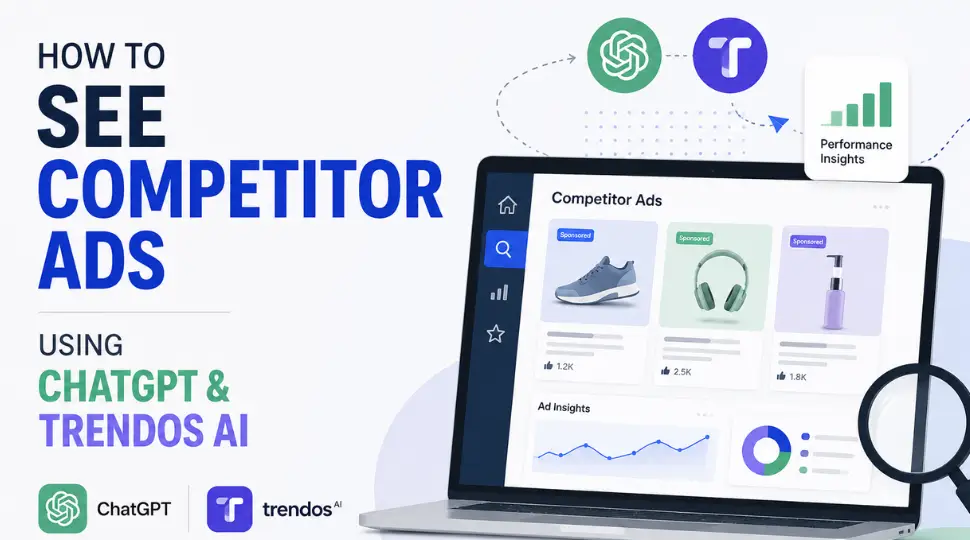
How to See Competitor Ads Using ChatGPT and Trendos AI
Why Competitor Ad Research Matters
Competitor ad analysis assists marketers to comprehend what works currently within the market. Rather than inventing campaigns from scratch, brands can look to the successful plans already in use by other brands.
Competitor research is conducted by businesses for the following reason(s):
- Find the most popular ad creations
- Understand audience messaging
- Analyze CTA strategies
- Identify high-performing platforms
- Improve conversion-focused campaigns
Today's marketing is very data-centric. Regularly checking competitor activities can help businesses stay one step ahead of the game.
Brands that test creatives and constantly optimize based on competitor insight, report that they see much better results from ads over time.
What Is Trendos AI?
Trendos AI is a marketing intelligence tool with AI capabilities that allows businesses to find and analyse top trending ads in the market.
On the platform, marketers can:
- Monitor competitor ads
- Analyze creative trends
- Learn ad copy patterns
- Understand viral campaign types
- Create ideas for upcoming campaigns
Unlike conventional ad libraries where you have to do the searches manually, Trendos AI does it through automation and AI-driven recommendations.
This can save the marketer the research time while making campaigns more effective.
Key Features of Trendos AI
Ad Discovery Engine
Trendos AI helps users identify trending advertisements across industries and niches.
Creative Pattern Analysis
The platform highlights recurring creative structures that perform well.
AI-Based Recommendations
Marketers receive suggestions based on current advertising trends and engagement patterns.
Campaign Inspiration
Businesses can explore different hooks, visual styles, and storytelling methods for future campaigns.
How ChatGPT Helps Analyze Competitor Ads
While Trendos AI helps collect advertising data, ChatGPT helps marketers interpret and refine those insights.
ChatGPT can assist with:
- Summarizing competitor strategies
- Rewriting ad copy variations
- Identifying emotional triggers
- Generating alternative CTAs
- Improving audience targeting ideas
For example, marketers can paste competitor ad copies into ChatGPT and ask:
- What emotions does this ad target?
- Why might this hook perform well?
- How can this copy be improved?
- What audience is this ad targeting?
This combination of automation and strategic analysis significantly speeds up campaign development.
Benefits of AI-Powered Ad Intelligence
Faster Research
Traditional competitor analysis can take hours or even days. AI tools dramatically reduce research time.
Better Creative Decisions
By analyzing successful ad structures, marketers can make informed creative choices.
Improved ROI
Understanding market trends allows businesses to avoid ineffective campaigns and optimize ad spend.
Smarter Audience Targeting
AI tools help identify messaging patterns that resonate with specific audience groups.
Enhanced Testing Strategies
Marketers can build stronger A/B testing frameworks using competitor insights.
Step-by-Step Process to Analyze Competitor Ads
Step 1: Identify Top Competitors
Start by listing competitors within your niche or industry.
Focus on:
- Similar audience segments
- Similar pricing models
- Similar products or services
Step 2: Collect Ad Data
Use tools like:
- Meta Ad Library
- Trendos AI
- TikTok Creative Center
- Google Ads Transparency Center
Gather screenshots, ad copies, videos, and CTA examples.
Step 3: Analyze Ad Patterns
Look for:
- Repeated hooks
- Visual styles
- Emotional triggers
- Offer positioning
- CTA language
Patterns often reveal what resonates with audiences.
Step 4: Use ChatGPT for Insights
Feed ad copies into ChatGPT and ask for:
- Tone analysis
- Audience psychology
- Alternative headline ideas
- Creative improvements
This helps convert raw data into actionable strategies.
Step 5: Build Your Own Creative Strategy
Use insights ethically to inspire unique campaigns rather than copying competitors directly.
Focus on:
- Better storytelling
- Stronger visuals
- Clearer messaging
- Improved user experience
Key Metrics to Evaluate in Competitor Ads
When studying competitor ads, focus on metrics that reveal audience engagement and campaign effectiveness.
Engagement Indicators
- Likes
- Comments
- Shares
- Watch time
Creative Performance
- Hook effectiveness
- Video pacing
- Thumbnail quality
- Caption structure
Offer Strength
Evaluate:
- Discounts
- Bonuses
- Limited-time urgency
- Value propositions
Audience Positioning
Analyze how competitors speak to:
- Pain points
- Aspirations
- Emotions
- Desires
Common Mistakes Marketers Make
Copying Instead of Learning
Many businesses simply replicate competitor ads. This often results in weak brand identity. The goal should be inspiration, not duplication.
Ignoring Audience Psychology
Successful ads connect emotionally with users. Marketers who focus only on visuals often miss deeper messaging strategies.
Overlooking Creative Testing
Even well-designed ads fail without proper testing. Competitor research should support experimentation, not replace it.
Relying Only on AI
AI tools are powerful assistants, but human creativity and market understanding remain essential.
Real-World Example of AI Ad Research
Scenario: eCommerce Skincare Brand Researching Competitor Ads
Using Trendos AI, they discover:
- Most top-performing ads use "before and after" storytelling
- Short-form videos outperform static creatives
- Emotional hooks drive higher engagement
Using ChatGPT, the team then:
- Creates improved ad variations
- Refines audience targeting
- Tests multiple CTA styles
Within weeks, the brand improves click-through rates and lowers customer acquisition costs. This demonstrates how AI-powered competitor research can directly impact campaign performance.
EEAT and Ethical Considerations
Google's EEAT guidelines take into account:
- Experience
- Expertise
- Authoritativeness
- Trustworthiness
Marketing campaigns inspired by competitor research will consist of:
- Avoid plagiarism
- Putting emphasis on originality of ideas
- Refer to trusted sources of information
- Prioritize customer value
When there is authenticity, there is trust, and there is going to be more powerful long-term brand equity.
A good example is big name brands that capitalise on trends but don't just copy their competitors.
Future of AI in Advertising Research
Marketing tools powered by Artificial Intelligence will keep increasing in complexity.
These are some of the trends that could be considered for future:
- The predictive performance scoring for ads
- Automated creative generation
- Real-time competitor monitoring
- Personalized campaign recommendations
- AI-generated audience segmentation
Mastering the art of marrying human creativity with AI efficiency could be a significant advantage for marketers.
Conclusion
Marketers are leveraging AI for competitor research. Businesses can use platforms such as Trendos AI along with ChatGPT to analyse advertising strategies in a quicker time, recognise advertising patterns which are effective, and enhance advertising performance in a more efficient way.
But it's not about mimicking your competitors; it's about knowing how to think like them, about understanding their audience psychology, market trends and storytelling skills to make better choices in your marketing.
If you're looking for a digital marketing course in Thane, or digital marketing classes in Pune, an affordable digital marketing course in PCMC can help you lay a solid foundation without going over budget.
Creativity, ethical marketing, and an AI-driven approach to insights will undoubtedly give businesses a significant edge in navigating the ever-changing world of digital advertising.
FAQs
Is it legal to analyze competitor ads?
Yes, analyzing publicly available advertisements is legal. However, directly copying creatives or copyrighted materials is unethical and may violate platform policies.
Can ChatGPT spy on competitor ads?
No. ChatGPT does not spy on ads. It helps marketers analyze and interpret advertising content they manually provide.
What industries benefit most from competitor ad analysis?
Industries such as eCommerce, SaaS, education, real estate, fitness, and digital marketing benefit significantly from competitor research.
Is Trendos AI better than Meta Ad Library?
Trendos AI offers AI-powered insights and automation, while Meta Ad Library mainly provides manual ad searching capabilities.
How often should marketers analyze competitor ads?
Regular monitoring is recommended. Many businesses review competitor ads weekly or monthly to stay updated with trends.