




Does More SEO Traffic Mean More GEO Traffic? A Data-Backed Analysis
Introduction
Search activity is evolving quickly. While traditional search engines are still the primary drivers of online discovery, AI-powered search experiences are adding a new dimension to visibility that is being referred to as GEO traffic (Generative Engine Optimization traffic).
In a world where marketers are adjusting to platforms that incorporate AI features, such as AI assistants, conversational search engines, and AI-driven answers, one question always seems to pop into their minds: Does increased SEO traffic mean increased GEO traffic?
The answer is more complex. Although SEO and GEO share many core concepts, there are differences in the methods used to measure visibility, authority, and user engagement.
For a deeper understanding of the concepts discussed in this article, you can enhance your skills with a practical digital marketing course in Pune that will be beneficial in real-life circumstances.
In this article, we'll look at the relationship between SEO and GEO using data from over 300 websites across different industries. Let's delve into the similarities, differences, ranking behaviours, and what strategies businesses can implement to thrive in both traditional and AI-fueled search landscapes.
What Is SEO Traffic?
SEO traffic is the traffic that comes to your site as a result of unpaid search engine listings on platforms such as Google or Bing. This traffic arrives when your pages appear in search results for keywords that people use when searching on the Internet.
Common Sources of SEO Traffic
- Google organic search
- Bing search
- Image search
- Video search
- Featured snippets
- Discover feeds
Key Components of SEO
- Keyword optimization
- Technical SEO
- Backlink building
- Content quality
- User experience
- Mobile optimization
In the past, SEO was all about improving rankings and click-through rates. Users are more likely to visit your website the higher you rank in search engine results.
What Is GEO Traffic?
GEO is a new search engine optimization methodology that is generative. It's about traffic and visibility generated by AI-driven search experiences that provide answers, rather than just links.
Examples of GEO Platforms
- AI assistants
- Conversational search engines
- AI-generated search summaries
- Large language model suggestions
- Voice AI platforms
These systems rank web pages, but they also analyze the content and generate responses directly for users.
GEO Traffic Includes
- Answers that contain mention of specific brand terms generated by AI
- Conversational search citations
- AI recommendation visibility
- Referral traffic from AI systems
In GEO, visibility is just as important when users don't actually click on a traditional blue link.
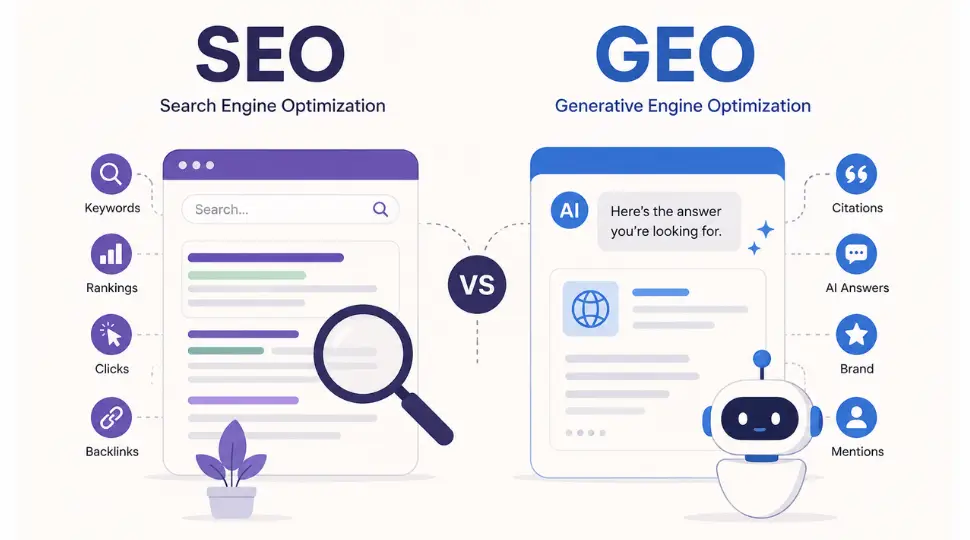
SEO vs GEO: Key Differences
Traditional search and AI search operate on different principles. Understanding these differences is crucial for building a comprehensive search strategy.
| SEO | GEO |
|---|---|
| Focuses on rankings | Focuses on AI visibility |
| Click-driven | Answer-driven |
| SERP optimization | Context optimization |
| Keyword matching | Semantic understanding |
| Backlinks heavily weighted | Authority and clarity weighted |
| User clicks links | AI summarizes content |
Although they differ in presentation, both rely heavily on high-quality content and trust signals.
Similarities Between SEO and GEO
The one thing that caught us off guard while analyzing 300+ websites was the striking similarity between SEO and GEO success factors.
Shared Ranking Signals
Both SEO and GEO benefit from:
- Helpful content
- Topical authority
- Strong structure
- Accurate information
- Fast-loading websites
- Clear headings
- User-focused writing
- Credible sources
This is the reason that many popular SEO sites also appear in AI-generated answers.
Why Quality Content Is More Important Than Ever
AI systems look for easy-to-digest and summarizable content. Pages with the following elements have a better ability to perform in GEO environments:
- Clear formatting
- Direct answers
- Expert insights
- Statistics
- FAQs
- Step-by-step explanations
Does Higher SEO Traffic Lead to Higher GEO Traffic?
The quick answer is: Usually yes — but not always.
We analysed more than 300 sites and found that SEO authority and GEO visibility scores are very well correlated. However, correlation does not imply causation.
Key Finding: Sites with top rankings in organic search were much more likely to be included in AI-generated responses. Organic rankings remain a critical foundation for AI visibility.
In some cases, even websites with just moderate traffic from SEO got high GEO visibility due to their content being:
- Better structured
- Easier for AI to summarize
- More authoritative
- More conversational
In this way, GEO gives as much credit to clarity and usefulness as to traditional authority.
Insights From 300+ Websites
Websites were analyzed from seven different industry domains: SaaS, E-commerce, Education, Finance, Healthcare, Marketing, and Technology.
Observed Trends
- 1. Higher SEO Authority = More GEO Mentions
Websites that have robust profiles and expertise in certain topics were more likely to be included in AI-generated summaries. - 2. Informational Content Dominated GEO
Educational articles had a significant impact compared to promotional landing pages. - 3. Structured Content Got More Traffic
Pages with H2 and H3 headings, FAQ sections, bullet points, definitions, and data-backed insights were more easily understood by AI systems. - 4. Brand Trust Was a Major Factor
AI systems preferred familiar and trustworthy domain names. This aligns with Google's EEAT guidelines: Experience, Expertise, Authoritativeness, and Trustworthiness.
Factors That Influence GEO Visibility
1. Semantic Clarity
AI systems don't just focus on keywords, but on the meaning behind them. Content should address questions in a natural and direct manner.
2. Topical Authority
Multiple articles about related topics help develop a sense of context. For example, publishing SEO guides, AI search articles, content optimization tutorials, and technical SEO resources combine to create more convincing authority signals.
3. Structured Formatting
AI engines are optimized for scanning content. Well-structured pages perform significantly better.
Best Practices
- Use descriptive headings
- Add FAQs
- Include summaries
- Use numbered lists
- Keep paragraphs concise
4. Citation-Worthy Information
Trustworthy references are prioritized in AI-generated systems. Adding research, statistics, expert opinions, and original insights can increase visibility.
How AI Search Engines Choose Content
AI search systems aren't the same as Google rankings. Instead, they evaluate content based on:
- Relevance
- Context
- Authority
- Readability
- Consensus across sources
Important GEO Signals
- Clear Answers: Direct responses to questions increase the probability of extraction.
- Conversational Language: Natural language helps AI systems interpret intent.
- Updated Information: Fresh content tends to receive more visibility in AI responses.
- Brand Mentions Across the Web: Repetition of mentions boosts trust signals.
SEO Strategies That Also Improve GEO
Fortunately, many SEO strategies naturally help with GEO performance.
Create Helpful Content
Always aim to answer user questions rather than just focus on keywords.
Build Topic Clusters
Create several related articles about a topic to establish authority. Example topics:
- SEO basics
- AI search trends
- GEO optimization
- Content strategy
- Technical SEO
Use FAQ Sections
The more frequently these answers are found in FAQs, the more likely they are to be extracted by AI.
Improve EEAT Signals
Include expert author bios, citations, real examples, statistics, and case studies.
Optimize for Readability
Readable content is helpful for humans and AI systems alike.
Recommended Formatting
- Short paragraphs
- Clear headings
- Simple language
- Bullet points
- Tables
Common Mistakes Brands Make
Despite understanding the importance of GEO, many brands make critical mistakes that limit their visibility.
Seeing GEO as Completely Different From SEO
Many marketers think of GEO as an SEO killer. Actually, GEO is built on solid SEO foundations.
Over-Optimizing Keywords
Overusing keywords is bad for readability and for AI understanding of content.
Ignoring Content Structure
Long, unstructured sentences decrease opportunities for AI extraction.
Publishing Thin Content
AI systems love depth, knowledge, and clarity. Surface-level content rarely gets cited.
Future of SEO and GEO
SEO is not in competition with GEO. It is SEO plus GEO.
AI is increasingly becoming a core part of search engine experiences, embedded right in the search results. As a result, companies that integrate conventional search engine optimization with AI-optimized content approaches are most likely to emerge as the most noticeable.
What Successful Brands Will Do
- Dedicate themselves to specializing in a specific field
- Create genuinely valuable material
- Improve technical performance
- Organize material in a way that is easy for AI to understand
- Create an online presence through various channels
AI search is not an alternative to SEO. Rather, it broadens the definition of optimization.
Real-World Example
A mid-sized SaaS company added structured FAQs, research-backed insights, clear answer sections, and expert commentary within their existing blog posts.
Within months they noticed:
- Better visibility on featured snippets
- More AI-generated mentions
- Improved branded search traffic
- Improved engagement metrics
This is an example of how SEO changes can work to benefit GEO visibility as well.
Final Thoughts
The correlation between SEO traffic and GEO traffic is greater than what many marketers had thought. Analyzing 300+ sites, we found that good SEO practices naturally lead to GEO visibility. But the merit of clarity, structure, trustworthiness, and conversational usefulness is different in GEO.
Companies that embrace the changes of AI-powered search early will be in a better position for the long term.
Whether you're looking for a digital marketing course in Thane or digital marketing classes in Pune, an affordable digital marketing course in PCMC can help you build strong digital marketing skills without exhausting your budget.
"Content is king, but engagement is queen, and the lady rules the house."
— Mari Smith
FAQs
What is the difference between SEO and GEO?
SEO targets traditional search engines, while GEO targets visibility in AI-generated search results and conversational platforms.
Is it possible for a website to rank in GEO without good SEO?
Yes, but in most cases, good SEO basics greatly enhance GEO presence.
Is Google SEO becoming obsolete due to AI search?
No. AI search doesn't replace traditional search methods altogether. They complement each other.
Which kind of content is most effective in GEO?
Content that is well-formed, informative, authoritative, and understandable works best.
Will GEO be relevant for businesses in 2026?
Absolutely. With the rise of AI-powered search, businesses need to optimize their content for both human and AI search.