




PPC Metrics That Actually Drive Business Growth (Not Just Clicks)
Introduction
The majority of marketers begin their paid advertising quest with the assumption that success only comes from audiences clicking to them, seeing them, and visiting them. However, it's a lot more complicated than it sounds. If you're a beginner, you'll find it's the understanding of the right PPC metrics that make you a good marketer.
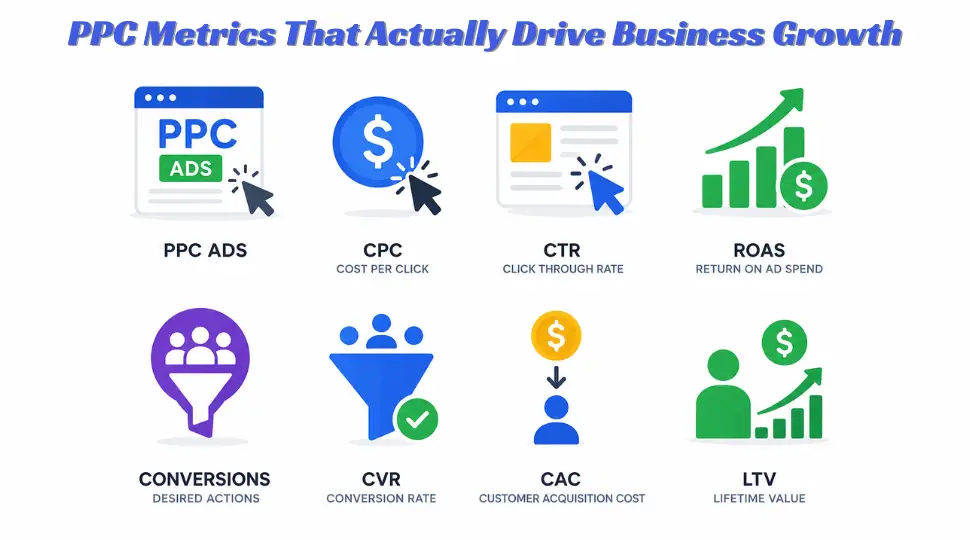
At the beginning many professionals are concerned about CPC (Cost Per Click) and CTR (Click-Through Rate). These metrics are significant but only the tip of the iceberg! When you focus on traffic you're not thinking about real growth; when you are focusing on metrics like ROAS, CAC, LTV, and CVR, you're focusing on real growth.
If you want to deepen your knowledge of what has been discussed in Search vs Performance Max vs Demand Gen: Key Differences Explained, you might want to get a hands-on digital marketing course in Pune that can be applied in real-life settings.
What Are PPC Metrics and Why They Matter
PPC (Pay-Per-Click) Metrics are statistics that track the effectiveness of your ads. They give you insight into whether or not your ads are driving traffic, leads, or revenue.
Not every metric is equal, though. Some provide you with superficial information; others have a direct effect on the growth of your business.
Why PPC Metrics Matter:
- Accurately measure ROI
- Guide optimization decisions
- Improve budget allocation
- Identify profitable campaigns
Key Insight: If you don't monitor the correct data, you're essentially shooting in the dark with ads.
The Problem with Vanity Metrics
Many marketers get caught up in vanity metrics: vanity metrics are numbers that look good but don't translate into business value.
Common Vanity Metrics:
- High impressions
- Low CPC
- High CTR
Why They're Misleading:
- While a high CTR does not equal sales, it does indicate a positive engagement
- Even cheap clicks can be unqualified traffic
- Impressions don't equal intent
The reality: Clicks do not grow business, systems do.
Key PPC Metrics That Actually Drive Growth
Let's get to the numbers that really count when it comes to profitably scaling campaigns.
ROAS (Return on Ad Spend)
ROAS is a metric used to determine the profit generated from each rupee invested in ads.
Formula:
ROAS = Revenue / Ad Spend
Why ROAS Matters:
- A resource that provides direct information about the profitability of a company or an industry
- Supports in the identification of successful campaigns
- Guides scaling decisions
Example:
If you spend ₹10,000 and generate ₹50,000, your ROAS is 5x.
CAC (Customer Acquisition Cost)
CAC is a measure of how much it costs a company to attract one customer.
Formula:
CAC = Total Ad Spend / Number of Customers
Why CAC Matters:
- Determines sustainability of campaigns
- Helps control marketing budgets
- Essential for business growth planning
Pro Tip: When there is a lower CAC, it means that campaigns are more efficient.
LTV (Customer Lifetime Value)
LTV (Lifetime Value) is the total amount of money that a customer can contribute to the business over their lifetime.
Why LTV Matters:
- Helps you to comprehend the long-term profitability of your business
- Enables increased ad investment without fear
- Supports scaling strategies
Key Insight
If your LTV is high, then you can have a high CAC.
CVR (Conversion Rate)
CVR is a ratio of users who accomplish a desired action.
Formula:
CVR = (Conversions ÷ Clicks) × 100
Why CVR Matters:
- Measures the performance of a landing page
- Reflects audience quality
- Assists with increasing funnels performance
How to Shift from Clicks to Conversions
The shift from vanity metrics to growth metrics takes a change in perspective.
So how to do it:
1. Establish Clear Conversion Goals
- Purchases
- Leads
- Sign-ups
2. Optimize Landing Pages
- Improve load speed
- Clear CTA
- Mobile-friendly design
3. Reach the Appropriate Audience
- Use intent-based keywords
- Leverage audience segmentation
4. Track Micro and Macro Conversions
- Add-to-cart (micro)
- Purchase (macro)
The Power of an Integrated PPC Ecosystem
One of the most significant advances in the success of PPC is to know how tools work together.
Key Tools:
- Google Ads – Engaging in the execution of Google ads campaigns
- Google Analytics 4 (GA4) – User behavior tracking
- Google Tag Manager (GTM) – Event tracking system
Why Integration Matters:
- Provides full-funnel visibility
- Accurately records user journey
- Improves attribution
Key Insight: Campaigns aren't ads anymore when they are driven by these tools.
Real-Life Example: From Clicks to Profitability
Scenario:
A small business eCommerce selling:
- Low CPC
- High traffic
- However, had trouble with sales
What Changed:
They started tracking:
- ROAS
- CAC
- LTV
Results:
- Cut down on ad spend wastage by 30%
- Increased conversions by 45%
- Boosted the ROAS by 4 times in just 3 months
The Lesson
Decisions based on data are better than guesses.
Common Mistakes in PPC Measurement
If you desire consistent growth then you should not commit these errors:
Mistakes to Watch Out For:
- Addressing only surface metrics: Talk about more than clicks and impressions
- Ignoring Attribution Models: Understand multi-touch journeys
- Not Setting up conversion tracking: Without tracking, there's no optimization
- Overlooking LTV: Opting for the short-term benefit may affect long term development
Tools That Help Track the Right Metrics
Let's take a look at essential tools for effective PPC tracking:
1. Google Analytics 4
- Tracks user behavior
- Measures conversions
2. Google Tag Manager
- Simplifies event tracking
- No coding required
3. Google Ads Dashboard
- Campaign performance insights
4. CRM Tools
- Track customer lifecycle
- Measure LTV
Best Practices for Sustainable PPC Growth
To create campaigns that scale to:
✔ Focus on Profitability
Not just traffic
✔ Continuously Test Campaigns
A/B testing is key
✔ Use Data to Optimize
Use information to make decisions
✔ Link Marketing to Business Objectives
Have campaigns support revenue goals
Conclusion
The single biggest change that leads to a successful PPC campaign is when you stop trying to drive clicks and begin to concentrate on the PPC metrics that are going to lead to business growth. ROAS, CAC, LTV, and CVR are among the metrics that provide a clear understanding of what works and what doesn't.
Your campaigns transcend from being merely ads to becoming engines for growth when paired with a robust set of tools and a data-informed approach.
You can find affordable digital marketing courses in PCMC and help establish a strong base without breaking the bank, whether you're considering a digital marketing course in Thane or comparing digital marketing classes in Pune.
"Marketing used to be about making a myth and telling it. Now it's about telling a truth and sharing it."
— Seth Godin
FAQs
1. What is the most crucial PPC metric?
ROAS is frequently the most critical since it directly measures profitability.
2. What is the problem with CTR?
CTR only measures engagement, not conversions, revenue.
3. What are some ways to enhance my CVR?
Tune landing pages, optimise targeting and optimise messaging.
4. What is a good ROAS?
Again, this is dependent on your business, but generally 3x–5x is good.
5. What is the relationship between LTV and PPC?
A higher LTV enables you to spend more money on acquiring customers profitably.