




Ecommerce SEO Analytics Cheat Sheet: Metrics That Drive Revenue
Introduction
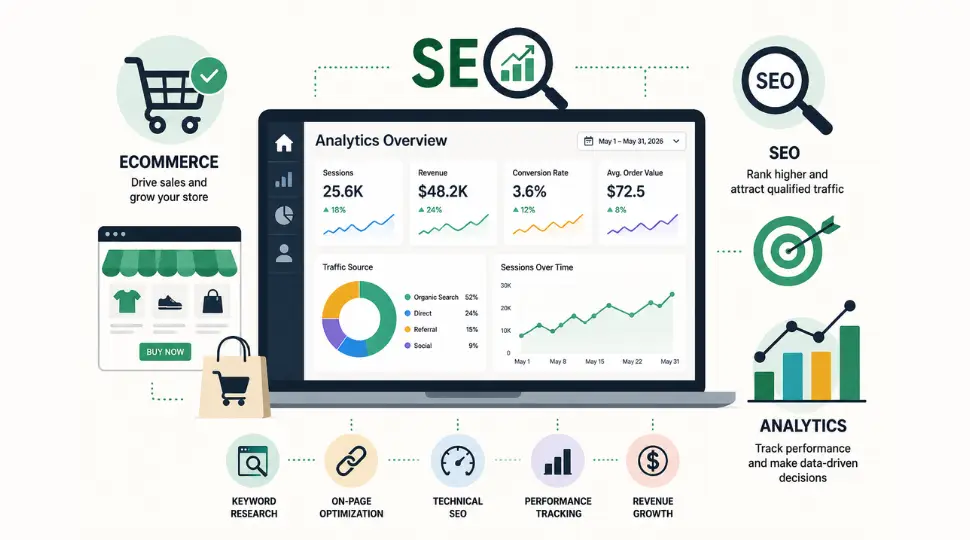
When you have an online store, counting the number of traffic is an expensive error. The ultimate Ecommerce SEO Analytics Cheat Sheet is not the vanity metrics but it will enable you to track what actually drives revenue, conversions and growth.
Most ecommerce leaders rejoice in increasing traffic- but not the rate at which that traffic is converted. That is similar to the emphasis on revenue without monitoring profit margins. In order to really scale, you must measure the correct SEO analytics.
To further learn the concepts presented in 12 Local SEO Directories Every Business Must Use, you may want to sharpen your own skills in a practical digital marketing course in Pune designed to be applied in the real world.
In this guide, you will learn which specific metrics Shopify and D2C brands need to be tracking to make SEO a revenue-generating engine.
What is Ecommerce SEO Analytics?
Ecommerce SEO analytics is defined as the tracking, analysis and optimization of information pertaining to your organic search performance. It assists you in knowing how users browse your store, engage with it and transform into customers.
In contrast to conventional SEO, ecommerce analytics is greatly concerned with revenue-based results, including:
- Organic traffic sales
- Conversion rates
- Product page performance
- Customer acquisition
Why Tracking the Right Metrics Matters
Not all metrics are created equal. Although the figures of traffic and impressions appear stunning, they may not always be converted into revenue.
Measuring the appropriate right ecommerce SEO metrics can help you:
- Identify high-performing pages
- Optimize underperforming content
- Increase conversions
- Improve ROI from SEO efforts
Key Insight: The majority of successful ecommerce brands are based on the few important metrics that drive 80% of their results.
Ecommerce SEO Analytics Cheat Sheet (Core Metrics)
1. Organic Revenue Attribution
What It Means
This ratio indicates the level of revenues directly caused by organic search traffic.
Why It Matters
When you are unable to tie SEO with real revenue, then you are making decisions without clarity.
How to Track
- Use Google Analytics 4 (GA4)
- Navigate to: Acquisition → Traffic Acquisition
- Free search: filter to Organic Search
Pro Tip
Look at the pattern of revenues, not only the increases in traffic. Even slight increase in high converting traffic is more valuable compared to huge irrelevant traffic.
2. Organic Click-Through Rate (CTR)
What It Means
CTR is a metric that quantifies the number of users who clicked your listing after viewing it in the search results.
Why It Matters
Big impressions and poor CTR = poor titles and meta descriptions.
How to Track
- Go to Google Search Console
- Go to Performance → Pages
Optimization Tips
- Write new headings with power words
- Combine sums and emotions
- Find the matching search intent
3. Top Landing Pages by Conversions
What It Means
Determines which pages are most effective in making purchases or conversions.
Why It Matters
Most ecommerce stores: 10-15 pages yield an approximate of 80 percent of revenue.
What to Do
- Reduce efforts in favor of pages that are performing well
- Optimize and update the conversion of blog posts
- Eliminate or optimize poorly-performing pages
4. Keyword Rankings by Intent
What It Means
Songs in which your keywords appear according to the user intention.
Types of Keywords
- Branded Keywords (your company brand name)
- Non-Branded Keywords (new customer acquisition)
- BOFU Keywords (e.g., best shoes to run in)
Why It Matters
Non-branded growth = business growth.
Best Practice
Monitor high-intent keywords each week and optimize pages that focus on those queries.
5. Page Load Speed (Mobile)
What It Means
Measures your site speed when using a mobile device.
Why It Matters
- Low bouncing rates = slow sites
- Page speed is a ranking factor used by Google
Benchmark: Target is to achieve a score of more than 70. Under 50 = severe problems with performance.
How to Fix
- Compress images
- Remove unused apps/plugins
- Enable lazy loading
6. Organic Add-to-Cart Rate
What It Means
Tracks the number of organic visitors who are adding products to their cart.
Why It Matters
It is the mid-point in the funnel and not only traffic or final sales.
If It's Low
- Improve product descriptions
- Include social evidence (reviews, ratings)
- Optimize CTA placement
- Use high-quality images
7. Indexation Health
What It Means
Displays the number of your pages that are listed with search engines.
Why It Matters
Unindexed pages = invisible pages.
Common Ecommerce Issue
Places such as Shopify raise:
- Duplicate URLs
- Filtered pages
- Thin content
How to Check
Google Search Console → Pages → Why pages are not indexed.
Fixes
- Remove duplicate pages
- Use canonical tags
- Optimize crawl budget
8. Internal Link Distribution
What It Means
The manner in which links are spread throughout your site.
Why It Matters
The most internal links should be provided to important pages.
Common Mistake
Hiding product pages 4 or more clicks away.
Optimization Tips
- Improve navigation menus
- Add links in blogs
- Optimize footer structure
How to Use These Metrics for Growth
Monitoring information is not sufficient, you have to do something with it.
The following is a basic monthly workflow:
- Pick 2–3 key metrics
- Analyze trends
- Identify issues
- Implement changes
- Measure results
Example
- Low CTR → Rewrite titles
- Low add-to-cart → Enhance product page UX
- Low income → Concentrate on keywords with high intent
Common Mistakes to Avoid
These are some of the mistakes to avoid in order to optimise your Ecommerce SEO strategy:
Mistakes to Watch Out For:
- Measuring too many things at the same time
- Ignoring conversion data
- Only emphasizing traffic
- Not updating old content
- Not testing changes
Keep in mind: There is nothing like analytics without action, which is just a dashboard.
Tools to Track Ecommerce SEO Metrics
These are some of the tools that every ecommerce business must employ:
Essential Tools
- Google Analytics 4 (GA4)
- Google Search Console
- PageSpeed Insights
- Ahrefs / SEMrush
- Hotjar (user behavior)
Practical (EEAT Boost)
Case Study: D2C Skincare Brand
A D2C skincare company increased its organic revenue by 62 per cent in 4 months by targeting only three measures:
- Better CTR through rephrasing titles
- Maximized best landing pages
- Faster page load speed decreased to 2.1s as compared to 5.2s
This demonstrates that when small data-driven optimizations are implemented, the outcome can lead to tremendous growth.
Conclusion
A good Ecommerce SEO Analytics Cheat Sheet allows you to concentrate on what really matters- revenue, conversions and growth.
Rather than monitoring all of them, select a handful of high-impact measures and act on them regularly. That is how you can turn SEO into a cost center and the scalable revenue engine.
Whether you are studying a digital marketing course in Thane or comparing digital marketing courses in Pune, having an affordable digital marketing course in PCMC can help you to build the strong fundamentals without having to stretch your budget.
"Without data, you're just another person with an opinion."
— W. Edwards Deming
FAQs
1. What is the most vital ecommerce SEO measure?
The most essential one is organic attribution of revenue since it is the one that directly links the business outcomes to the SEO efforts.
2. Which frequency should I use to monitor SEO measures?
Look at the main measures every month and the priority ones (such as rankings) every week.
3. Does SEO have the capacity to directly boost sales?
Yes, when performed right, SEO can generate high-intent traffic, which can be converted to customers.
4. What should a good CTR of ecommerce be?
Any CTR between 2%-5% is average although higher is always better depending on your niche.
5. What can I do to enhance SEO conversions?
Pay attention to user experience, product pages and search intent alignment.