



Meta Ads vs Google Ads: Which Platform Is Better for Your Business?
Introduction
Digital advertising is one of the most effective methods of generating leads, growing sales and building brand awareness for businesses. One question is still on the lips of every marketer:
Which platform to use — Meta Ads OR Google Ads?
There's no simple answer to that question. This will vary based on the business objectives, target market, budget and marketing plans.
Some companies require instant leads from people searching online, whilst others require creative campaigns to generate awareness and demand which increase over time. To gain a clear understanding of how both platforms operate can help this benefit businesses to make smarter investments and gain better ROI.
For those looking to deepen their knowledge of the concepts covered in "Meta Ads Campaign Structure for Better ROI", you should consider taking a digital marketing course in Pune that provides hands-on experience in digital marketing.
In this guide, we'll explain the differences between Meta Ads and Google Ads, discuss their pros and cons, and explain when to use each and how to maximise the performance of a brand that is using both platforms.
What Are Meta Ads?
Meta Ads are paid ads on the following:
- Messenger
- Audience Network
Meta Ads are tailored to target audiences by their interests, demographics, behaviors, and online activity.
The main focus of Meta Ads is on discovery marketing as opposed to search-based advertising. While it's not the user who is out actively looking for a product, strong visuals and good storytelling can create interest and demand.
Key Features of Meta Ads
Visual-First Advertising
Meta platforms prioritize:
- Images
- Videos
- Reels
- Carousels
- Stories
This is the perfect terrain for Meta to play with brand stories and emotions.
Advanced Audience Targeting
Businesses can target users by:
- Age
- Location
- Interests
- Purchase behavior
- Website interactions
- Custom audiences
Strong Retargeting Capabilities
Meta Ads are really good for retargeting users that:
- Visited your website
- Added products to cart
- Engaged with social content
- Watched videos
What Are Google Ads?
Google Ads is a paid advertising platform that has the ability to get businesses to show up on the following:
- Google Search
- YouTube
- Gmail
- Google Display Network
- Google Maps
Google Ads targets prospects who are most likely to make a purchase.
Users will type in phrases such as the following:
- "Best digital marketing agency"
- "Purchasing running shoes online"
- "SEO services local"
They already have a need or problem that they wish to solve.
Key Features of Google Ads
Search Intent Targeting
Google Ads is focused on people who are looking for products or services.
Fast Lead Generation
Businesses can generate effectively via search campaigns:
- Phone calls
- Website leads
- Online sales
- Store visits
Measurable ROI
Google Ads also provides in-depth analytics such as the following:
- Cost per click (CPC)
- Conversion rate
- Return on ad spend (ROAS)
- Keyword performance
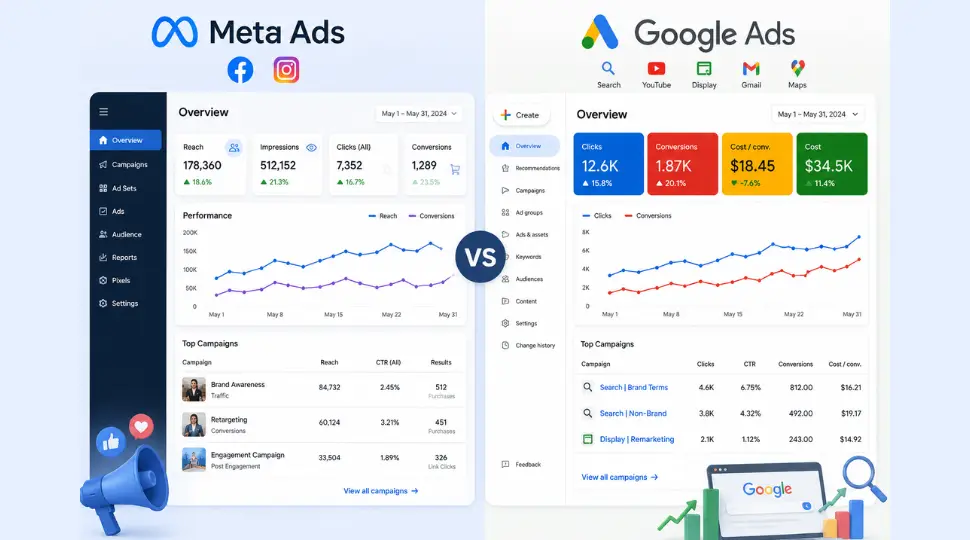
Meta Ads vs Google Ads: Key Differences
| Feature | Meta Ads | Google Ads |
|---|---|---|
| User Intent | Discovery-based | Search intent-based |
| Best For | Brand awareness | Lead generation |
| Ad Format | Visual content | Search + display |
| Audience Targeting | Interests & behaviors | Keywords & search intent |
| Conversion Speed | Medium-term | Fast |
| Creative Importance | Very high | Moderate |
| CPC Cost | Often lower | Often higher |
| Retargeting | Excellent | Strong |
When Should You Use Meta Ads?
If the aim is to create awareness and engage audiences creatively, businesses should leverage Meta Ads.
Best Use Cases for Meta Ads
Brand Awareness Campaigns
Meta actively supports businesses in bringing their products to new target markets.
E-Commerce Product Promotion
Brands in the fashion, beauty, lifestyle and fitness sectors can do very well on Instagram and Facebook.
Video Marketing Campaigns
Brief video content has done well on the Meta platforms.
Retargeting Existing Visitors
Meta's pixel monitoring is the basis for sophisticated retargeting strategies.
Example
A brand launching a new skin care product line can employ the use of:
- Instagram Reels
- Carousel Ads
- Influencer-style creatives
Before they even go to the internet to search, to create demand.
When Should You Use Google Ads?
Google Ads works well when businesses require users to take action when they're actively seeking a solution.
Best Use Cases for Google Ads
High-Intent Lead Generation
Industries like real estate, education, healthcare, and legal services can find Google Search Ads extremely helpful.
Local Business Advertising
Google Ads can be targeted to people who are looking around the area.
Emergency / Urgent Services
Users who are looking to find urgent requirements may convert quickly. Examples include:
- "Emergency plumber"
- "Laptop repair near me"
- "The dentist's office is open now"
B2B Lead Generation
Google Search Ads are suitable for professional service-based companies.
Why Smart Brands Use Both Platforms
The best companies don't rely on a single platform!
Rather, they have a full-funnel marketing plan in which:
- Meta Ads generate interest
- Google Ads attract buyers
This is a way to acquire customers and maximise ROI from marketing.
The Funnel Operation
Top of Funnel (Awareness)
Meta Ads bring the brand to the people with engaging ads.
Middle of Funnel (Consideration)
Retargeting campaigns provide users with testimonials, videos and educational material.
Bottom of Funnel (Conversion)
Google Search Ads attract customers who are ready to make a buy.
Audience Intent vs Audience Discovery
The two main distinctions between these platforms are the users' mindsets.
Meta Ads = Audience Discovery
Users are casually surfing social media. They are creatively interrupted by ads as they scroll.
Success depends on:
- Strong visuals
- Emotional messaging
- Creative hooks
Purchase Intent = Google Ads
Users are familiar with what they require.
Success depends on:
- Relevant keywords
- Strong landing pages
- Clear offers
- Fast website experience
Cost Comparison: Meta Ads vs Google Ads
Advertising expenses vary depending on the type of industry, and the targeting of the audience.
Meta Ads Costs
Typically offer:
- Lower CPC
- Affordable reach
- Cost-effective awareness campaigns
The quality of the conversion can however be inconsistent based on targeting and creative quality.
Google Ads Costs
Usually have:
- Higher CPC
- Better lead intent
- Faster conversions
For competitive industries, like insurance, finance, and legal, these keywords can be costly.
Best Industries for Each Platform
Industries That Perform Well on Meta Ads
- Fashion
- Beauty
- Fitness
- Food & beverage
- Travel
- Lifestyle brands
- Influencer businesses
Industries That Perform Well on Google Ads
- Real estate
- Education
- Healthcare
- Legal services
- Home services
- SaaS businesses
- B2B services
Common Mistakes Businesses Make
Selecting Platforms According to Trends
Many businesses select platforms merely because their rivals are on it. The factors that influence the success in advertising include business goals, customer behavior, and sales funnel structure.
Ignoring Creative Quality
Great targeting is no good without a great creative. Businesses should invest in high-quality visuals, strong copywriting, and clear CTAs.
Assessing the Wrong Metrics
Likes and impressions come and go, but not necessarily with associated revenue. Focus on leads, sales, ROAS, and conversion rate.
Performance Marketing Strategies That Work
Combine Organic and Paid Marketing
Paid ads work best when they have these elements:
- SEO
- Content marketing
- Social proof
- Email marketing
Build Strong Landing Pages
If the landing page isn't strong, then the ad isn't strong. The most important components of a landing page are the following:
- Fast loading speed
- Clear CTA
- Trust signals
- Mobile responsiveness
Use Retargeting Consistently
Retargeting can help businesses regain lost conversions. Research indicates that several interactions with the product may occur before the purchase.
Role of AI in Modern Advertising
AI is reshaping both Meta Ads and Google Ads.
AI Features in Meta Ads
Meta now offers:
- Automated targeting
- AI audience expansion
- Advantage+ campaigns
- Automated placements
AI Features in Google Ads
Google uses AI for:
- Smart bidding
- Performance Max campaigns
- Automated keyword optimization
- Predictive audience targeting
AI-powered optimization can make a huge difference in optimizing campaigns.
Measuring ROI Across Platforms
How to track is a major component of performance marketing. It is best to keep track of a group of key metrics to track.
For Meta Ads
- Click Through Rate (CTR)
- CPM (Cost Per Thousand Impressions)
- Video watch time
- Engagement rate
For Google Ads
- Conversion rate
- Cost per acquisition
- Quality score
- ROAS
Importance of Conversion Tracking
If there is no tracking, then businesses can't optimize campaigns properly. Many tools can be used, such as Google Analytics, Meta Pixel, Google Tag Manager, and CRM integrations.
Real-World Example of Combined Advertising Strategy
Scenario: Coaching Institute Launching a New Online Course
Step 1: Meta Ads for Awareness
The brand runs Instagram Reels, student testimonials, and educational videos to introduce the course.
Step 2: Retarget Interested Users
People who view videos are presented with success stories, free webinar registrations, and lead magnet offers.
Step 3: Google Ads Capture Intent
If users want to search later for "best online marketing course" or "digital marketing certification", Google Ads is able to grab those high-intent searches.
This makes for a full performance marketing funnel.
Expert Tips for Better Campaign Performance
Focus on Customer Journey
Know how consumers flow from Awareness → Consideration → Conversion before putting down ad dollars.
Test Multiple Creatives
Test successful campaigns and then it will happen with headlines, ad copies, visuals, and CTAs.
Optimize for Mobile Users
The majority of traffic is now via smartphones. Ensure fast-loading pages, mobile-friendly forms, and easy navigation.
Invest in Analytics
Predictions are better than data-driven marketing decisions.
Conclusion
When it comes to Meta Ads vs Google Ads, the question isn't about which one is the best across the board.
But the question is:
Which platform is most suitable for your business goal?
If your goal is brand awareness and connecting with users, Meta Ads is the way. If you want to lead generate and direct conversion, Google Ads is the answer.
However, the best performance marketing tactics are when both platforms complement each other.
Businesses that get it are always better than their competitors at digital advertising. Digital advertising is won by businesses that are familiar with audience psychology, customer intent, creative storytelling and analytics.
If you want to invest in a digital marketing course in Thane or even digital marketing classes in Pune, you should opt for the best digital marketing course in PCMC to get a strong foundation in your digital marketing career.
"Stopping advertising to save money is like stopping your watch to save time."
— Henry Ford
Frequently Asked Questions
Meta Ads vs Google Ads: which is better for beginners?
For that reason, they are more likely to be successful for beginners, as the cost to start and the level of audience targeting are simpler. It may be necessary to do deeper keyword research and bidding strategies for Google Ads.
Do Meta Ads cost less than Google Ads?
Meta Ads can be more cost-effective for many industries, with lower CPCs compared to other platforms. But with Google Ads, you can get more intent visitors.
Do small companies have the ability to employ both of these?
Yes. Businesses of any size can use Meta Ads for awareness and Google Ads for lead generation.
Which platform is quicker?
Google Ads is likely to give you quicker conversions since people are looking for answers.
Is creative quality more important on Meta Ads?
Yes. Meta Ads are a lot about visual narratives and creativity.