




Mastering Meta Ads Campaign Structure for Better ROI
Introduction
The Meta Ads campaign structure is the foundation of lucrative advertising. Even the most creative and budget-friendly creatives might not produce any results without a clear structure. Most businesses end up spending money without knowing due to lack of direction and organization in their campaigns.
With a funnel-like design of your campaigns, each step of the customer journey will be purposeful and result in greater targeting, increased engagement, and increased conversions.
To get a better idea of the concepts covered in How to Structure Content for AEO Success, you would want to sharpen your skill base by taking a hands-on digital marketing course in Pune that can be applied in the real world.
What is Meta Ads Campaign Structure?
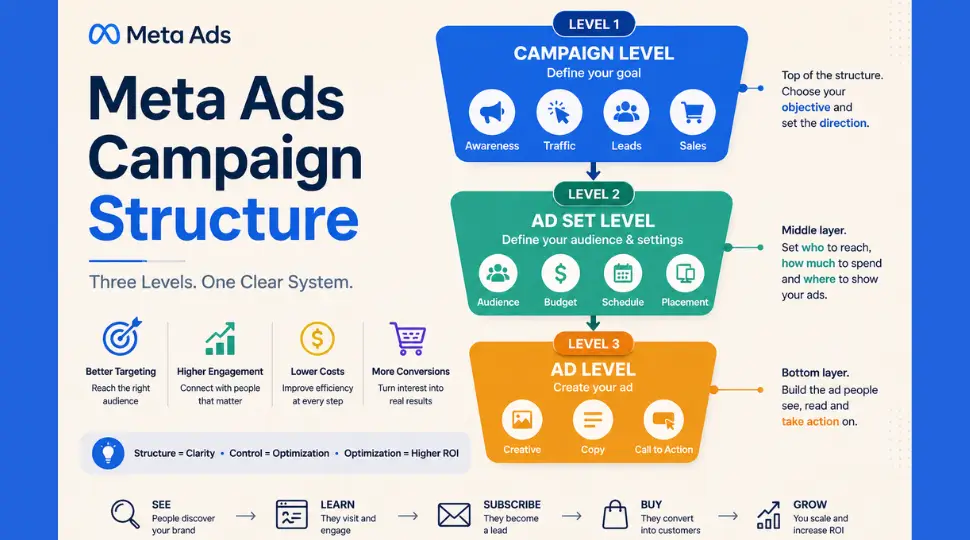
A Meta Ads campaign structure is the way you build your campaigns, ad sets, and ads within Facebook and Instagram. It is generally arranged in a hierarchy:
- Campaign → Specifies the goal (awareness, traffic, leads, sales)
- Ad Set → Determines audience, budget and placement
- Ad → Includes the creative (image/video + copy)
A clear structure in place provides clarity, control and scalability.
Why Campaign Structure Matters for ROI
Ineffective structure results in:
- Audience overlap
- Budget wastage
- Confusing performance data
A powerful framework on the other hand assists you:
- Reach the appropriate group of people
- Analyze performance easily
- Minimize cost per outcome
- Scale campaigns effectively
Key Insight: Form provides you with control. Control enables optimization. Optimization results in improved ROI.
The 4-Stage Meta Ads Funnel Strategy
In order to get the best possible results, your Meta Ads campaign setup must correspond to the marketing funnel.
1. Brand Awareness Campaigns
At the top of the pyramid, you want to be visible.
Objective
- Reach new audiences
- Increase brand recall
Best Practices
- Take advantage of captivating video messages
- Concentrate on narrating, not marketing
- Reach target mass or interest groups
Example: A fitness brand displays video advertising with stories of transformation to capture interest.
2. Traffic Campaigns
When people are aware of your brand, direct them to your landing page or website.
Objective
Clicks to drive and site traffic.
Best Practices
- Make powerful CTAs such as "Learn More"
- Maximize landing page views
- Retarget engaged users
Example: A product category page is where users are redirected by an eCommerce store.
3. Lead Generation Campaigns
Transform interest into leads now.
Objective
Gather emails, phone numbers or enquiries.
Best Practices
- Use lead forms or landing pages
- Provide value (Free ebook, webinar, discount)
- Keep forms short and simple
Example: A digital marketing institute offers a free webinar sign-up.
4. Conversion / Sales Campaigns
This is where sales occur.
Objective
Make purchases or sign-ups.
Best Practices
- Retarget warm audiences
- Utilize reviews and testimonials
- Build a sense of urgency (time-constrained offers)
Example: A SaaS business re-targets users who had visited the pricing pages yet failed to convert.
Best Practices for Structuring Meta Ads
In order to maximize your Meta Ads campaign structure, consider the following strategies:
1. Campaign = One Goal
Avoid mixing objectives. Every campaign ought to have one objective.
2. Ad Set = One Audience
This guarantees clean data and optimization.
3. Test Creatives Strategically
Rather than testing a lot of ads:
- Test 2–4 creatives per ad set
- Pay attention to differences (headline, images, CTA)
4. Budget Allocation Strategy
- Increase investment in campaigns with good results
- Use CBO (Campaign Budget Optimization) for scaling
5. Use Retargeting Smartly
- Website visitors
- Video viewers
- Engaged users
Common Mistakes to Avoid
Marketing structural errors are made even by experienced marketers:
- Combining Hot and Cold Audiences — Causes ineffective targeting and budget wastage
- Too Many Ad Sets — Scatters budget excessively
- Ignoring Funnel Stages — Skipping nurturing to direct sales
- Failure to Track Performance — Optimization cannot take place without data
Real-World Example of a Winning Campaign Structure
Suppose you operate an online courses business. Here is the funnel setup:
Campaign 1: Awareness
- Audience: Interests (marketing, business)
- Content: Educational videos
Campaign 2: Traffic
- Audience: Video viewers (50%)
- Content: Blog/landing page
Campaign 3: Leads
- Audience: Website visitors
- Offer: Free webinar
Campaign 4: Sales
- Audience: Webinar attendees
- Offer: Paid course
Results
- Lower cost per lead
- Higher conversion rates
- Better ROI
Tools & Metrics to Track Performance
To gauge your Meta Ads campaign layout, monitor these key metrics:
| Key Metrics | What It Measures |
|---|---|
| CTR (Click-Through Rate) | Ad engagement and relevance |
| CPC (Cost Per Click) | Efficiency of ad spend |
| CPA (Cost Per Acquisition) | Cost to acquire a customer |
| ROAS (Return on Ad Spend) | Revenue generated per rupee spent |
Recommended Tools
- Meta Ads Manager — Native campaign management and analytics
- Google Analytics 4 — Cross-channel attribution and behavior tracking
- Heatmaps (Hotjar, Crazy Egg) — Landing page optimization insights
Advanced Optimization Tips
Feel like stepping up your campaigns? Consider these advanced strategies:
Use Lookalike Audiences
Reach more like-minded users based on your best customers.
Dynamic Creative Testing
Allow Meta to optimize combinations automatically.
A/B Testing
Test variations of:
- Headlines
- Creatives
- Audiences
Frequency Control
Don't let ad fatigue set in — update creatives regularly.
Conclusion
Having a well-planned Meta Ads campaign structure is not a simple matter — it is the key to success. Consistent growth and profitability are unlocked when you match your campaigns to the funnel, have clear objectives, and make strategic optimization.
Be it studying a digital marketing course in Thane or researching digital marketing classes in Pune, the best digital marketing course in PCMC may enable you to develop the essentials without exceeding your budget.
The following is an SEO-friendly guide intended to aid in creating high-performers, enhancing ROI, and growing your advertising outcomes successfully.
"Marketing is no longer about the stuff that you make, but about the stories you tell."
— Seth Godin
FAQs
1. How do we have the best Meta Ads campaign set-up?
The best structure is funnel-based with awareness, traffic, leads and conversions.
2. What is the number of ad sets to be created?
Begin with 2-5 ad sets that will reach a diverse audience.
3. What should be the optimal budget strategy?
Start small with a budget and then expand winning campaigns.
4. What is my timing of running ads before optimization?
Wait a minimum of 3-5 days to collect sufficient data.
5. What is causing my Meta Ads ROI to be low?
Some of the usual causes are ineffective targeting, ineffective creatives and absence of structure.