




How to Structure Content for AEO (Answer Engine Optimization) Success
Introduction
The majority of the content on the web today is written in order to get ranked in search engines – but not always to fulfil the purpose of the user. That is precisely why a big part of the content is overlooked by AI-powered platforms and answer engines. Your content will not be extracted, featured, and recommended unless it is properly structured.
AEO (Answer Engine Optimization) is a game-changer. It favours clarity, form and straightforward responses as opposed to lengthiness and uncontrolled material.
In an attempt to grasp the concepts presented in the SEO & Marketing Funnel Guide for Higher Conversions better, you can enhance your understanding with a practice-based digital marketing course in Pune that will help you apply what you have learnt in practical scenarios.
This tutorial will take you through the steps of how to organize content to succeed on AEO so that your content is selected for AI tools, featured snippets, and voice search results.
What is AEO (Answer Engine Optimization)?
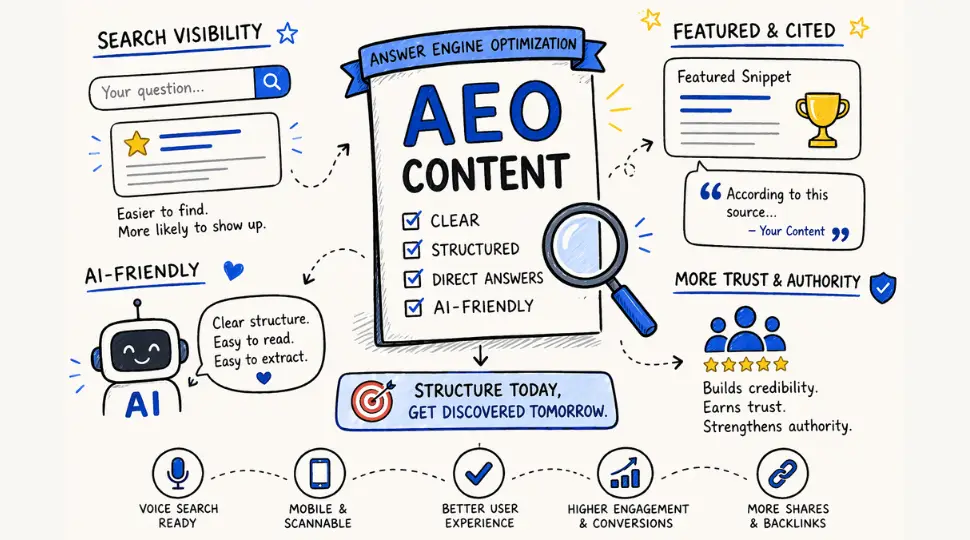
The process of organizing your content in such a manner that it directly responds to user queries in a manner that can be easily extracted by search engines and AI platforms is known as Answer Engine Optimization (AEO).
As opposed to traditional SEO where emphasis is laid on ranking pages, AEO emphasises the following:
- Giving straightforward responses.
- Formatting information to be read by AI.
- Snippet and voice search optimization.
- Increasing the likelihood of AI citation.
Google Search, ChatGPT, and voice assistants give preference to structured, answer-first content.
Why Traditional Content Fails in AI Search
The majority of blog posts are inadequate in AEO since they:
Common Issues
- Pay much attention to keywords, rather than to answers.
- Write long and unstructured paragraphs.
- Bury the answer deep into the content.
- Inaccurate formatting (headings, lists, etc.)
Key Insight: AI does not read the content as human beings do; it gathers information. Unless your content is organized well, it just gets overlooked.
The Perfect AEO Content Structure
And now, let's deconstruct the perfect framework that makes your content AI-compatible.
1. Question-Based H1
Your title must be a question that corresponds to the user intent.
Examples:
- What is AEO in SEO?
- What is the Content Structure in AEO?
This puts your content in line with search by people.
2. Direct Answer Block
Immediately after the H1, give a definite, brief answer in 2-3 sentences.
The most important part for the following is:
- Featured snippets
- Voice search
- AI extraction
Example:
AEO involves organizing the content in such a way that it provides direct answers to user queries in a simple and succinct form, thus becoming easier to extract and present by search engines and AI applications.
3. Supporting Context
Once you have given the answer, elaborate with supporting information:
- Definitions
- Background information
- Why it matters
Make paragraphs short and readable.
4. Structured Headings (H2 and H3)
Divide your material into rational parts:
- Main topics: use H2.
- Subtopics: use H3.
This improves readability, SEO ranking, and AI parsing.
5. Lists & Steps
AI is fond of formatted content such as the following:
- Bullet points
- Numbered lists
- Step-by-step instructions
The content can be extracted and displayed more easily in these formats.
6. Entities & Examples
Create authority using real world entities. Examples include:
- Tools (e.g., Google Analytics)
- Platforms
- Brands
- Case studies
This enhances EEAT (Experience, Expertise, Authority, Trust).
7. Schema & FAQ
Add more structured information, such as:
- FAQ schema
- How-to schema
This will give you more chances of rich results, featured snippets, and AI citations.
Step-by-Step Guide to Structuring AEO Content
The following is a workflow that you can practice:
Step 1: Recognize User Purpose
Focus on questions that people are asking and intent of search in relation to keywords. Use tools like Google Trends and keyword research platforms.
Step 2: Compose a Question-Based Title
Turn your keyword into a question. Example: Rather than "AEO Guide," use "How to structure content in AEO?"
Step 3: Include a Direct Answer
Short answer to be given immediately after the title. Keep it clear, concise, and informative.
Step 4: Add Context
Describe in simple terms. Use examples, analogies, and use cases.
Step 5: Cut into Parts
Arrange text with headings: H2 for main topics, H3 for subtopics.
Step 6: Include Lists and Visual Structure
Use bullet points, tables, and steps. This enhances readability and extraction.
Step 7: Include FAQs
Discuss some of the usual questions on your topic. This improves SEO, voice search visibility, and AI extraction.
Real-Life Example of AEO Content
Let's compare poorly structured content versus AEO-optimized content:
Poorly Structured Content
- Long paragraphs
- No headings
- No direct answer
AEO-Optimized Content
- Clear H1 question
- Top answer at top
- Structured headings
- Lists and examples
Result: Higher visibility, better AI extraction, and improved engagement.
Best Practices for AEO Optimization
Follow these strategies:
- Write your answer within 100 words.
- Use simple language.
- Make paragraphs concise (2-4 lines).
- Use structured formatting.
- Provide actual examples and objects.
- Make it voice-search friendly.
Common Mistakes to Avoid
Never commit the following mistakes:
- Writing to the keywords.
- Ignoring user intent.
- Excessive use of long paragraphs.
- Skipping structured headings.
- Not including FAQs.
Conclusion
The next type of content is not SEO; it is AEO (Answer Engine Optimization). Unless you format your writing to respond to queries in a clear manner, it will not perform well in a search environment dominated by AI.
Be it looking at a digital marketing course in Thane or looking at digital marketing classes in Pune, by selecting the best digital marketing course in PCMC, you can establish a solid foundation with digital marketing skills from Digital Trainee.
Get organized on your content today, and not only will you rank, but you will also be featured, cited, and trusted.
"Content is king, but context is God."
— Gary Vaynerchuk
FAQs
1. What is AEO in digital marketing?
AEO (Answer Engine Optimization) is aimed at organizing the content in a way that responds directly to user queries to enhance its visibility in AI and search engines.
2. What is the difference between AEO and SEO?
SEO is concerned with ranking pages, whereas AEO is concerned with giving direct answers that can be obtained using AI systems.
3. What is the significance of structured content?
Formatted content enhances readability, search engine performance, and AI extraction.
4. What is the best type of content for AEO?
Question-based content, list-based articles, step-by-step guides, and FAQs work best for AEO.