




Claude + GSC Hack for AI Citations: The GEO Strategy That Actually Works
Introduction
The speed at which AI search revolutionises SEO is beyond most marketers' reckoning. It is no longer just about ranking — it is about being cited by AI engines such as ChatGPT and Perplexity.
This is where the Claude + Google Search Console hack for AI citations comes in as a game-changer. You do not guess what to make visible — you use actual data to engineer visibility.
In order to get a better grasp of the concepts presented in How to Use Claude AI to Build a Smarter SEO Report in 2026 , you can enhance your understanding with a practice-based digital marketing course in Pune that will help you apply what you have learnt in practical scenarios.
The experimentation with GEO (Generative Engine Optimization) is going blind for most marketers today. However, the fact is: the information that you seek is already at your disposal. It is located in Google Search Console.
What Is the Claude + GSC Hack?
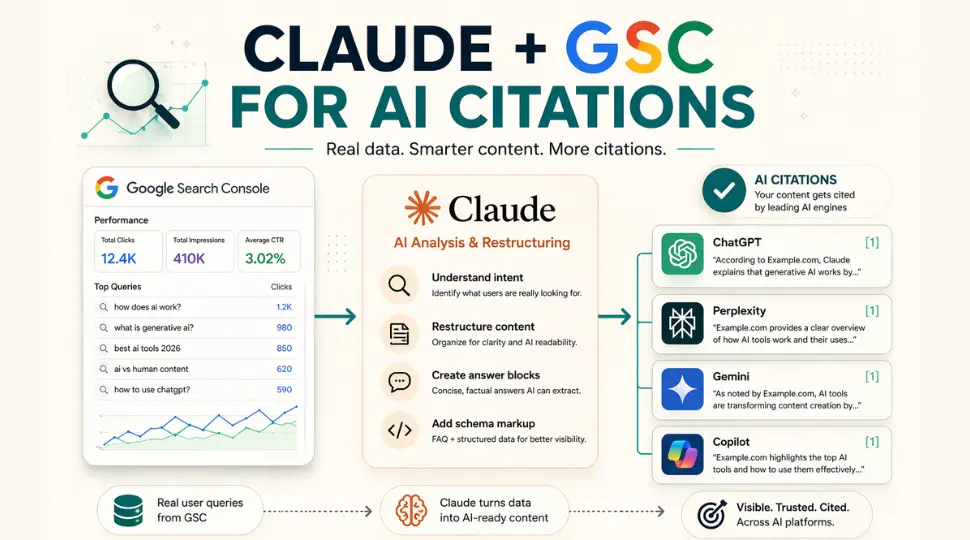
The Claude + GSC hack for AI citations is a systematic approach to using:
- Google Search Console data.
- Claude AI to optimize content.
- FAQ schema + answer blocks.
To develop content that AI engines would like to reference.
Rather than creating new content from scratch, you:
Extract
Get actual search queries from GSC.
Optimize
Optimize existing pages with answer blocks.
Re-package
Re-package materials in AI-friendly formats.
Why Traditional SEO Fails for AI Citations
Classic SEO is concentrated on:
- Keyword density
- Backlinks
- Long-form content
However, AI search engines operate differently.
Key Difference: AI does not read your whole article. It typically extracts 1 short paragraph (40–60 words) out and disregards the rest.
What This Means
Unless your material contains the following, it will not be mentioned — no matter how high it ranks:
- Clear answer blocks
- Structured responses
- Verified facts
Step-by-Step: Using GSC Data for GEO Strategy
The following is a workflow that you can implement immediately:
Step 1: Export GSC Question-Based Queries
Go to Performance → Queries and apply filters for: how, what, why, best, vs, is, can, should. Export to CSV.
Why This Matters: This list represents real user intent, existing ranking opportunities, and AI citation potential. Within 4 minutes, you're building your entire GEO content roadmap.
Step 2: Examine Data with Claude
Upload the CSV to Claude and enter the following prompt framework:
"Determine major query purpose. Write an answer block (60 words). Insert a fact or statistic. Mention our brand at the very beginning. Generate FAQPage schema. Flag weak URL slugs."
Output You Get
- Ready-to-use answer blocks
- Schema markup
- SEO improvements
- Content optimization roadmap
All within seconds.
Step 3: Deploy and Close the Loop
Now execute the following:
- Add answer blocks to pages.
- Add FAQ schema markup.
- Update weak slugs.
- Request indexing in GSC.
Why Request Indexing is Important: This step is eluded by most marketers, but it ensures faster crawling, faster AI discovery, and faster citation opportunities.
How to Identify Content Gaps Using AI
Upon production of answer blocks, copy and paste them into ChatGPT or Perplexity. Then ask:
"Who can provide the best source for this topic?"
If It Is Not You
Good. That is insight.
Now:
- Duplicate the mentioned rival URL.
- Feed it to Claude.
- Ask: "What form does this assume which mine does not assume?"
This is what you are lacking — and exactly what you need to optimize.
Understanding Answer Blocks & AI Behavior
What Is an Answer Block?
A brief, concise paragraph that:
- Responds to a question literally.
- Includes a fact or statistic.
- Mentions your brand.
- Stays under 60 words.
Example Structure:
- Direct answer
- Supporting data
- Brand mention
Why Answer Blocks Win
AI models prefer content that is:
- Structured
- Concise
- Fact-based
- Easy to extract
Stat Insight: Research indicates that LLMs refer to only 2–7 domains per response. That means competition is limited and early adopters win.
Why This Strategy Works (Backed by Data)
1. Uses Real Search Data
GSC displays the actual searches of users — not guesses.
2. Conforms to AI Behavior
Concise, summarized content appeals directly to LLM extraction patterns.
3. Creates a Feedback Loop
GSC → Claude → Optimization → Indexing → AI Citation. This cycle multiplies outcomes in the long run.
Real Example of GEO Optimization
Let's compare poorly structured content versus GEO-optimized content:
Before Optimization
- Long blog paragraph
- No structure
- No clear answer
After Optimization
- 50-word answer block
- Schema markup
- Clear intent match
Result: Faster indexing, higher AI visibility, and increased citation probability.
Common Mistakes to Avoid
Never commit the following mistakes:
- Composing long, unstructured content — AI disregards the majority of it.
- Skipping schema markup — reduces discoverability significantly.
- Ignoring query intent — causes extraneous responses that don't match user needs.
- Not requesting indexing — slows down AI discovery dramatically.
Future of AI SEO & GEO
The game of SEO is taking a new direction:
- Answer-based optimization
- Structured data
- AI transparency on standings
Prediction
Within the next 6–12 months:
- The use of AI will be highly competitive with citations.
- The pioneers will dominate the limelight.
- The brands that have already applied GEO will turn into default providers tomorrow.
Conclusion
The Claude + GSC hack for AI citations is not merely another SEO strategy — it is a fundamental change in the paradigm of visibility in the era of AI.
You are not chasing rankings; you are:
- Engineering answers
- Structuring data
- Powering AI engines with what they require
The result? More references, more credibility, and future-proof SEO.
Be it looking at a digital marketing course in Thane or looking at digital marketing classes in Pune, by selecting the best digital marketing course in PCMC, you can establish a solid foundation with digital marketing skills from Digital Trainee.
Start using the Claude + GSC hack today, and turn your existing data into AI citations that build authority.
"We are moving from a mobile-first to an AI-first world."
— Sundar Pichai
FAQs
1. What is GEO in SEO?
GEO (Generative Engine Optimization) is about optimizing content for artificial intelligence engines rather than traditional search engines alone.
2. What is the significance of Google Search Console with regard to AI SEO?
It gives actual user queries, which assists in determining content that AI is likely to discover and cite.
3. What are the ideal lengths of answer blocks?
Ideally 40–60 words for maximum AI extraction and citation potential.
4. Does schema markup aid in AI citations?
Yes, it enhances content organization and findability for both search engines and AI models.
5. Is this strategy applicable to beginners?
Absolutely. It is among the easiest and most data-driven methods to initiate AI SEO.