




AI Content Strategies That Backfire: What Marketers Must Avoid in 2026
Introduction
Content marketing has undergone a rapid transformation that few companies saw coming with the introduction of AI tools. AI is now the backbone of digital strategy, ranging from article creation to crafting advertising copy and social media captions. But there are certain AI Content Strategies that many brands are finding have short-lived effects and will negatively impact rankings, customer trust, or engagement.
Search engines are increasingly better at recognizing the repetitive or low-value AI-generated content, or the content that isn't helpful. Those businesses over-reliant on automation without man power are starting to suffer from traffic, conversions, and loss of trust.
If you would like to make your understanding of the concepts as presented in this article more firm, you might want to enhance your abilities through a practical digital marketing course in Pune for actual use.
In 2026, as the tools behind search algorithms keep developing, marketers should refine their approach to ensuring they deliver both efficiency and authenticity, expertise, and user experience.
What Are AI Content Strategies?
AI content strategies involve planning, creating, optimising, and distributing content using AI tools across digital platforms.
The following are strategies that are often used:
- AI-generated blog writing
- Automated social media captions
- AI-powered keyword research
- Content repurposing
- AI image generation
- SEO optimization automation
- Predictive content planning
AI tools like ChatGPT make creating content like blog posts and articles easier at scale. But just because it is a big site doesn't mean it is of high quality or is visible to the search engines.
In a lot of cases, companies generate several hundred AI-generated pages devoid of expertise, insights, and value for the user. This is frequently followed by short-term surges in traffic numbers followed by a drop in ranking.
Why Some AI Content Strategies Fail
Over-Reliance on Automation
The worst thing that marketers can do is to let AI take the place of thinking altogether.
While AI is quite effective at summarizing information, it doesn't perform well on providing:
- Original experiences
- Industry expertise
- Emotional understanding
- Unique case studies
- Trust-building insights
If the content is generic and AI-generated, then users will get bored of it because it is untrue to itself and repetitive.
Example
Many affiliate websites used AI to mass-produce thousands of product reviews in 2024 and 2025. At first, these sites got a lot of traffic. However, with Google's Helpful Content updates, many have suffered huge drops in their rankings because of thin and low-quality content.
Common AI Content Mistakes Marketers Make
1. Publishing Generic Content
AI models tend to produce repetitive and formulaic content.
Content can be copied without editing and then be:
- Sound robotic
- Repeat common advice
- Lack originality
- Provide outdated information
This is something that readers would pick up on, particularly in competitive niches such as finance, healthcare, and digital marketing.
2. Ignoring Search Intent
A lot of marketers are leveraging AI to target keywords rather than address user problems.
The following are some important points to keep in mind for good SEO today:
- User satisfaction
- Helpful answers
- Clear expertise
- Practical examples
In the absence of usefulness for readers, search engines eventually down-rank content.
3. Production of Mass Content Without QC
Producing 100 articles per month, one of which is an AI-generated article, sounds like a lot of work, but it's not necessarily high-quality work.
- Duplicate ideas
- Factual inaccuracies
- Poor readability
- Keyword stuffing
This has a negative impact on domain authority.
The Google EEAT Factor and AI Content
Google's EEAT is an acronym for:
- Experience
- Expertise
- Authoritativeness
- Trustworthiness
These are crucial aspects of modern SEO.
The Importance of EEAT in 2026
People with real-life experiences are becoming a more important source of search engine produced content.
For example:
- A marketer who provides genuine campaign outcomes
- A businessman talking about genuine business issues
- A specialist who provides tried and tested strategies
These signals drive increased trust and engagement.
AI cannot replace real-life experience.
Why AI Content Fails EEAT
Weak AI Content Strategies typically do not work because they:
- Lack expert attribution
- Contain inaccurate statistics
- Through recycling of the web content that can be reused
- Avoid unique perspectives
This therefore leads to quick user bounce, which has an impact on the user engagement and consequently on the ranking.
AI Content Strategies That Still Work
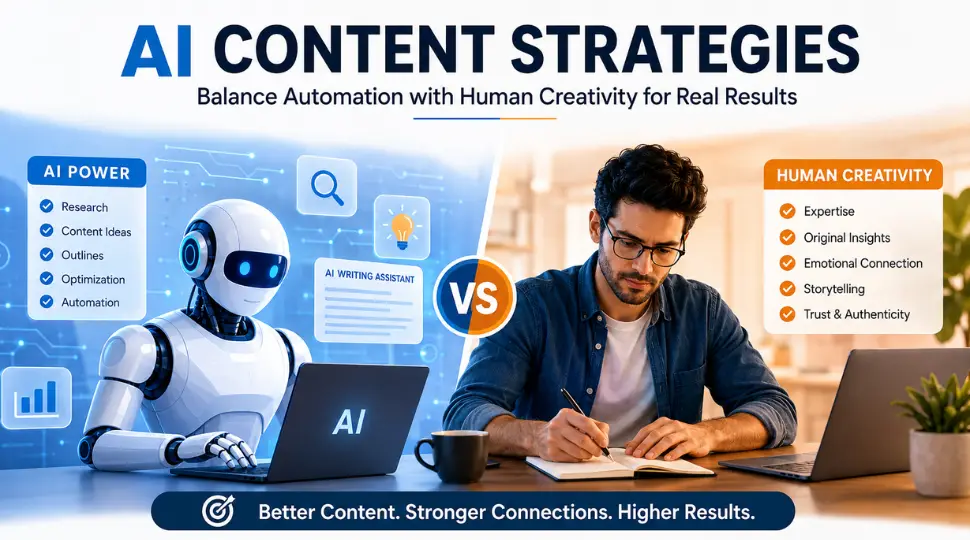
While there are risks, AI is very useful when used strategically.
Utilize AI to Aid in Research and Ideation
AI tools can be great for:
- Brainstorming headlines
- Content outlines
- Topic clustering
- Keyword grouping
- FAQ generation
This will save lots of planning time.
Integrate AI and Human Editing
The most successful content goes through this process:
- AI generates structure
- Use the expertise of humans to add to the findings
- Editor improves readability
- A firm understanding of how to leverage intent can boost your SEO strategy
- You can tailor your brand's voice in a manual way
This combination technique yields better results.
Include Real Examples and Data
Content does best when it has:
- Original screenshots
- Performance metrics
- Real campaign experiences
- Industry observations
- Expert opinions
These additions enhance the credibility and set content apart from generic AI-generated pages.
How to Combine AI and Human Expertise
Create Human-Led Content
Marketers should lead the process, rather than relying on AI to generate full articles.
Step 1: Use AI to Research
Gather:
- Topic ideas
- Search intent patterns
- Content gaps
- Keyword variations
Step 2: Add Industry Expertise
Include:
- Personal observations
- Client experiences
- Real-world examples
- Lessons learned
Step 3: Optimize for Readability
Ensure:
- Short paragraphs
- Clear headings
- Natural keyword placement
- Mobile-friendly formatting
Step 4: Fact-Check Everything
There are times when AI provides incorrect information.
Always verify:
- Statistics
- Quotes
- Dates
- SEO updates
- Industry trends
Best Practices for Sustainable AI SEO
Putting the User Value First
Before publishing, ask:
- Is this information actually useful to readers?
- Is it unique when compared to other articles?
- Does it meet the search intent well?
Otherwise, enhance it before sharing it.
Maintain Brand Voice
Inconsistency is one of the biggest problems with artificial intelligence-generated content.
Strong brands maintain the following:
- Consistent tone
- Clear messaging
- Unique personality
- Audience relevance
Human editing guarantees that the content is consistent with the brand's image.
Avoid Thin Content
Web pages containing little useful information or redundant information are not always successful in search results.
Instead:
- Add detailed explanations
- Include visuals
- Use examples
- Provide actionable tips
Real-World Examples of AI Content Failures
Case Study 1: Affiliate Product Reviews
There are a few specialized affiliate sites that only focused on AI-generated product reviews.
Problems included:
- No firsthand product testing was done
- Generic comparisons
- Repeated descriptions
- Weak trust signals
Many suffered a blow to their organic traffic after search engine updates.
Case Study 2: AI News Summaries
News summaries were automatically generated without editorial control on some media websites.
This created:
- Inaccurate reporting
- Misleading headlines
- Duplicate coverage
Readers quickly lost trust, impacting engagement and authority.
Future of AI Content Marketing
AI is not a replacement for humans. AI is not going to replace people.
The future of AI content marketing is collaboration.
Successful Businesses Will Leverage AI To:
- Improve efficiency
- Accelerate research
- Personalize experiences
- Analyze audience behavior
However, Human Skills Will Continue to Be Vital For:
- Creativity
- Trust
- Storytelling
- Strategic thinking
Search Engines Will Give Reward to Authenticity
Content that shows how is becoming more important to Google and other search engines every day:
- Real experience
- Expert knowledge
- Unique perspectives
- User satisfaction
This trend is expected to keep increasing in 2026 and beyond.
Content Quality Checklist
When publishing AI-generated content, make sure to go through this checklist:
| Check | Status |
|---|---|
| Does the article meet the user goal? | Yes / No |
| Is the information correct? | Yes / No |
| Have humans read through the material? | Yes / No |
| Do keywords occur organically? | Yes / No |
| Are there examples or insights found in the article? | Yes / No |
| Would the formatting be suitable for mobile devices? | Yes / No |
| Is there a clear structure in the organisation of headings? | Yes / No |
| Are the content and tone credible? | Yes / No |
These steps will help to minimize the risk of SEO and enhance the user experience.
Conclusion
With the rapid advancement of AI in content marketing, it is becoming dangerous to simply automate everything. The best AI Content Strategies for 2026 aren't purely automated; they're integrated strategies that involve a mix of AI and human effort.
While speed and quantity might lead to short-term increases, authentic, trusted, and user value are the keys to long-term SEO success.
When it comes to digital marketing course in Thane and digital marketing classes in Pune, selecting an affordable digital marketing course in PCMC can help you build strong fundamentals without overspending.
The future is where marketers who think smartly with AI are going to thrive, and that's because they are still going to be creative, knowledgable and valuable to their users.
FAQs
Is AI-generated content bad for SEO?
No. AI-generated content is not automatically harmful. Problems occur when businesses publish low-quality, unhelpful, or unedited AI content.
Can Google detect AI content?
Google focuses more on content quality than detection itself. Helpful, accurate, and trustworthy content can perform well regardless of how it was created.
Should marketers stop using AI tools?
No. AI tools are valuable for research, brainstorming, optimization, and productivity. The key is combining AI efficiency with human expertise.
What industries are most affected by poor AI content?
Industries requiring expertise and trust such as healthcare, finance, legal services, and digital marketing are more vulnerable to AI content quality issues.
How can businesses improve AI-assisted content?
Businesses should add expert insights, include real examples, fact-check information, improve readability, and focus on audience value.