




Enterprise SEO and AI Trends: The Future of Search Visibility in 2026
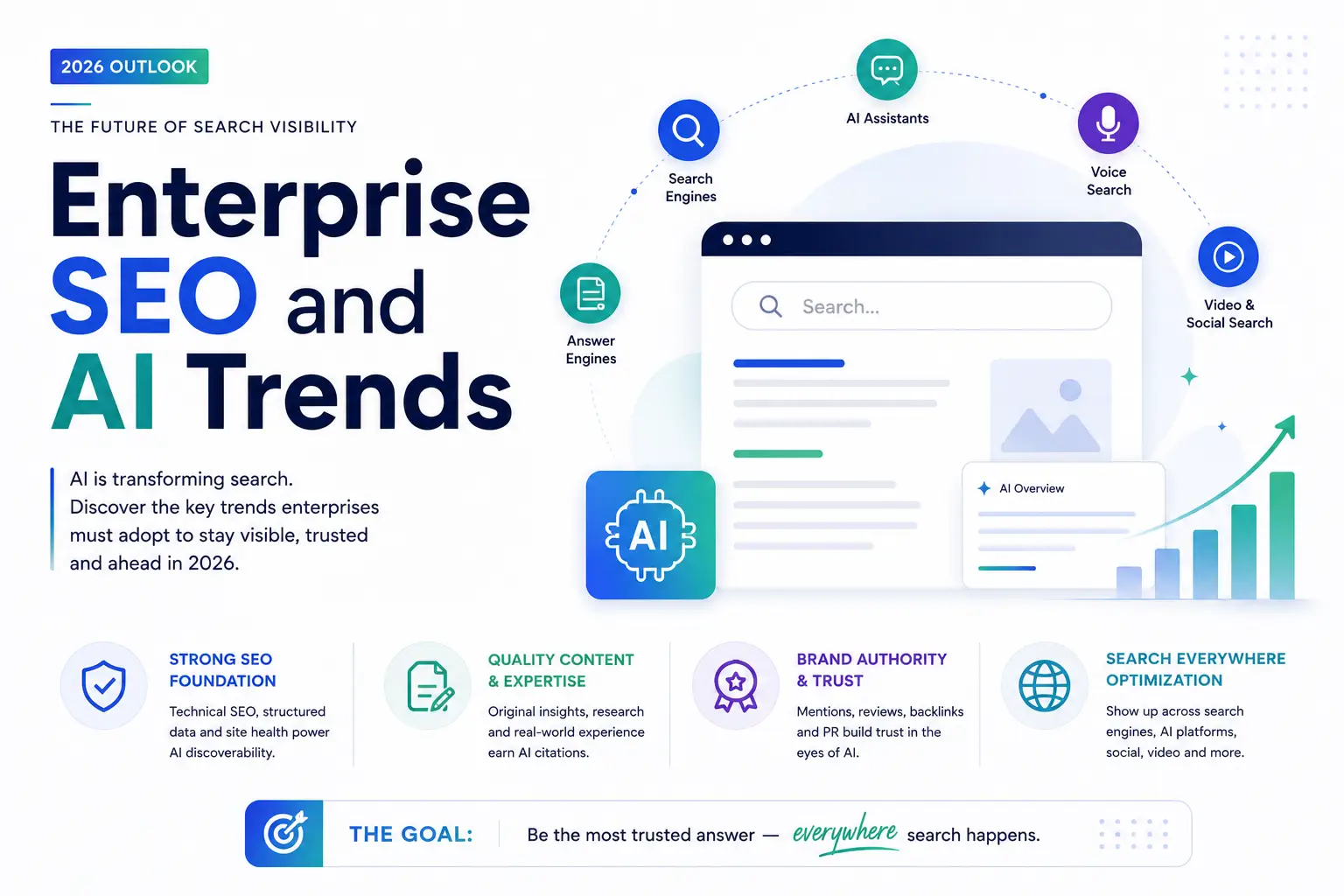
Introduction to Enterprise SEO in the AI Era
Enterprise SEO is entering a transformative phase. As artificial intelligence reshapes how users discover information, businesses must rethink their search strategies. The convergence of traditional SEO with AI-driven search platforms is creating new opportunities and challenges for enterprise organizations.
This guide explores the latest Enterprise SEO and AI Trends, providing actionable insights for marketers, SEO professionals, and business leaders who want to stay ahead in 2026.
To better understand the ideas discussed in this article, consider strengthening your skills with a practical digital marketing course in Pune designed for real-world application.
How Search Behavior Has Changed
For years, SEO focused primarily on ranking web pages in Google. Businesses optimized websites, created content, earned backlinks, and improved technical performance.
Today, search has expanded far beyond a single platform.
Users now discover information through:
- Google Search
- Google AI Overviews
- ChatGPT
- Perplexity
- Gemini
- YouTube
- Voice assistants
- Social media platforms
This shift means enterprise brands must optimize their presence across multiple search and AI ecosystems rather than focusing solely on traditional rankings. Industry experts increasingly refer to this approach as "Search Everywhere Optimization."
Why AI Search Matters for Enterprises
AI-powered search engines provide direct answers instead of traditional lists of blue links.
Research shows AI-generated search experiences are expanding rapidly and influencing how users access information. Modern AI systems often cite trusted sources, summarize content, and provide recommendations directly within responses.
As a result:
- Visibility matters more than rankings alone.
- Brand authority influences citations.
- Content structure impacts AI understanding.
- Trust signals become increasingly important.
Organizations that adapt early gain a significant competitive advantage.
Key Enterprise SEO and AI Trends
1. SEO Fundamentals Are the Foundation of AI Success
Many marketers assume AI optimization replaces SEO.
The reality is the opposite.
Technical SEO remains the foundation that allows AI systems to discover, understand, and cite content effectively. Without strong SEO fundamentals, AI visibility becomes difficult.
Essential Technical SEO Priorities
- Crawlability
- Indexation
- Site architecture
- Core Web Vitals
- Structured data
- Internal linking
- Mobile optimization
Why It Matters: AI engines rely on machine-readable content. Structured websites help AI systems understand entities, relationships, products, and expertise more effectively.
2. Content Quality Becomes the Biggest Differentiator
AI systems can generate generic content themselves.
What they seek to cite are:
- Original research
- Expert insights
- Unique experiences
- Case studies
- Trusted sources
Enterprise websites that publish valuable, experience-driven content are more likely to appear in AI-generated responses.
Content Best Practices
Lead with Insights — Provide key takeaways early in the article.
Use Clear Structure — Headings, subheadings, lists, FAQs.
Include Real Examples — Case studies improve trust and credibility.
Demonstrate Expertise — Show author credentials and practical experience.
3. Multimodal Search Is Growing Rapidly
Search is no longer text-only.
Modern users interact through:
- Images
- Videos
- Voice
- Text
- AI conversations
This trend is creating new opportunities for brands that diversify content formats. Enterprise marketers should invest in:
Video Content
Tutorials, product demonstrations, webinars, interviews.
Visual Assets
Infographics, charts, diagrams, screenshots.
Interactive Tools
Calculators, templates, checklists, assessment tools.
Research indicates AI platforms increasingly reference multimedia content when generating responses.
4. Brand Authority Will Matter More Than Rankings
In AI search environments, authority often determines whether a brand gets cited.
The focus is shifting from:
"Do we rank?"
to
"Are we trusted?"
AI systems evaluate credibility using signals such as:
- Backlinks
- Reviews
- Brand mentions
- Expert citations
- Media coverage
- User engagement
Building AI Trust Signals
- Publish original research
- Earn media mentions
- Develop thought leadership
- Encourage customer reviews
- Strengthen author expertise
Studies show earned media and third-party mentions significantly influence AI citations.
5. Search Everywhere Optimization Becomes Essential
Enterprise organizations can no longer focus exclusively on Google.
Customers now discover brands across multiple platforms.
| Platform Type | Examples |
|---|---|
| Traditional Search | Google, Bing |
| AI Platforms | ChatGPT, Gemini, Perplexity |
| Community Platforms | Reddit, Quora |
| Video Platforms | YouTube, Shorts |
| Social Discovery | LinkedIn, Instagram, TikTok |
Successful brands create content ecosystems rather than isolated webpages.
Understanding Generative Engine Optimization (GEO)
Generative Engine Optimization (GEO) focuses on improving visibility within AI-generated responses.
Unlike traditional SEO, GEO aims to help content become:
- Discoverable
- Understandable
- Citable
- Trustworthy
Research indicates GEO strategies can significantly improve content visibility within AI-generated search environments.
GEO Best Practices
- Use structured content
- Include authoritative citations
- Add statistics
- Answer questions directly
- Create semantic content clusters
Understanding Answer Engine Optimization (AEO)
Answer Engine Optimization focuses on helping content become the preferred answer for AI systems.
AEO Tactics
- FAQ sections
- Schema markup
- Concise definitions
- Direct answers
- Conversational content
AEO and GEO are increasingly becoming critical extensions of traditional SEO strategies.
Measuring Success in AI Search
Traditional SEO metrics remain valuable but are no longer sufficient.
| Metric | Description |
|---|---|
| AI Presence Rate | How often your brand appears in AI-generated responses. |
| Citation Authority | Frequency of citations across AI platforms. |
| Share of AI Conversation | Brand visibility compared with competitors. |
| Brand Sentiment | How AI platforms describe your brand. |
| Organic Search Performance | Traffic, rankings, and conversions. |
Enterprise organizations should combine SEO and AI visibility reporting into a unified measurement framework.
Building an Enterprise AI SEO Strategy
Step 1: Strengthen Technical SEO
Conduct regular audits. Focus on site speed, crawlability, and structured data.
Step 2: Create High-Authority Content
Publish research studies, industry reports, and expert commentary.
Step 3: Diversify Content Formats
Produce blogs, videos, podcasts, and visual content.
Step 4: Build Digital PR
Increase mentions through media outreach, guest contributions, and partnerships.
Step 5: Monitor AI Visibility
Track performance across ChatGPT, Gemini, Perplexity, and Google AI Overviews.
Common Mistakes to Avoid
Publishing Generic AI Content
AI-generated content without expertise rarely earns citations.
Ignoring Technical SEO
Even great content can fail without strong technical foundations.
Focusing Only on Rankings
Visibility now extends beyond search result positions.
Neglecting Brand Authority
Trust signals heavily influence AI recommendations.
Missing Structured Data
Schema markup helps AI understand content context.
Future of Enterprise SEO
Enterprise SEO is evolving into a broader visibility strategy.
Organizations will increasingly optimize for:
- Search engines
- AI assistants
- Voice search
- Social discovery
- Video platforms
The companies that combine traditional SEO excellence with AI-focused optimization will be best positioned for long-term success.
Search is no longer just about ranking pages. It is about becoming the trusted source that both users and AI systems rely on for answers.
Frequently Asked Questions
1. What is Enterprise SEO?
Enterprise SEO refers to large-scale search engine optimization strategies used by organizations with extensive websites, multiple stakeholders, and complex digital ecosystems.
2. What is Generative Engine Optimization (GEO)?
GEO is the process of optimizing content to increase visibility and citations within AI-generated search results.
3. How does AI affect SEO?
AI changes how information is discovered, summarized, and recommended. Brands must optimize for both search engines and AI platforms.
4. Is traditional SEO still important?
Yes. Technical SEO, content quality, and authority remain the foundation for both traditional and AI search visibility.
5. What is Search Everywhere Optimization?
Search Everywhere Optimization is a strategy that focuses on visibility across search engines, AI platforms, social networks, video platforms, and community websites.
6. What is Answer Engine Optimization (AEO)?
AEO focuses on helping content become the preferred answer for AI systems through FAQ sections, schema markup, concise definitions, and direct answers.
Conclusion
Enterprise SEO is entering a new era where rankings, citations, authority, and AI visibility work together. Businesses that embrace AI-driven search optimization while maintaining strong SEO fundamentals will gain a substantial competitive advantage.
Whether you're exploring a digital marketing course in Thane or comparing digital marketing classes in Pune, choosing an affordable digital marketing course in PCMC can help you build strong fundamentals without overextending your budget.
The future belongs to brands that become trusted sources across every search experience from Google to AI assistants and beyond.
"The best way to predict the future is to invent it."
— Alan Kay