




Enterprise AI Search in 2026: What 300 Marketing Leaders Reveal About the Future of SEO
Introduction
Enterprise AI Search is rapidly reshaping how users discover information online. As platforms like ChatGPT, Gemini, Perplexity, and AI Overviews become mainstream, marketers are facing a critical question: Will AI replace traditional SEO, or will both channels coexist?
A recent survey of 300 enterprise marketing executives provides valuable insights into how organizations are adapting to this shift. The findings reveal significant investments in AI search optimization, growing traffic from AI-powered platforms, and new challenges in attribution and measurement.
To better understand the ideas discussed in this article, consider strengthening your skills with a practical digital marketing course in Pune designed for real-world application.
This guide explores the key findings from the report and explains what marketers, SEO professionals, and business leaders should do next.
What Is Enterprise AI Search?
Enterprise AI Search refers to the use of AI-powered search experiences that help users discover information through conversational interfaces instead of traditional search results.
Examples include:
- ChatGPT Search
- Google AI Overviews
- Gemini
- Perplexity AI
- Copilot Search
- AI-powered enterprise knowledge platforms
Unlike traditional search engines that display lists of links, AI search platforms generate summarized answers using information gathered from multiple sources. This shift is changing how businesses approach content creation, optimization, and visibility.
Why AI Search Is Growing So Fast
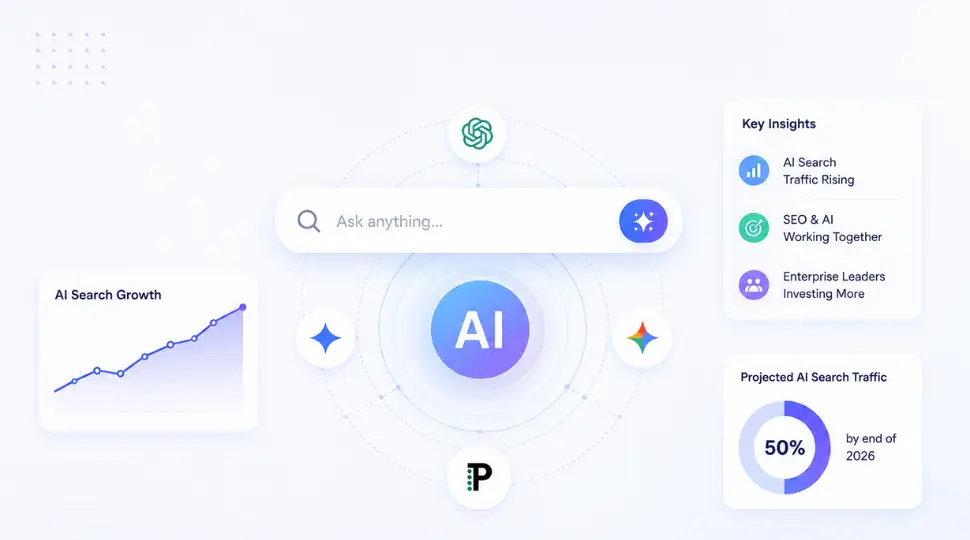
AI search adoption has accelerated at an unprecedented pace. According to the survey, enterprise marketers estimate that AI search now accounts for approximately 35% of website traffic and could reach nearly 50% by the end of 2026.
Key Drivers Behind AI Search Growth
- Faster information retrieval
- Conversational user experience
- Personalized responses
- Improved recommendation systems
- Integration across multiple platforms
Users increasingly start their research journey inside AI assistants before moving to traditional search engines to validate information or complete purchases.
Finding #1: AI Search Is Not Replacing SEO
One of the biggest misconceptions in digital marketing is that SEO is becoming obsolete. The research suggests the opposite.
Enterprise leaders expect traditional SEO traffic to grow from 45% of website traffic in 2025 to 53% in 2026, while AI search traffic is also expected to rise significantly from 35% to 50%.
What This Means
Instead of replacing search engines, AI search is creating additional discovery opportunities. Users often:
- Ask AI platforms for recommendations.
- Receive summarized answers.
- Conduct follow-up searches on Google.
- Visit multiple websites before converting.
This creates a hybrid search journey where AI and traditional SEO work together.
Real-World Example
Imagine someone planning a trip. They may:
- Ask ChatGPT what to pack.
- Request destination recommendations.
- Search Google for specific products.
- Compare reviews.
- Complete purchases through ecommerce sites.
Each step generates multiple opportunities for brands to gain visibility.
How User Search Behavior Is Changing
Traditional search behavior was keyword-driven. Modern AI search behavior is conversation-driven.
| Traditional Search | AI Search |
|---|---|
| Short queries | Natural language questions |
| Multiple searches | Contextual conversations |
| Manual research | Personalized recommendations |
| Link exploration | Faster decision-making |
Research also shows that AI-generated search experiences often present information differently than traditional search engines, influencing which sources receive visibility. This means marketers must optimize content for both humans and AI systems.
Finding #2: Enterprises Are Investing Heavily in AI Search
The survey revealed a dramatic shift in marketing budgets.
Budget Allocation Trends
- 65% of enterprise marketers allocate at least 25% of their marketing budget toward AI search initiatives.
- 28% allocate more than half of their marketing budget to AI-related optimization.
- 98% are actively optimizing for AI search or plan to within 12 months.
These numbers demonstrate that AI search is no longer experimental. For many enterprises, it is becoming a core marketing channel.
Industries Leading Adoption
Several sectors are aggressively investing in AI visibility:
- Financial Services
- Retail & Ecommerce
- Travel & Hospitality
- Media & Entertainment
- Healthcare
Organizations recognize that early adoption can create competitive advantages.
The AI Attribution Challenge
While AI search traffic is growing, measuring its impact remains difficult. The report found that many marketers feel confident about AI attribution, yet a majority still face significant measurement challenges.
Why Attribution Is Difficult
AI platforms often:
- Hide referral details
- Aggregate user journeys
- Influence purchases indirectly
- Generate zero-click interactions
For example, a customer might discover a product through ChatGPT, visit Google later, click a retargeting ad, and purchase directly. Which channel deserves credit? This complexity creates major challenges for marketers.
Recommended Measurement Approach
Track:
- Organic traffic
- AI referrals
- Direct traffic
- Assisted conversions
- Brand search growth
The future of attribution will likely depend on advanced modeling rather than last-click attribution.
AI Search Optimization Best Practices
Organizations preparing for AI-driven search should focus on foundational optimization techniques.
1. Improve Content Clarity
AI models prefer content that is easy to understand, well-structured, factually accurate, and organized with clear headings.
2. Build Topical Authority
Cover topics comprehensively through guides, FAQs, case studies, and research content.
3. Use Structured Data
Schema markup helps AI systems understand products, organizations, reviews, FAQs, and articles.
4. Strengthen Internal Linking
Strong internal linking improves crawlability, content discovery, and entity understanding.
5. Create Question-Based Content
AI search platforms frequently reference FAQs, how-to guides, comparison pages, and educational resources.
Survey data indicates many enterprises are prioritizing AI-friendly content formats and improved crawlability.
SEO vs AI Search: Key Differences
| Factor | Traditional SEO | AI Search |
|---|---|---|
| Output | List of links | Generated answers |
| User Intent | Query-based | Conversation-based |
| Attribution | Easier | More difficult |
| Optimization | Rankings | Citations & visibility |
| Discovery | Search results | Recommendations |
Understanding these differences is essential for modern digital marketing strategies.
Future of Enterprise Search and Discovery
Experts believe enterprise search is evolving rather than disappearing. Modern AI systems increasingly rely on search infrastructure to gather and validate information before generating responses.
AI-Powered Transactions — Many enterprise leaders expect users to complete transactions directly within AI platforms in the near future.
Agent-Based Search — Future systems may move beyond answering questions and begin completing tasks automatically. Examples include booking appointments, creating reports, managing workflows, and research automation.
Greater Focus on Trust — As AI-generated content expands, trust signals become increasingly important: brand authority, expert content, citations, reviews, and user-generated content.
Action Plan for Marketers
Short-Term Priorities
- Optimize existing content
- Improve technical SEO
- Build FAQ sections
- Track AI referral traffic
- Monitor brand visibility in AI platforms
Long-Term Priorities
- Develop AI-focused content strategies
- Invest in entity-based SEO
- Improve first-party data collection
- Build stronger attribution models
- Strengthen brand authority across channels
Organizations that act early will likely gain significant advantages as AI search continues expanding.
Key Takeaways
- AI search and traditional SEO are growing simultaneously, not replacing each other.
- Enterprise marketers estimate AI search accounts for ~35% of traffic, heading toward 50% by end of 2026.
- 65% of enterprises dedicate at least 25% of budget to AI search optimization.
- 89% of enterprise leaders saw improved marketing performance from AI search in 2025.
- 87% expect AI platforms to complete closed-loop transactions within 12 months.
- Attribution and measurement remain the biggest practical challenges.
- Content clarity, structured data, and topical authority are top optimization tactics.
- Early adopters will gain significant competitive advantages.
Frequently Asked Questions
1. Is AI Search replacing SEO?
No. Research indicates both AI search and traditional SEO are growing simultaneously, creating complementary traffic channels. Traditional SEO traffic is projected to grow from 45% to 53% of website traffic by the end of 2026, while AI search traffic is projected to grow from 35% to 50%.
2. How much traffic comes from AI Search?
Enterprise marketers report AI search currently accounts for roughly 35% of website traffic and could reach 50% by 2026.
3. What is the biggest challenge with AI Search?
Attribution and measurement remain the biggest obstacles because AI-assisted customer journeys are difficult to track accurately. AI platforms often hide referral details, aggregate user journeys, and generate zero-click interactions.
4. What type of content performs best in AI Search?
FAQ pages, comparison content, educational guides, case studies, and highly structured content tend to perform well in AI-driven environments.
5. Should businesses invest in AI optimization now?
Yes. Most enterprise organizations are already investing in AI search visibility and optimization strategies. 98% are actively optimizing or planning to within 12 months.
6. What is GEO and how does it differ from SEO?
Generative Engine Optimization (GEO) is the practice of optimizing content and brand presence to appear in AI-generated responses. Unlike traditional SEO, which focuses on ranking in a list of links, GEO is concerned with whether a brand is included in synthesized answers that AI platforms generate.
Conclusion
Enterprise AI Search is no longer a future trend — it is already transforming how users discover information online. The evidence suggests that AI search and traditional SEO will coexist, creating new opportunities for brands that adapt quickly.
Organizations that focus on high-quality content, structured information, accurate measurement, and strong authority signals will be best positioned for success in this evolving landscape.
Whether you're exploring a digital marketing course in Thane or comparing digital marketing classes in Pune, choosing an affordable digital marketing course in PCMC can help you build strong fundamentals without overextending your budget.
As AI continues to reshape search behaviour, marketers must think beyond rankings and focus on visibility wherever users seek answers.
"The best way to predict the future is to invent it."
— Alan Kay