




The Anatomy of a High-Ranking Blog Post in 2026: What Actually Drives SEO Success
Introduction
The major portion of the population assumes that there is one key to success in SEO: it is through keywords. However, the structure of a top-tier blog post is much more complicated. Nowadays, content is not ranked as it is written; it is ranked as being strategically constructed.
The search engines are increasingly focusing on structure, intent, depth and clarity more than on keyword stuffing. Unless your content is up to these expectations, it will not perform regardless of the number of keywords that you have.
In order to get a clearer picture of the concepts addressed in AI Content Optimization Tools: How to Check If AI Understands Your Content, it is better to deepen your knowledge with a practical digital marketing course in Pune that is orientated towards practice.
What is the Anatomy of a High-Ranking Blog Post?
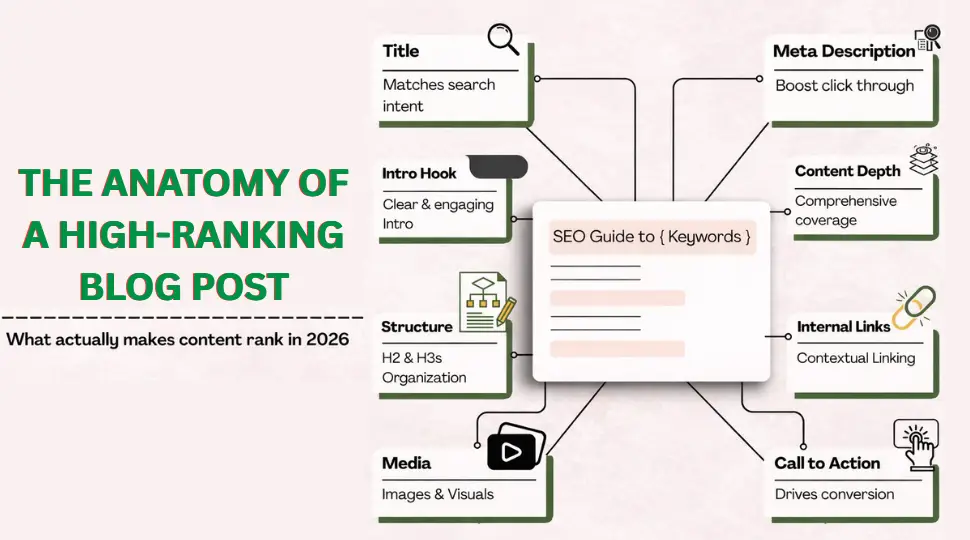
An anatomy of a high-ranking blog post can be understood as the building blocks that are vital in assisting the content to rank on the search engines. A good-performing blog incorporates the following:
- The matching search intent title
- An attractive meta description
- A strong introduction hook
- Good organization in terms of H2s and H3s
- In-depth content
- Internal linking
- Visual elements
- A clear call to action
Think of it as a system – not just a piece of writing.
Why Keywords Alone Don't Work Anymore
Search engines such as Google have progressed. Algorithms now understand context, user behaviour and content-quality at a deeper level.
What Matters More Than Keywords:
- Search Intent Matching – Understanding what users actually want
- Content Quality & Depth – Comprehensive coverage of topics
- User Experience (UX) – How easily users can consume your content
- Engagement Signals – Dwell time, bounce rate, and interaction metrics
Example: There are two blogs that focus on the same keyword:
• Blog A: Stuffed with keywords, ill-structured
• Blog B: Well-organised, useful, engaging
Result: Blog B will be ranked higher – despite fewer instances of keywords.
Key Elements of a High-Ranking Blog Post
Let's deconstruct each element that makes content rank:
1. Title Optimization (Matches Search Intent)
The title is the first thing that users and search engines view.
Best Practices:
- Add the keyword naturally as part of it
- Address user intent directly
- Keep it clear, compelling, and under 60 characters
Weak: "SEO Tips"
Strong: "The Anatomy of a High-Ranking Blog Post in 2026"
2. Meta Description (Increases Click-through Rate)
An effective meta description increases CTR (Click Through Rate).
Tips:
- Keep it between 140 and 160 characters
- Include the main keyword naturally
- Introduce a benefit or curiosity hook
3. Intro Hook (Engages Instantly)
The introduction determines whether users stay or leave.
Strong intro includes:
- A problem statement that resonates
- A bold claim or surprising insight
- A clear promise of value
4. H2, H3 Organization: Content Structure
Design enhances search engine optimization and readability.
Use:
- H2 for main sections
- H3 for subtopics
- Bullet points for clarity and scannability
Benefits of well-organised material:
- Users can scan easily
- Search engines understand context better
- Content becomes eligible for featured snippets
5. Content Depth (Comprehensive Coverage)
Thin content does not rank anymore. Add depth by:
- Covering subtopics thoroughly
- Responding to related questions
- Using real examples and case studies
| Factor | High-Quality Blog Content | Low-Quality Blog Content |
|---|---|---|
| Search Intent | Fully matches user intent and answers queries clearly | Ignores or misunderstands user intent |
| Content Depth | Comprehensive, detailed, and covers subtopics | Thin content with surface-level information |
| Structure | Well-organized with H2, H3, bullet points | Poor structure, large text blocks |
| Readability | Simple language, short paragraphs, easy to scan | Complex sentences, hard to read |
| Keyword Usage | Natural keyword placement | Keyword stuffing or no optimization |
| User Engagement | Keeps users engaged with examples and visuals | High bounce rate, low engagement |
| Visual Elements | Includes images, infographics, videos | No visuals or irrelevant media |
| Internal Linking | Strategic internal links for navigation | No or random internal links |
| EEAT Signals | Shows expertise, experience, and credibility | Lacks trust and authority |
| Call to Action (CTA) | Clear next step (subscribe, read more, etc.) | No direction for the reader |
| SEO Performance | Ranks higher, better CTR and dwell time | Poor rankings and low visibility |
6. Internal (Contextual) Linking
Internal linking enhances navigation and search optimization.
Benefits:
- Distributes page authority across your site
- Keeps users engaged longer
- Helps search engines crawl your site effectively
7. Media/Images (Increases Interaction)
Visual content is more memorable and engaging.
Include:
- Infographics that simplify complex data
- Screenshots for tutorials and guides
- Diagrams to illustrate concepts
- Videos for deeper engagement
8. Call to Action (Conversion Driver)
Each blog must lead users to the next step.
Examples:
- Subscribe to newsletter
- Download a resource
- Enroll in a course
- Read another related blog
Step-by-Step Framework to Build Ranking Content
Follow this proven process to create content that ranks:
Step 1: Understand Search Intent
Analyze what users truly want when they search your target keyword. Look at the current top-ranking results to understand content expectations.
Step 2: Develop a Content Outline
Plan before you write. Structure your headings (H2, H3) to cover all aspects of the topic logically and comprehensively.
Step 3: Create High-Value Content
Focus on solving problems, not just mentioning them. Provide actionable insights, data, and real-world examples.
Step 4: Add Visual Elements
Use diagrams, images, and infographics to break up text and enhance understanding. Visual learning improves retention.
Step 5: Optimize for SEO
Add keywords naturally in titles, headings, and throughout content. Ensure meta tags are optimized for click-through rates.
Step 6: Add Internal Links and CTA
Guide users to the next step with strategic internal linking and a clear, compelling call-to-action.
Real-World Content Example
Case Study: A digital marketing blog improved its rankings by:
- Adding structured headings (H2, H3)
- Expanding content volume to 1800+ words
- Using relevant images and internal links
- Implementing EEAT signals
Results:
• 2x increase in organic traffic
• 40% lower bounce rate
• Better position in Google SERP
• Increased time on page
EEAT: The Real SEO Differentiator
Google evaluates content based on EEAT – Experience, Expertise, Authoritativeness, and Trustworthiness.
The EEAT Framework:
- Experience – Practical, first-hand knowledge of the subject
- Expertise – Depth of knowledge and professional credentials
- Authoritativeness – Recognition as a trusted source in your field
- Trustworthiness – Accuracy, transparency, and reliability
How to Apply EEAT:
- Share real examples from your experience
- Add statistics from credible sources
- Link to authoritative external resources
- Show author expertise and credentials
- Keep information accurate and up-to-date
Common SEO Mistakes to Avoid
Even experienced marketers make these errors:
- Keyword stuffing – Overusing keywords hurts readability and rankings
- Ignoring search intent – Writing what you want, not what users need
- Poor formatting – Walls of text without structure
- Thin content – Surface-level coverage that doesn't satisfy users
- No internal linking – Missing opportunities to build site authority
- Missing CTA – Leaving readers without direction
Conclusion
The reality is simple – it's not the quantity of writing that matters for ranking, but the intelligent nature of it.
A high-ranking blog post has the following anatomy:
- Intent-driven titles that match user queries
- Structured content with clear H2s and H3s
- Deep, valuable insights that solve real problems
- Clear readability with visual elements
- Strategic internal linking for navigation
- Strong EEAT signals that build trust
Be it in the event of studying a digital marketing course in Thane or digital marketing classes in Pune, an affordable digital marketing course in PCMC would enable you to develop sound pillars without overstretching your finances.
"Good content isn't about good storytelling. It's about telling a true story well."
— Ann Handley
FAQs
1. What is the most significant aspect of ranking content?
The most important factors are search intent matching and content quality. Your content must fully satisfy what users are looking for while providing genuine value.
2. How long should a blog post be?
For competitive topics, aim for ideally between 1500 and 2000 words. However, quality always trumps quantity – every word should add value.
3. Do keywords matter anymore?
Yes, but they must be applied naturally within context. Focus on topics and intent rather than exact-match keyword placement.
4. What is EEAT in SEO?
EEAT stands for Experience, Expertise, Authoritativeness, and Trustworthiness. It's Google's framework for evaluating content quality and credibility.
5. What can I do to get better blog interactions?
Apply images, proper formatting, and clarity in writing. Use internal links to keep users engaged, and always include a clear call-to-action.