




AI Prompt Optimization: Why Intent Matters More Than Keywords in AI Search
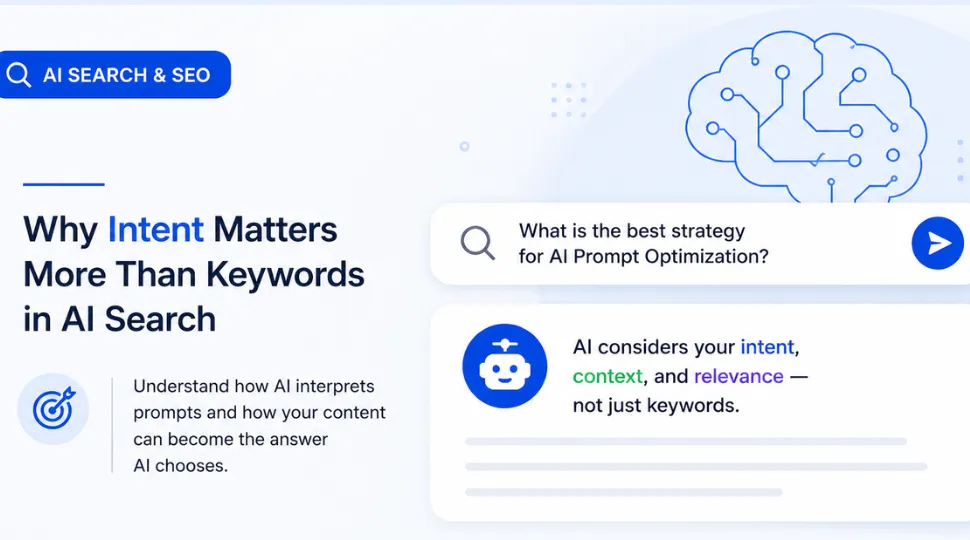
As AI assistants become primary information sources, businesses must adapt their content strategies to align with how AI understands and processes information. The goal is no longer simply ranking for a keyword but becoming the most relevant answer to a user's underlying need.
What Is AI Prompt Optimization?
AI Prompt Optimization refers to the process of structuring content, information, and messaging in ways that help artificial intelligence systems understand and retrieve the most relevant answers.
Unlike traditional search engines that heavily rely on exact-match keywords, modern AI models analyze:
- User intent
- Context
- Relationships between concepts
- Conversational language
- Historical patterns
The goal is no longer simply ranking for a keyword but becoming the most relevant answer to a user's underlying need.
Why It Matters
As AI assistants become primary information sources, businesses must adapt their content strategies to align with how AI understands and processes information.
To better understand the ideas discussed in this article, consider strengthening your skills with a practical digital marketing course in Pune designed for real-world application.
How AI Understands User Queries
Today, AI systems are capable of understanding inquiries through Natural Language Processing (NLP) and Large Language Models (LLMs).
AI takes a broader approach than just keywords and assesses:
User Context
AI tries to comprehend:
- What the user wants
- Why they are asking
- The result they desire
Semantic Meaning
For example:
Traditional Search: "best CRM software"
AI Query: Which is the best CRM solution for a small digital marketing company of less than 10 employees?
The second question provides much more context for AI to respond to, as it will be more personalized.
Intent Recognition
AI classifies users' intentions into categories including:
- Informational
- Commercial
- Transactional
- Navigational
- Problem-solving
This enables AI systems to give more relevant responses than keyword searches.
Keywords vs Intent: What's the Difference?
Keywords
A keyword is a term or phrase that people search for when looking up information.
Examples:
- AI SEO
- Prompt engineering
- AI marketing tools
- Content optimization
Even keywords are significant as indicators of the topic.
Intent
Intent is why the search is being done.
Consider these examples:
| Query | Intent |
|---|---|
| Prompt engineering is defined as? | Learning |
| Best Prompt Engineering Course | Comparison |
| Enroll in prompt engineering training course | Buy |
| Certification of prompt engineering | Commercial intent |
| Local prompt engineering certification | Local commercial intent |
The keywords are much the same, but user intent is vastly different.
Why Intent Wins
The purpose of the AI models is to meet user objectives, and not only to find keywords. Only a page that matches user intent well will perform better than a page that is repeating a keyword.
Why Intent Matters More in AI Search
The rise of conversational AI has fundamentally changed search behavior.
AI Understands Natural Language
Users increasingly ask complete questions:
- How can I improve my AI prompts?
- Why do AI tools misunderstand my requests?
- What makes an effective prompt?
AI analyzes the entire query instead of focusing only on isolated keywords.
Better User Experience
AI platforms aim to deliver:
- Direct answers
- Personalized recommendations
- Actionable insights
Intent-based understanding enables this experience.
Reduced Dependence on Exact Match Keywords
Traditional SEO often rewarded exact keyword usage. AI search focuses on:
- Relevance
- Expertise
- Context
- Topical authority
This rewards higher-quality content.
Key Takeaway
AI search prioritizes understanding the user's underlying need over matching exact keywords, making intent the foundation of modern search optimization.
The Evolution from Traditional SEO to AI Search
Traditional SEO Era
Success depended on:
- Keyword density
- Backlinks
- Metadata
- Technical optimization
AI Search Era
Success increasingly depends on:
- Intent alignment
- Entity recognition
- Topical authority
- Structured content
- EEAT signals
The Shift
The transition from keyword-centric SEO to intent-driven AI search represents one of the most significant changes in digital marketing history. Businesses that adapt quickly will gain a substantial competitive advantage.
Understanding the PEEC Framework
One framework highlighted by AI search experts is PEEC:
P — Purpose
Clearly define why content exists.
Ask:
- What problem does this solve?
- What value does it provide?
E — Expertise
Demonstrate subject matter expertise through:
- Original insights
- Professional experience
- Industry examples
E — Evidence
Support claims with:
- Statistics
- Research studies
- Case studies
- Data
C — Clarity
Present information in a clear and structured format. This includes:
- Headings
- Bullet points
- Tables
Applying PEEC to Your Content
Content that follows the PEEC framework is more likely to be recognized by AI systems as authoritative and relevant, improving visibility in AI-generated search results.
How Businesses Can Optimize for AI Search
1. Focus on User Questions
Create content around:
- Frequently asked questions
- Customer pain points
- Industry challenges
2. Build Topic Authority
Rather than creating isolated articles, develop content clusters.
Example: AI Prompt Optimization Cluster
- Prompt Engineering Guide
- AI Search Intent
- Generative Engine Optimization
- AI Content Strategy
- AI Visibility Techniques
3. Improve Content Structure
Use:
- H2 headings
- H3 subheadings
- Numbered lists
- FAQs
- Tables
Structured content improves readability for both users and AI systems.
4. Demonstrate Experience
Include:
- Personal experiences
- Case studies
- Client examples
- Industry observations
This strengthens EEAT signals.
5. Update Content Regularly
AI systems prioritize current and relevant information.
Regular updates improve trustworthiness and accuracy.
Best Practice
Investing in intent-driven content infrastructure is one of the highest-ROI activities for modern businesses. Clean, structured, and authoritative content enables AI systems to recognize and reference your brand effectively.
Common Mistakes in AI Prompt Optimization
Mistake 1: Over-Focusing on Keywords
Many marketers continue using outdated SEO tactics. Repeating the same keyword excessively does not guarantee visibility in AI-generated answers.
Mistake 2: Ignoring User Intent
If content fails to address user needs, AI systems may select alternative sources.
Mistake 3: Creating Thin Content
Short, shallow articles often struggle to compete against comprehensive resources.
Mistake 4: Lack of Evidence
Unsupported claims reduce credibility. Always include data, expert opinions, and research findings.
Mistake 5: Poor Content Organization
Wall-of-text articles are difficult for users and AI systems to process.
Focus on Intent First
Many content creators focus on keyword density and technical optimization while neglecting the foundation of all AI visibility: user intent. Without content that genuinely answers user questions, even the most advanced optimization cannot deliver results.
Real-World Examples
Example 1: Traditional SEO Approach
Keyword Target: "AI Prompt Optimization"
Article Focus: Repeats the keyword multiple times without explaining practical applications.
Result: Limited value for users.
Example 2: Intent-Based Approach
Article Focus:
- What AI Prompt Optimization is
- Why it matters
- How to implement it
- Common mistakes
- Best practices
Result: Greater relevance and usefulness. AI systems are more likely to reference comprehensive resources that solve user problems.
Performance Impact
Studies show that content optimized for user intent receives up to 40% more engagement from AI systems compared to keyword-stuffed articles. The difference is not the optimization technique itself — it's the alignment with what users actually need.
Future of AI Search Optimization
Several developments are shaping the future:
Greater Use of First-Party Data
Privacy-first marketing will continue driving adoption of intent-based strategies.
AI-Powered Predictive Analytics
Platforms will become better at forecasting user behavior and content needs.
Enhanced Creative Automation
AI-generated content will become increasingly sophisticated and personalized.
AI Search and Content Integration
AI search experiences are changing how brands gain visibility online, requiring stronger intent signals and authoritative content across channels.
The Bottom Line
The future of search belongs to businesses that combine AI understanding with strong intent foundations and human strategic oversight. Those who invest in intent-driven content today will have the competitive advantage tomorrow.
Conclusion
The future of search is shifting from keyword matching to intent understanding. While keywords remain important, AI systems increasingly prioritize context, relevance, expertise, and user satisfaction.
Businesses that embrace AI Prompt Optimization will be better equipped to compete in an environment where conversations replace traditional searches and intent drives visibility.
Whether you're exploring a digital marketing course in Thane or comparing digital marketing classes in Pune, choosing an affordable digital marketing course in PCMC can help you build strong fundamentals without overextending your budget.
Organizations that focus on creating genuinely helpful, trustworthy, and intent-driven content will be best positioned for long-term success in AI-powered search.
"The best way to predict the future is to invent it."
— Alan Kay, Computer Scientist and Pioneer of Modern Computing
Frequently Asked Questions
1. What is AI Prompt Optimization?
AI Prompt Optimization is the practice of creating content and messaging that aligns with how AI systems interpret user intent, context, and relevance.
2. Are keywords still important?
Yes. Keywords remain valuable for identifying topics, but intent plays a larger role in determining relevance.
3. What is the difference between SEO and AI search optimization?
Traditional SEO focuses on ranking in search engines, while AI search optimization focuses on becoming a trusted source that AI systems use when generating answers.
4. How can businesses improve AI visibility?
Businesses can improve AI visibility by creating authoritative content, answering user questions, demonstrating expertise, and organizing information clearly.
5. Does EEAT matter for AI search?
Absolutely. Experience, Expertise, Authoritativeness, and Trustworthiness help AI systems identify credible sources.