




SEO Content Pyramid: The Smart Framework to Boost Conversions & Traffic
Introduction
One of the most potent models that can be used to create traffic that can actually turn into income and not a meaningless vanity pageviews is the SEO Content Pyramid. Lots of companies release dozens of educational blog posts and cannot get any leads or sales.
In order to grasp the concepts covered in How to Rank on Google 1st Page in 2026: SEO Without Backlinks Explained, you can enhance your competencies by taking Digital Trainee's digital marketing courses in pune that would be applicable in practice.
One of the most prevalent errors made is the initiation of SEO by using simple educational content rather than targeting high-intent pages initially. This article discusses why the SEO Content Pyramid turns that strategy around and assists you to create a well-structured content strategy, which attracts purchasers, cultivates potential customers, and educates novices in the appropriate sequence.
This principle will forever alter your content planning strategy in case you seek predictable SEO growth as opposed to unpredictable blog traffic.
What Is the SEO Content Pyramid
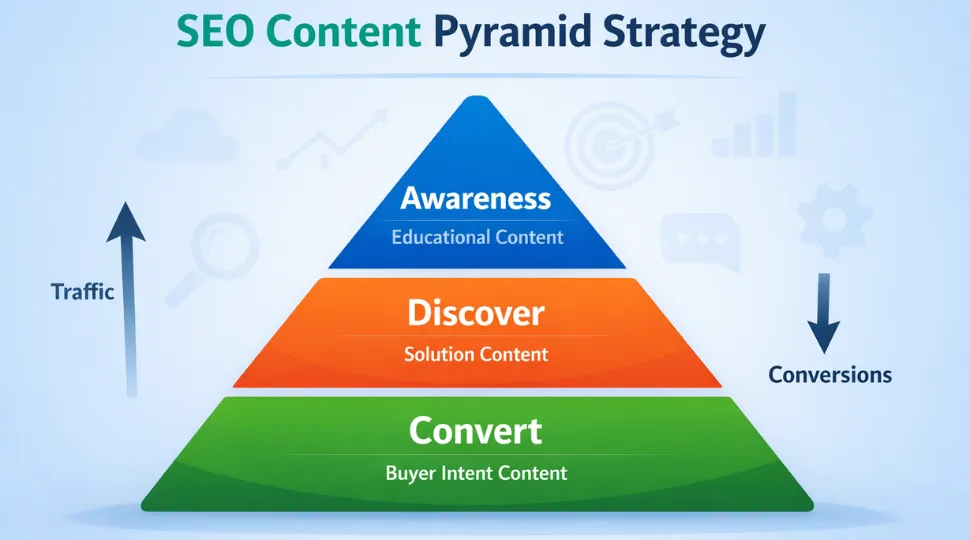
The SEO Content Pyramid is a format or a well through SEO process that focuses on a content placement on the basis of purchase intent as opposed to search volume in isolation.
This framework recommends: not to publish hundreds of informational posts in the first place.
- Begin with buyers-intent content.
- Transfer to solution-exploration material.
- Complete with educational awareness content.
This is a reflection of the behavior of real customers searching until they purchase a product or a service.
Google and other search engines are putting more emphasis on content that meets the intent of the user, other than keywords.
Why Most Content Strategies Fail
Most companies take months to write the beginner level of blog posts such as:
- What is email marketing
- Benefits of newsletters
- Simple tips of digital marketing.
Such issues are traffic-generating and do not necessarily generate revenue.
The Problem
The content of education appeals:
- Students
- Researchers
- Early-stage learners
But rarely immediate buyers.
The Result
- High traffic
- Low conversion
- Wasted content budget
This is the reason why SEO Content Pyramid recommends the top and not the bottom.
Level 1: Convert Content (Top of Pyramid)
It is the most significant layer as it is aimed at the users who are willing to buy.
These guests have already recognized their issue and desire it to be solved.
Comparison Pages of Competitors
These pages will attract users to make comparisons on tools prior to purchase.
Examples:
- Product A vs Product B
- Best substitutes to competitor.
Such keywords normally include:
- "vs"
- "alternative"
- "comparison"
Examples of SaaS comparisons might refer to such platforms as Beehiiv or Kit.
Why they convert well:
Choosing users are close to making a decision.
Product Review Pages
One of the benefits of review content is that it develops trust and resolves buyer objections.
Examples:
- Brand reviews
- In-depth product descriptions.
- User experience analysis
Both meaningful and high-quality review pages should have:
- Pros & cons
- Pricing analysis
- Screenshots
- Real user cases
Buyer Guides
Buyer guides are aimed at individuals who are on the hunt.
Examples:
- Best email marketing tools
- Best CRM for startups
- Best entry level marketing sites.
Such pages tend to perform well since they fulfil commercial purpose of search.
Product and Service landing Pages
These are the pages that are directly aimed at transactional keywords.
Examples:
- Email marketing software
- Pricing of newsletters platforms.
- CRM for small businesses
Landing pages must include:
- Clear features
- Pricing transparency
- Testimonials
- Demo options
Level 2: Discover Content (Middle of Pyramid)
The users of this content will be those that are aware of their issue and still seeking a solution.
These guests are extremely great future clients.
The Pain-Point Solution Articles
Such posts address real issues that users have.
Examples:
- How to start a newsletter
- Newsletter best practices
- The way to engage email more.
This kind of content generates authority and trust.
Case Studies
Case studies present social evidence and actual findings.
Examples:
- The case of a brand that increased its subscribers to 100K.
- Email marketing success story.
Strong case studies are supposed to have:
- Timeline of results
- Strategy breakdown
- Metrics before vs after
Data Studies & Benchmarks
Captured content will tend to gain backlinks and credibility.
Examples:
- Email marketing statistics
- Open rate benchmarks
These articles do not fail to perform well as they:
- Attract journalists
- Earn citations
- Gain organic backlinks
Templates and Tools
Concrete downloadable materials are very effective.
Examples:
- Newsletter templates
- Email subject generators
- Campaign checklists
This content is very shareable because of the ready-to-use assets that users enjoy.
Level 3: Awareness Content (Bottom of Pyramid)
It is introductory level learning material.
It appeals to the greatest number of people but with the least amount of purchasing intentions.
Definitions & Basics
Examples:
- What is open rate
- Deliverability of emails explained.
These posts contribute to the topical power.
Educational Guides
Examples:
- What to do to improve email open rate.
- How to write engaging emails
Brand recognition and long-term trust are acquired through educational content.
Industry News & Trends
Indicatively, the email marketing strategy is usually affected by the changes in email marketing platforms such as Gmail.
Trend content demonstrates the reader that she is abreast with what is going on in the industry.
Idea Lists
Examples:
- Newsletter content ideas
- Ideas of holiday email campaign.
The posts create high social sharing.
Step-by-Step Implementation Plan
The very following order will be required:
Step 1: Design First Convert Content
Build:
- Comparison pages
- Review articles
- Buyer guides
- Service pages
Step 2: Add Discover Content
Next create:
- Case studies
- Templates
- Solution guides
- Research reports
Step 3: Publicize Awareness Content Final
You should not publish until you have done the two upper layers:
- Beginner blogs
- Definitions
- Educational posts
Real-World Example of Pyramid Strategy
Scenario:
A SaaS startup publishes:
- 50 beginner blogs
- 20 educational tutorials
- 0 comparison pages
The sales level off and traffic increases.
After implementing pyramid:
They create:
- 10 competitor comparison posts.
- 5 buyer guides
- 8 product review pages
Within months:
- Conversion rate increases
- Lead quality improves
- Sales begin rising
This proves the point of intent over volume in SEO.
Best Tools for Building SEO Pyramid
Helpful tools include:
- Keyword research platforms
- SERP analysis software
- Content clustering tools
- Analytics dashboards
It is more important to track conversions rather than traffic.
Common Mistakes to Avoid
- Writing only beginner blogs
- Lack of competitor keyword consideration.
- Paying attention to search volume.
- Eschewing commercial purpose pages.
- The unstructured publishing of random content.
Conclusion
The SEO Content Pyramid is effective because it entails matching the contents of the pyramid with the real buying decision making process of people.
Rather than chasing traffic initially, attention should be paid to conversion-ready content followed by discovery pages and lastly expanding awareness topics.
You are either doing Digital Trainee's digital marketing course in Thane or you are doing digital marketing classes in Pune. Comparing digital marketing courses in PCMC, you would want to make a good purchase of a digital marketing course in pune which would offer you good foundations without spending way beyond your financial means.
When used properly, this framework does not merely up the rankings, it makes SEO a revenue stream to be counted upon.
"Content marketing is the only marketing left."
— Seth Godin
FAQs
1. What is the SEO Content Pyramid?
It is a systematic SEO framework that places the first priority on the buyer-intent content followed by the discovery content and lastly the educational content.
2. What is conversion content? Why should I begin with conversion content?
Due to the fact that the high-intent keywords will bring in a faster revenue compared to informational keywords.
3. Is the content of awareness still significant?
Yes, however, that is not created until high intent pages are created.
4. What is the time of this strategy?
Average of 3-6 months based on the competition and the quality of content.