




SEO Content Pyramid: A Smart Framework to Drive Traffic and Revenue
Introduction
Most companies spend lots of money on content marketing without realising business outcomes. They are posting dozens of blogs and gathering thousands of visitors but cannot turn them into leads or sales. This is because of one reason only; their approach to the SEO strategy is on traffic rather than purpose.
The SEO Content Pyramid is a strategic model that considers high-intent content to be the first priority and that the content should help a business to grow before addressing the subject of education or information. This model reverses the conventional SEO model and makes the content relevant to the customer journey.
Better insights into the concepts presented in AI for SEO: How Smart Marketers Use AI Without Losing Strategy, one could enhance his/her competencies with a practical digital marketing course in Pune, practice-orientated learning.
This guide will discuss the SEO content pyramid, its functionality and how it can be utilized to achieve a significant boost in your SEO performance.
What is the SEO Content Pyramid?
The SEO Content Pyramid is a content marketing model which has made its content hierarchy more buyer-intent focused instead of focused on search volume.
Rather than beginning with informational content such as "What is SEO?" or "Benefits of Email Marketing", the pyramid strategy starts with the high-intent content aimed at people who are willing to purchase.
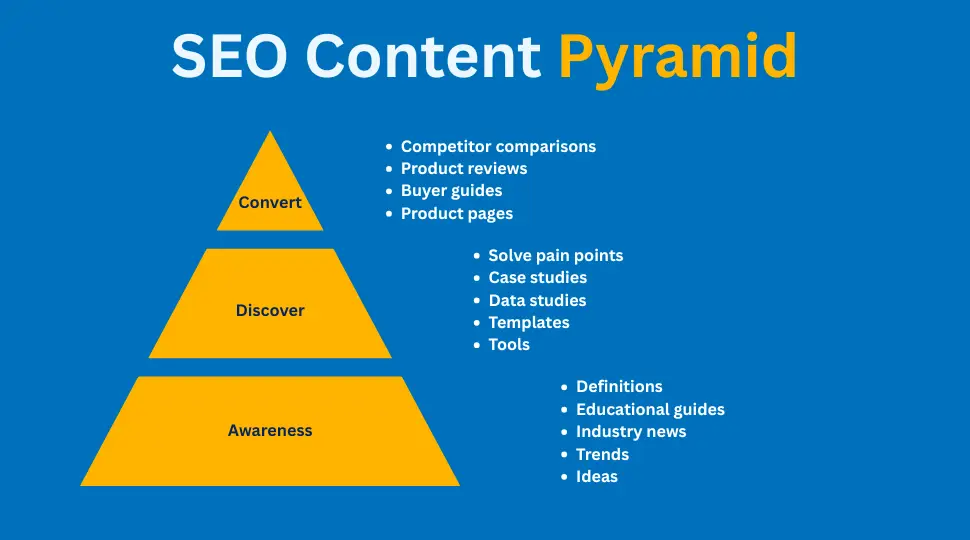
The pyramid has three layers:
- Convert Content: High-purpose, sales-orientated content.
- Discover Content: Problem-solving and solution-based content.
- Awareness Content: Educative and informative content.
Such a structure will make sure that your SEO strategy contributes to the increase of traffic and the revenues.
Why Traditional Content Strategies Fail
Most businesses begin their search engine optimisation process by producing top-of-funnel content.
Typical examples include the following:
- What is email marketing
- Benefits of newsletters
- Introduction to SEO
- Digital marketing basics
These are good subjects that produce traffic and poor conversions.
The Problem:
Companies often publish the following:
- 50-60 informational blog posts
- Optimizing on high-volume keywords
- With low purchase intent
The Result:
- Traffic increases
- Revenue remains stagnant
The SEO Content Pyramid is the solution to this issue as it helps to match the two content and customer intent.
The Three Layers of the SEO Content Pyramid
The pyramid works from top to bottom based on business impact.
| Pyramid Level | Content Goal | User Intent |
|---|---|---|
| Convert | Drive sales | Ready to buy |
| Discover | Evaluate solutions | Exploring options |
| Awareness | Learn concepts | Early research |
The key rule: Start with Convert content → then Discover → then Awareness.
Convert Content (Top of the Pyramid)
This is the highest-value layer of content, as this layer is aimed at users who are already near to making a purchasing decision.
These users are actively searching on:
- Product comparisons
- Product reviews
- Buying guides
- Pricing details
Types of Convert Content:
Competitor Comparisons
Competitor comparison search users are normally facing a choice between two products.
Examples:
- Beehiiv vs Kit
- HubSpot vs Mailchimp
- Shopify vs WooCommerce
Such posts appeal to high intent buyer.
Why it works: The users are already considering the use of tools and only require final assurance prior to buying.
Product Reviews
The content of product review is geared towards:
- Your own product
- Competitor products
Examples:
- Beehiiv reviews
- Kit review
- Mailchimp review
Include:
- Features
- Pros and Cons
- Pricing
- User feedback
This assists users in decision making.
Buyer Guides
One of the strongest SEO tools is buyer guides.
Examples include:
- Best newsletter websites in 2026
- Best SEO tools for beginners
- Best online promotion products
Buyer guides are also good since they assist a user to compare several solutions simultaneously.
Product Pages
Conversion-oriented SEO requires the use of optimized product pages.
Examples:
- Email newsletter software
- Email automation platform
- Pricing of newsletter platform
These pages should include:
- Features
- Use cases
- Pricing plans
- Testimonials
- Product screenshots
Discover Content (Middle of the Pyramid)
This layer targets those users who are aware that they have a problem but are still in the process of searching for solutions. They are also researching strategies and tools prior to purchasing.
Solve Pain Points
These articles focus on particular problems of users.
Examples:
- How to start a newsletter
- Newsletter best practices
- The way to increase email subscribers
This kind of content generates trust and authority.
Case Studies
There are success stories given in case studies.
Examples:
- The way a brand was able to reach 100k subscribers
- Email marketing case studies
- The scaling of startups with newsletters
Case studies provide:
- Credibility
- Social proof
- Actionable insights
Data Studies
Semantic content that is based on data is very shareable and authoritative.
Examples include:
- Email open rate benchmarks 2026
- Email marketing statistics
- Newsletter growth trends
The use of statistics and graphs enhances EEAT signals and the number of backlinks.
Templates and Tools
The templates and tools are useful.
Examples:
- Newsletter templates
- Subject line email generator
- Email campaign templates
The fact that users can save time and enhance productivity in downloadable resources makes them love them.
Awareness Content (Bottom of the Pyramid)
This information will appeal to customers at the learning phase of the buyer journey. These subjects achieve high volumes of traffic, but most often, they are less likely to be purchased.
Definitions
Definition posts are those that address straightforward questions.
Examples:
- What is open rate
- Email deliverability explained
- What is a marketing funnel
Such posts contribute to the creation of top-of-funnel traffic.
Educational Guides
Educational directions entail learning step-by-step.
Examples include:
- How to increase email open rate
- How to write engaging emails
- Email marketing strategies
Such articles create brand authority.
Industry Trends and News
Trend articles make your audience informed.
Examples:
- Email marketing trends 2026
- Gmail management of subscriptions
- Future of newsletters
The trend based content assists to take advantage of search demand in time.
Content Ideas
Idea posts can be convenient to marketers and creators.
Examples:
- Newsletter content ideas
- Holiday email campaign notions
- Content marketing ideas
Such subjects are very searchable and appeal to creators and marketers.
How to Implement the SEO Content Pyramid Strategy
Do this in a step-by-step manner.
Step 1: Selecting and identifying high intent keywords.
Focus first on:
- Product comparisons
- Alternatives
- Reviews
- Best tools
Use tools like:
- Ahrefs
- SEMrush
- Google Keyword Planner
Step 2: Publication Convert Content First.
Begin with content that makes direct conversions:
- Comparison posts
- Review articles
- Buying guides
This makes sure that your SEO plan is a revenue earner.
Step 3: Build Discover Content
When conversion-oriented material has been discussed, begin publishing:
- Tutorials
- Case studies
- Templates
- Industry statistics
This increases your funnel middle reach.
Step 4: Spread To Awareness Content.
Lastly, target with your SEO:
- Educational topics
- Beginner guides
- Definitions
Such articles contribute to the growth of organic traffic in the long-term.
Real Example of the SEO Pyramid in Action
Suppose you are introducing a newsletter software product. Your content strategy would be as follows:
Convert Content
- Best newsletter platforms
- Beehiiv vs Mailchimp
- Beehiiv review
Discover Content
- How to start a newsletter
- Email marketing case studies
- Newsletter templates
Awareness Content
- What is email open rate
- Email marketing basics
- Newsletter content ideas
This is an organized process that all the content is strategic.
Key Benefits of Using the SEO Content Pyramid
The application of this framework has the following benefits:
- Higher Conversions: High-intent information appeals to those who are willing to purchase.
- Faster ROI from SEO: You do not have to wait months to get leads, but rather you begin generating them.
- Enhanced Prioritization of Content: Teams concentrate on the influential issues in the first place.
- Stronger SEO Strategy: The pyramid also aligns SEO with business objectives and revenue increase.
Common Mistakes to Avoid
- Beginning the Only with Awareness Content: Production of informational blogs is done first by many companies, postponing revenue impact.
- Neglect of Product Comparisons: The buying intention of comparison keywords is frequently high.
- Publishing Random Topics: The content ought to have a systematic approach and not just a random selection of keywords.
Conclusion
The SEO Content Pyramid is a potent model that can match SEO activities to actual business performance. This strategy is user-intent conversion-based, as opposed to being traffic-based.
Businesses can create a balanced content ecosystem through conversion of content, followed by discovery and awareness, which would contribute traffic and revenue.
And whether you are looking at a digital marketing course in Thane or are comparing digital marketing classes in Pune, you can find an affordable digital marketing course in PCMC that will enable you to develop a solid foundation without stretching your financial means.
"Content is king, but marketing is queen and runs the household."
— Gary Vaynerchuk
FAQs
1. What is SEO Content Pyramid?
The SEO Content Pyramid is a content strategy that assigns more emphasis on the content development according to the buyer intent, beginning with content that is dedicated towards conversion.
2. What is the reason why businesses should begin with conversion content?
Target conversion content focuses on those users who are ready to buy, and it is more likely to raise leads and income.
3. What is the number of articles in each layer?
An effective plan may involve:
- 20% convert content
- 40% discover content
- 40% awareness content
4. Is content in awareness still relevant?
Yes. Awareness content is useful in creating high levels of traffic and creating brand authority in the long run.