




How to Make Your Marketing Channels Work Together for Better Results
Introduction
In today's digital-first world, businesses often invest in multiple marketing channels such as SEO, social media, email marketing, paid advertising, content marketing, and video marketing. However, many organizations fail to connect these efforts, resulting in inconsistent messaging, fragmented customer experiences, and lower marketing ROI.
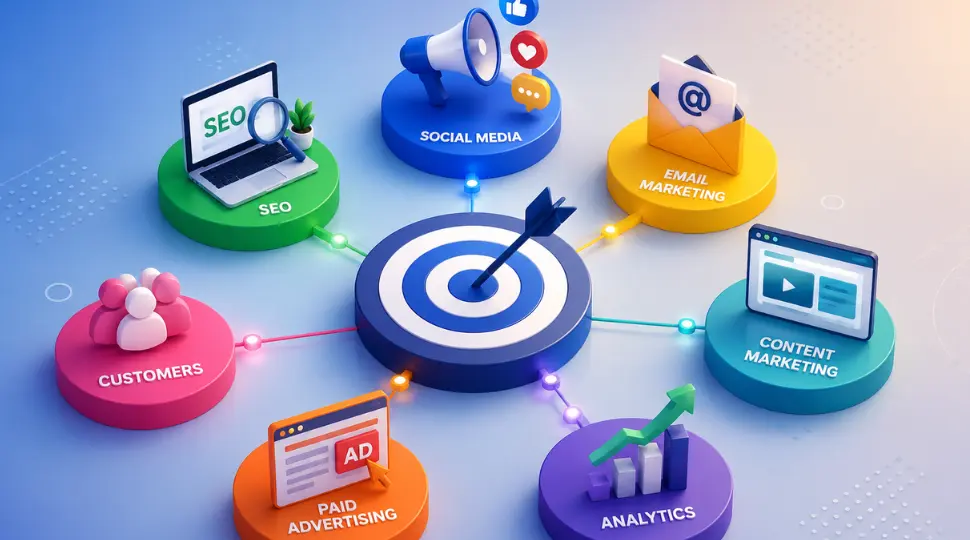
A strong Marketing Channels Strategy ensures that all your marketing efforts work together toward a common goal. When channels support one another, businesses can improve customer engagement, increase brand visibility, and drive more conversions.
To better understand the ideas discussed in this article, consider strengthening your skills with a practical digital marketing course in Pune designed for real-world application.
What Is a Marketing Channels Strategy?
A marketing channels strategy is a structured approach that coordinates multiple marketing platforms to deliver a consistent customer experience.
Instead of treating channels independently, businesses create a unified system where:
- SEO supports content marketing
- Content fuels social media campaigns
- Social media drives email subscriptions
- Email nurtures leads
- Paid advertising amplifies high-performing content
The goal is to guide prospects smoothly through every stage of the customer journey.
Marketing Channels Commonly Used by Businesses
- Search Engine Optimization (SEO)
- Social Media Marketing
- Content Marketing
- Email Marketing
- Pay-Per-Click Advertising (PPC)
- Influencer Marketing
- Video Marketing
- Affiliate Marketing
- SMS Marketing
- Website and Landing Pages
Why Marketing Channel Alignment Matters
Customers rarely convert after a single interaction. Research consistently shows that buyers engage with multiple touchpoints before making a purchase decision.
For example:
- A customer sees your Instagram Reel.
- They visit your website.
- They read a blog article.
- They subscribe to your newsletter.
- They receive promotional emails.
- They finally make a purchase.
If each channel communicates a different message, customers become confused. Consistent messaging builds trust and accelerates decision-making.
Benefits of Integrated Marketing
Improved Brand Consistency
When all channels communicate the same value proposition, customers recognize and remember your brand more easily.
Better Customer Experience
Customers receive a seamless experience regardless of where they interact with your business.
Higher Conversion Rates
Aligned campaigns reduce friction and help customers move smoothly through the sales funnel.
Increased Marketing ROI
Integrated campaigns allow businesses to maximize the value of every piece of content and advertising spend.
Understanding the Modern Customer Journey
Today's customer journey is no longer linear.
Traditional Journey
Awareness → Consideration → Purchase
Modern Journey
Awareness → Research → Comparison → Social Validation → Purchase → Retention → Advocacy
Customers switch between devices and platforms multiple times before making decisions.
This is why integrated marketing has become essential.
Example: A software company publishes SEO blog articles, YouTube tutorials, LinkedIn posts, email newsletters, and retargeting ads. Each channel reinforces the same message, making it easier for prospects to trust the brand.
Five Ways to Make Marketing Channels Work Together
1. Create Unified Campaign Goals
One of the biggest mistakes marketers make is assigning different objectives to every channel without connecting them.
Instead, define one primary business goal.
Example Goal: Generate 500 qualified leads in 60 days.
Then assign channel-specific responsibilities:
| Channel | Purpose |
|---|---|
| SEO | Drive organic traffic |
| Blog Content | Educate prospects |
| Social Media | Increase engagement |
| Email Marketing | Nurture leads |
| PPC Ads | Accelerate conversions |
Every channel contributes to the same objective.
2. Maintain Consistent Brand Messaging Across Every Channel
Your audience should immediately recognize your brand, whether they discover you through Google Search, Instagram, LinkedIn, YouTube, email, or a paid advertisement. Consistency builds familiarity, and familiarity builds trust.
Every marketing channel should communicate the same:
- Brand voice
- Core message
- Visual identity
- Value proposition
- Call-to-action (CTA)
For example, if your campaign focuses on "Growing Your Business with AI Marketing," your website, blogs, emails, advertisements, and social media posts should reinforce that message instead of promoting unrelated topics.
Best Practices
- Create a brand style guide.
- Use consistent colors, fonts, and logo placement.
- Maintain the same tone of voice across all platforms.
- Keep campaign messaging aligned.
- Update landing pages to match ad creatives.
Example: Imagine an online fitness brand launching a "30-Day Transformation Challenge." Every channel supports the campaign: Instagram publishes workout reels, YouTube shares full exercise tutorials, blogs explain nutrition strategies, email sends daily motivation, Facebook Ads promote sign-ups, and landing pages feature the same visuals and messaging. Customers experience one unified campaign rather than disconnected marketing efforts.
3. Use Customer Data to Connect Every Marketing Channel
The most successful marketing strategies are powered by data—not assumptions.
Every interaction a customer has with your business provides valuable insights. Integrating analytics across channels helps marketers understand customer behavior and deliver more personalized experiences.
Valuable Data Sources
- Website analytics
- CRM software
- Email marketing platforms
- Social media insights
- Google Analytics 4
- Advertising dashboards
- Customer surveys
When data is shared across platforms, marketers can create highly relevant campaigns.
Example: A visitor reads your SEO blog but doesn't make a purchase. Instead of losing that lead, you can add them to a remarketing audience, display relevant Google Display Ads, send helpful educational emails, recommend similar blog articles, and offer a free downloadable guide. Each interaction moves the customer closer to conversion.
Benefits of Data Integration
- Better audience segmentation
- Personalized communication
- Improved customer retention
- Higher conversion rates
- More accurate campaign reporting
4. Repurpose Content Across Multiple Marketing Channels
Creating high-quality content requires significant time and effort. Instead of producing entirely new content for every platform, maximize your return by repurposing your best-performing assets.
One comprehensive blog can be transformed into multiple content formats, allowing you to reach audiences wherever they prefer to consume information.
Example Content Repurposing Workflow
A 2,000-word blog article can become:
- 10 Instagram carousel posts
- 5 LinkedIn posts
- 8 X (Twitter) posts
- 3 YouTube Shorts
- 2 Instagram Reels
- 1 podcast episode
- 1 downloadable checklist
- 1 email newsletter
- 1 infographic
- 1 webinar presentation
This approach extends the lifespan of your content while maintaining consistent messaging.
Benefits
- Saves production time
- Improves SEO performance
- Increases content reach
- Strengthens brand recall
- Supports multiple stages of the buyer journey
Example: A software company publishes a blog titled "AI Tools Every Small Business Should Use." It can also create short video demonstrations, customer case studies, LinkedIn thought leadership posts, email tips series, infographics summarizing key tools, and webinar sessions. One idea fuels an entire multi-channel campaign.
5. Measure Performance Across All Marketing Channels
An integrated marketing strategy isn't complete without measurement.
Tracking each channel independently provides limited insights. Instead, evaluate how channels contribute collectively to business goals.
Important KPIs
Awareness
- Website traffic
- Organic impressions
- Social reach
- Brand searches
Engagement
- Time on page
- Bounce rate
- Comments
- Shares
- Video watch time
Lead Generation
- Form submissions
- Newsletter subscriptions
- Ebook downloads
- Webinar registrations
Sales
- Conversion rate
- Revenue
- Cost per acquisition (CPA)
- Return on Ad Spend (ROAS)
- Customer Lifetime Value (CLV)
Attribution Matters
A customer may:
- Discover your brand through SEO.
- Return via social media.
- Click an email.
- Convert after seeing a Google Ad.
Without proper attribution, marketers often credit only the final interaction, overlooking the contribution of earlier touchpoints.
Tools for Performance Measurement
- Google Analytics 4
- Google Search Console
- Google Ads
- Meta Ads Manager
- HubSpot
- Salesforce
- Microsoft Clarity
- Looker Studio
- SEMrush
- Ahrefs
Common Challenges and Solutions
While integrating marketing channels offers significant benefits, businesses often face common challenges during implementation.
Challenge: Siloed Teams
When SEO, social media, email, and paid advertising teams work independently, messaging becomes fragmented.
Solution: Establish cross-functional meetings, shared campaign calendars, and unified reporting dashboards to keep all teams aligned.
Challenge: Inconsistent Data
Different platforms measure success differently, making it difficult to compare performance.
Solution: Define standard KPIs across all channels and use a centralized analytics tool like Google Analytics 4 or Looker Studio for unified reporting.
Challenge: Resource Constraints
Small businesses may lack the budget or personnel to manage multiple channels effectively.
Solution: Start with 2–3 core channels that reach your target audience, then expand gradually as resources allow. Focus on quality over quantity.
Challenge: Content Overload
Creating unique content for every channel can quickly become overwhelming.
Solution: Implement a content repurposing strategy. One high-quality piece of content can fuel multiple channels with minimal additional effort.
Tools That Help Integrate Marketing Channels
Several tools can help streamline the process of integrating marketing channels:
Google Analytics 4
Tracks user behavior across websites and apps, providing unified insights into how different channels contribute to conversions.
HubSpot
Combines CRM, email marketing, social media management, and analytics in one platform for seamless channel integration.
SEMrush
Offers SEO, content marketing, social media, and advertising tools with competitive analysis features.
Mailchimp
Email marketing platform with automation, landing pages, and social media posting capabilities.
Zapier
Connects different marketing tools and automates workflows between platforms without coding.
Measuring Success Across Channels
Effective measurement requires looking beyond individual channel metrics to understand how they work together.
Multi-Touch Attribution
Use attribution models that credit multiple touchpoints in the customer journey, not just the final click.
Customer Lifetime Value (CLV)
Track how integrated marketing efforts impact long-term customer value rather than just immediate conversions.
Cross-Channel Conversion Paths
Analyze the sequences of interactions that lead to conversions to identify which channel combinations are most effective.
Real-World Example
Case Study: Integrated Campaign Success
A B2B SaaS company wanted to increase demo requests for their project management software. Instead of running isolated campaigns, they implemented an integrated strategy:
- SEO: Published in-depth guides targeting keywords like "best project management software for remote teams."
- Content: Created comparison articles, case studies, and video tutorials.
- Social Media: Shared snippets and infographics on LinkedIn and Twitter.
- Email: Sent targeted nurture sequences to blog subscribers.
- PPC: Ran Google Ads and LinkedIn Ads promoting high-converting content.
- Retargeting: Displayed ads to website visitors who didn't convert initially.
Results: Demo requests increased by 180% over six months, cost per acquisition decreased by 35%, and brand search volume grew by 65%.
Best Practices for Long-Term Success
- Define clear, measurable goals before launching any campaign.
- Create detailed buyer personas to guide channel selection.
- Develop a content calendar that coordinates across all channels.
- Regularly review analytics and adjust strategies based on data.
- Test different channel combinations to find what works best.
- Maintain brand consistency across all touchpoints.
- Invest in marketing automation to scale personalized communication.
- Train teams on cross-channel collaboration and shared objectives.
- Stay updated on platform changes and new marketing technologies.
- Focus on customer experience rather than channel-specific metrics alone.
Expert Insight (EEAT)
Successful businesses rarely rely on a single marketing channel. Instead, they create integrated systems where every platform supports the next stage of the customer journey.
For example, many SaaS companies attract users with educational SEO content, nurture them through email automation, build trust with webinars and customer testimonials, and finally convert them using personalized sales outreach. This coordinated approach often delivers stronger long-term results than isolated campaigns.
Additionally, organizations that regularly review analytics, test messaging, and refine campaigns based on user behavior are more likely to improve marketing efficiency and customer satisfaction over time.
Frequently Asked Questions
1. What is a marketing channels strategy?
A marketing channels strategy is a structured approach to using multiple marketing platforms—such as SEO, social media, email marketing, paid advertising, and content marketing—to deliver a consistent customer experience and achieve common business goals.
2. Why is integrating marketing channels important?
Integrating marketing channels helps businesses create a seamless customer journey, improve brand consistency, increase engagement, and maximize return on marketing investment (ROI). It also ensures that each channel supports the others rather than operating in isolation.
3. What are the most effective digital marketing channels?
Some of the most effective marketing channels include Search Engine Optimization (SEO), Content Marketing, Social Media Marketing, Email Marketing, Google Ads (PPC), Video Marketing, Influencer Marketing, and Affiliate Marketing. The best mix depends on your audience, industry, and business objectives.
4. How can small businesses benefit from a multi-channel marketing strategy?
Small businesses can reach a wider audience, build stronger customer relationships, increase brand awareness, and improve lead generation by combining multiple marketing channels into one cohesive strategy.
5. Which tools help manage multiple marketing channels?
Popular tools include Google Analytics 4, Google Search Console, HubSpot, SEMrush, Ahrefs, Meta Ads Manager, Mailchimp, Looker Studio, Microsoft Clarity, and Salesforce. These platforms help track performance, automate marketing tasks, and measure campaign success.
6. How do I measure the success of my marketing channels?
Track key performance indicators (KPIs) such as website traffic, organic rankings, click-through rate (CTR), conversion rate, customer acquisition cost (CAC), Return on Ad Spend (ROAS), Customer Lifetime Value (CLV), email open and click rates, and social media engagement. Review these metrics regularly to optimize your marketing strategy.
Conclusion
Building a successful Marketing Channels Strategy is no longer optional—it's essential for businesses that want to stay competitive in today's digital landscape. Instead of treating SEO, social media, email marketing, content marketing, and paid advertising as separate activities, bring them together under one unified strategy. When every channel shares the same message, supports the customer journey, and is measured against common goals, your marketing becomes more effective, scalable, and profitable.
Start by defining clear objectives, maintaining consistent branding, leveraging customer data, repurposing valuable content, and continuously measuring performance. Small improvements across connected channels often lead to significant increases in traffic, leads, customer engagement, and conversions over time.
Whether you're a business owner, marketing professional, or aspiring digital marketer, understanding how different channels work together is a valuable skill. Whether you're comparing different digital marketing classes in Pune or looking for an affordable digital marketing course in PCMC, choosing practical, industry-focused training can help you build strong fundamentals and confidently implement integrated marketing strategies in real-world scenarios.
"Marketing is no longer about the stuff that you make, but about the stories you tell." — Seth Godin, Author and Marketing Expert
EEAT: Experience, Expertise, Authoritativeness & Trustworthiness
This guide is based on established marketing principles, integrated marketing strategies, and modern digital branding practices used by successful businesses worldwide. The recommendations focus on practical implementation rather than theory, helping brands improve marketing efficiency, engagement, and customer trust through consistent communication across channels.
To ensure continued success, businesses should regularly test messaging, analyze audience feedback, and refine their communication based on measurable performance indicators.