




Markdown for AI SEO: What Google Really Says About AI Search Optimization
Introduction
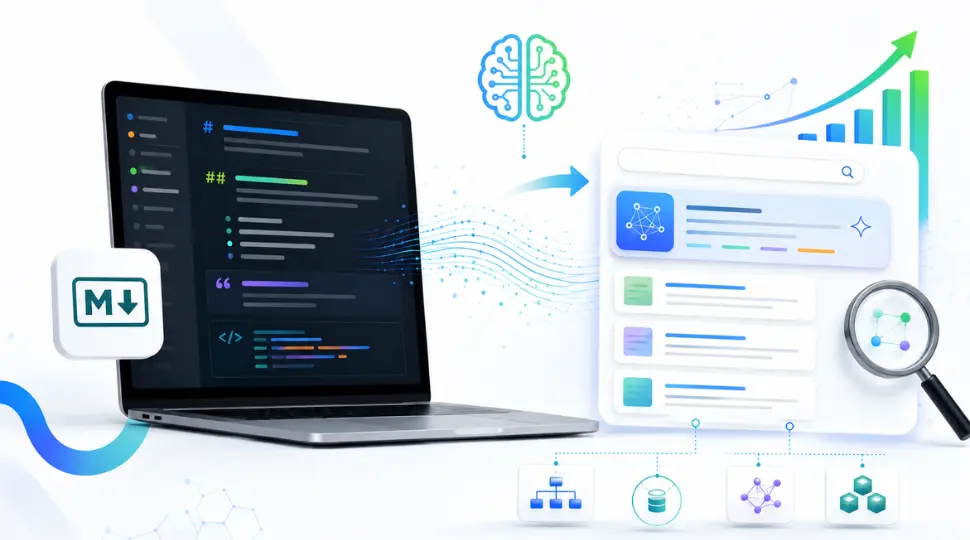
Markdown for AI SEO has become a trending topic among marketers, bloggers, website owners, and SEO professionals. Many people are asking whether they should create Markdown versions of their web pages to help AI tools, AI Overviews, and search engines understand their content better.
The short answer is: Markdown can be useful for writing and content workflows, but Google does not recommend creating separate Markdown pages just for AI SEO. Google's official guidance says website owners do not need special AI text files, extra AI markup, or Markdown to appear in Google Search and its generative AI features.
To better understand the ideas discussed in Markdown for AI SEO, consider strengthening your skills with a practical digital marketing course in Pune designed for real-world application.
In this blog, we will explain what Google actually says about Markdown, HTML, AI Overviews, AI Mode, structured data, and SEO best practices. You will also learn what to do instead of chasing AI SEO shortcuts.
What Is Markdown for AI SEO?
Markdown is a lightweight writing format that uses simple symbols to structure text. For example, a single # is used for a main heading, ## is used for a subheading, and bullet points can be created with dashes.
Many writers, developers, and documentation teams use Markdown because it is clean, portable, and easy to convert into HTML. It is popular for GitHub files, documentation pages, technical blogs, and content drafts.
Markdown for AI SEO refers to the idea of creating Markdown versions of website content so AI systems can read it more easily. Some marketers believe that plain, stripped-down content may be easier for AI crawlers and large language models to process.
However, this idea has created confusion. SEO is not only about giving machines plain text. It is also about helping users, search engines, browsers, and assistive technologies understand the full context of a page.
Why Markdown Became Popular in AI SEO
AI tools are changing how people search online. Google AI Overviews, AI Mode, ChatGPT, Perplexity, Gemini, and other AI search experiences often summarize information instead of showing only traditional blue links.
Because of this shift, some website owners started looking for new optimization tactics. One such tactic is creating Markdown or .md versions of important pages.
The logic sounds simple:
- Markdown is cleaner than HTML.
- AI systems process text.
- Plain text may be easier to understand.
- Therefore, Markdown pages may help AI visibility.
But SEO is rarely that simple. Google's AI systems are built on its existing Search index, ranking systems, and quality systems. Google says generative AI features in Search are rooted in its core Search ranking and quality systems, and foundational SEO still applies.
This means AI SEO is not a separate game where Markdown automatically gives you an advantage. The basics still matter: helpful content, crawlability, page experience, internal links, structured data where useful, and trust signals.
What Google Says About Markdown for AI SEO
Google's official guidance is clear: you do not need to create new machine-readable files, AI text files, special markup, or Markdown to appear in Google Search, including generative AI features. Google also says such files neither help nor harm visibility in Google Search because Google Search ignores them for ranking purposes.
This is an important clarification for business owners and SEOs. It means you should not treat Markdown as a ranking shortcut.
Search Engine Roundtable also reported that Google's John Mueller and Martin Splitt discussed Markdown vs HTML and indicated that HTML remains the standard for SEO and content discovery. The report summarized that Markdown files do not provide an SEO benefit.
Search Engine Journal covered a similar discussion, noting that Google pushed back against the idea that stripped-down content-only versions are better for AI search. The concern is that removing layout, links, navigation, media, and structured context can remove useful signals.
So, the key takeaway is simple: use Markdown if it helps your writing workflow, but publish strong, crawlable, user-friendly HTML pages for SEO.
HTML vs Markdown SEO: What Really Matters?
HTML is the standard language of the web. Browsers use HTML to render pages, screen readers use HTML structure to support accessibility, and search engines have decades of experience crawling and understanding HTML.
Markdown, on the other hand, is often a writing format. In many workflows, Markdown is eventually converted into HTML before being published on a website.
For SEO, the final published page matters more than the format used while drafting. A blog can be written in Markdown, Google Docs, WordPress, Notion, or a CMS editor. But when users and search engines access it, the page should be properly rendered, crawlable, and useful.
A strong HTML page can include:
- Clear H1, H2, and H3 headings
- Internal links
- Breadcrumbs
- Image ALT text
- Author information
- Product details
- Reviews or testimonials
- Schema markup
- Tables and FAQs
- Navigation and related resources
- Mobile-friendly layout
A stripped Markdown file may not carry all these signals in the same useful way. That is why replacing a complete HTML page with a plain Markdown version can reduce context instead of improving it.
| Factor | Markdown | HTML |
|---|---|---|
| Best for | Drafting and documentation | Published web pages |
| SEO value | No special ranking benefit | Standard for crawling and indexing |
| Context | Limited | Rich with links, media, schema, layout |
| Best use | Writing workflow | Website publishing |
Does Markdown Help with AI Overviews?
Google says there are no additional technical requirements to appear as a supporting link in AI Overviews or AI Mode. A page must be indexed and eligible to appear in Google Search with a snippet.
This means AI Overview visibility is not achieved by simply creating a Markdown file. Your page first needs to be discoverable, indexable, relevant, helpful, and aligned with Google Search quality expectations.
Google also explains that AI Overviews and AI Mode can use query fan-out, where multiple related searches are generated to answer a user's complex query.
For content creators, this means your page should answer related subtopics naturally. Instead of making separate thin pages for every long-tail variation, create one strong resource that covers the topic deeply and clearly.
For example, if your blog is about "Markdown for AI SEO," it should also answer:
- Does Google use Markdown for AI search?
- Is HTML better than Markdown for SEO?
- Do AI Overviews require special markup?
- Should I create llms.txt?
- What should I do for generative AI search optimization?
This approach helps users and search systems understand the page without keyword stuffing.
The Problem with Separate Markdown Pages
Creating a separate Markdown version of every important page can create technical and content problems.
First, it doubles your maintenance work. If your HTML page is updated but your Markdown page is forgotten, users and crawlers may discover outdated or inconsistent content.
Second, it can create duplicate content confusion. If the Markdown file repeats the same content as the HTML page, it may not add any user value.
Third, it may remove important context. A full web page often includes navigation, author details, images, FAQs, reviews, related links, product information, and trust signals. These elements help users make decisions and help search engines understand the page.
Fourth, hidden AI-only pages may go unnoticed when broken. If real users do not visit those pages, errors may remain undetected for a long time.
This is why the better strategy is to improve your main website pages instead of creating separate "AI-only" versions.
What Google Recommends Instead
Google recommends focusing on helpful, reliable, people-first content. Its guidance says content should be unique, non-commodity, useful, and satisfying for readers.
Google also recommends organizing content in a way that helps readers. Clear paragraphs, sections, headings, images, and videos can improve the experience for users and may also support visibility in AI search features.
Instead of asking, "How can I create Markdown for AI?" ask:
- Is my content genuinely helpful?
- Does it answer the user's real question?
- Does it include expert insights or first-hand experience?
- Is the page easy to read on mobile?
- Can Google crawl and index it?
- Does it have clear headings and internal links?
- Does it include images, examples, screenshots, or data?
- Is the author or business trustworthy?
This is where real AI SEO begins.
How to Optimize Content for AI Search
AI search optimization is not about tricks. It is about making your content easier to understand, more useful, and more trustworthy.
1. Answer the Main Question Early
Start your blog with a clear answer. Users and AI systems both benefit when the page quickly explains the main point.
Example: For this topic, the answer is: Google does not require Markdown for AI SEO. HTML pages with strong content and technical SEO are still the standard.
2. Use Clear Headings
Use headings that match user intent. For example:
- What Is Markdown for AI SEO?
- Does Google Recommend Markdown?
- HTML vs Markdown: Which Is Better?
- How to Optimize for AI Overviews?
This makes the content easier to scan and helps search systems understand the structure.
3. Add Real Examples
Generic content is easy to ignore. Add practical examples from real SEO workflows.
For example, a digital marketing agency may write blogs in Markdown internally, but publish them as optimized WordPress HTML pages with schema, images, internal links, and conversion-focused sections.
4. Use Tables and Comparisons
Tables are useful for mobile readers when kept simple. They help users compare ideas quickly.
| Factor | Markdown | HTML |
|---|---|---|
| Best for | Drafting and documentation | Published web pages |
| SEO value | No special ranking benefit | Standard for crawling and indexing |
| Context | Limited | Rich with links, media, schema, layout |
| Best use | Writing workflow | Website publishing |
5. Add Original Insights
Google encourages unique viewpoints and first-hand experience.
For AI SEO, this means your blog should not only summarize what others have said. Add your own observations, screenshots, experiments, client examples, or checklists.
Role of Structured Data in AI SEO
Structured data is not required for generative AI search, and Google says there is no special schema.org markup needed for AI features. However, structured data is still useful as part of your overall SEO strategy because it can help pages become eligible for rich results.
Google explains that structured data gives explicit clues about the meaning of a page and can help Google understand page content. It also shares case studies where structured data improved search performance, including higher CTR and increased visits for some websites.
For this blog topic, useful schema types may include:
- Article schema
- FAQ schema
- Breadcrumb schema
- Organization schema
- Author schema
Do not add structured data that does not match visible content. The markup should support the page, not manipulate search engines.
Practical Example for Website Owners
Imagine you run a digital marketing training website. You publish a blog titled "Markdown for AI SEO: What Google Says."
A weak approach would be:
Weak Approach
- Create a plain .md version only for AI crawlers.
- Repeat the same content across HTML and Markdown.
- Ignore images, examples, author bio, and internal links.
- Add keywords unnaturally.
A stronger approach would be:
Strong Approach
- Publish one complete HTML blog.
- Include a clear title and meta description.
- Add a table of contents.
- Use H2 and H3 headings.
- Explain Google's official position.
- Add comparison tables.
- Include screenshots from Google Search Central.
- Add FAQ schema.
- Link to related SEO learning resources.
- Mention the author's experience.
- Keep the page mobile-friendly.
The second approach is better because it serves real users first. It also aligns with Google's broader advice for AI search.
EEAT Strategy for AI SEO
EEAT stands for Experience, Expertise, Authoritativeness, and Trustworthiness. For AI SEO topics, EEAT is extremely important because many people publish speculative advice without testing or verifying it.
Experience
Add real experience from SEO projects. For example, mention how your team creates content drafts, publishes blogs, tracks rankings, and measures Search Console performance.
Expertise
Explain technical concepts in simple language. Show that you understand Markdown, HTML, indexing, structured data, and AI search behavior.
Authoritativeness
Cite trusted sources such as Google Search Central, Search Engine Journal, and Search Engine Roundtable. Avoid relying only on social media opinions.
Trustworthiness
Be honest about what is confirmed and what is not. For example, it is confirmed that Google does not require Markdown for AI Search. It is not confirmed that Markdown files provide any AI ranking advantage.
"Content is where I expect much of the real money will be made on the Internet." — Bill Gates
Key Insight
Even in the AI era, the winning strategy is not format manipulation. It is valuable content, clear structure, and user trust.
Common Mistakes to Avoid
Mistake 1: Creating Markdown Pages Only for AI Bots
Do not create AI-only content versions unless there is a real user or platform need. Google does not treat Markdown as a special AI SEO signal.
Mistake 2: Ignoring HTML Structure
Your published page should have clean headings, internal links, schema where useful, image ALT text, and mobile usability.
Mistake 3: Keyword Stuffing
Repeating "Markdown for AI SEO" unnaturally will not help. Use the keyword in important places like the title, introduction, headings, meta title, and conclusion, but keep the writing natural.
Mistake 4: Publishing Generic AI Content
Google encourages unique, non-commodity content. If your article only repeats common advice, it may not stand out.
Mistake 5: Forgetting Search Console
Track impressions, clicks, CTR, indexing, and query data in Google Search Console. Google says Search traffic from AI features is included in the Performance report under the Web search type.
Conclusion
Markdown for AI SEO is a useful discussion, but it should not distract from the fundamentals. Google does not require Markdown files, AI text files, or special markup to appear in AI Overviews, AI Mode, or regular Google Search.
The better strategy is to publish helpful, crawlable, well-structured HTML pages that answer real user questions. Use Markdown if it improves your writing workflow, but do not treat it as an AI ranking shortcut.
Focus on people-first content, strong technical SEO, clear page structure, internal links, useful visuals, author credibility, and trustworthy information. That is what gives your content a better chance in both traditional search and AI-powered search experiences.
Whether you're exploring a digital marketing course in Thane or comparing digital marketing classes in Hadapsar, choosing an affordable digital marketing course in PCMC can help you build strong fundamentals without overextending your budget.
EEAT: Experience, Expertise, Authoritativeness & Trustworthiness
This guide is based on established marketing principles, AI search optimization strategies, and modern digital branding practices used by successful businesses worldwide. The recommendations focus on practical implementation rather than theory, helping brands improve AI visibility, engagement, and customer trust through consistent communication.
To ensure continued success, businesses should regularly test messaging, analyze audience feedback, and refine their communication based on measurable performance indicators.
Frequently Asked Questions
1. What is Markdown for AI SEO?
Markdown for AI SEO is the idea of using Markdown-formatted content to make web pages easier for AI tools or AI search engines to read. However, Google does not recommend Markdown as a special SEO requirement for AI visibility.
2. Does Google prefer Markdown over HTML?
No. Google has not said that Markdown is preferred over HTML for SEO. Google's guidance says you do not need Markdown or special AI files to appear in Google Search or its generative AI features.
3. Should I create separate Markdown pages for AI crawlers?
In most cases, no. Creating separate Markdown pages can increase maintenance work, create duplicate content, and remove useful page context. It is better to improve your main HTML pages.
4. Can I write blogs in Markdown?
Yes. You can write drafts in Markdown if it helps your workflow. The important thing is that the final published page should be crawlable, user-friendly, and properly structured.
5. Does structured data help with AI SEO?
Structured data is not required for generative AI search, but it remains useful for traditional SEO and rich result eligibility. Use it when it accurately represents visible page content.
6. How can I optimize for Google AI Overviews?
Focus on helpful content, clear headings, strong topical coverage, crawlability, page experience, internal links, and trust signals. There are no special AI Overview-only technical requirements beyond being eligible for Google Search.
7. Is llms.txt important for Google SEO?
Google says you do not need special AI text files such as llms.txt for visibility in Google Search. Such files may be used by other systems, but they do not help or harm Google Search rankings.
8. What is the best format for SEO content?
The best format is a well-structured, mobile-friendly HTML page with helpful content, clear headings, optimized images, relevant internal links, and schema where useful.