




High CTR Doesn't Mean Your Ads Are Working: The Truth About PPC Performance in 2026
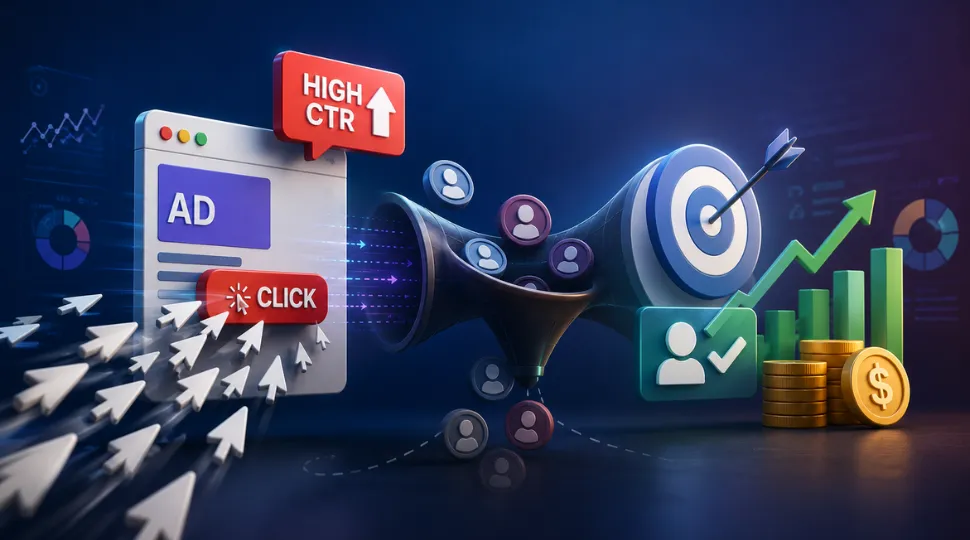
A high click-through rate may look impressive in your advertising dashboard, but it doesn't guarantee business success. In 2026, digital advertising has evolved far beyond simple engagement metrics. Modern PPC campaigns require a deeper understanding of conversion quality, return on ad spend, and customer lifetime value. This comprehensive guide explores why CTR alone is misleading, which metrics truly matter, and how to build high-performing PPC campaigns that drive real business outcomes.
What is Click-Through Rate (CTR)?
CTR measures the percentage of people who click on your advertisement after seeing it.
CTR Formula
CTR = (Clicks ÷ Impressions) × 100
For example:
- Impressions: 20,000
- Clicks: 1,200
- CTR = 6%
Generally, a higher CTR indicates that your advertisement is attracting attention. However, attracting attention is only one stage of the customer journey.
A click does not automatically translate into:
- Sales
- Leads
- App installs
- Purchases
- Revenue
- Customer retention
This is where many advertisers make costly assumptions.
Why CTR Became Such an Important Metric
Historically, CTR helped advertisers understand:
- Ad relevance
- Audience targeting
- Keyword quality
- Creative performance
- Search intent alignment
Platforms like Google Ads also use CTR as one factor when determining:
- Quality Score
- Ad Rank
- Cost Per Click (CPC)
Because of this, marketers naturally became obsessed with increasing CTR.
But optimization has evolved.
Modern advertising platforms now prioritize business outcomes instead of simple engagement.
CTR Is a Diagnostic Metric—Not a Success Metric
Think of CTR like a car's speedometer.
A high speed tells you how fast you're moving.
It doesn't tell you:
- Whether you're driving in the right direction
- Whether you'll reach your destination
- Whether you're wasting fuel
- Whether the engine is healthy
Similarly, CTR simply measures interest. It does not measure business success.
Why High CTR Doesn't Mean Your Ads Are Working
One of the biggest misconceptions in PPC advertising is assuming that more clicks automatically mean better campaign performance.
In reality, campaigns with exceptionally high CTR often produce:
- Lower conversion rates
- Higher bounce rates
- Poor lead quality
- Increased advertising costs
- Lower ROAS
- Negative profitability
Let's understand why.
1. Clicks Don't Equal Conversions
Imagine two campaigns.
| Metric | Campaign A | Campaign B |
|---|---|---|
| CTR | 11% | 4.2% |
| Conversion Rate | 0.9% | 11% |
| Cost Per Lead | ₹2,800 | ₹620 |
Which campaign performs better?
Despite having a much lower CTR, Campaign B generates significantly more valuable customers.
This illustrates why conversion-focused optimization outperforms click-focused optimization.
2. Curiosity Clicks Can Hurt Performance
Many advertisers write headlines designed solely to increase clicks.
Examples include:
- "You'll Never Believe This Marketing Trick!"
- "The Secret Google Doesn't Want You to Know"
- "This AI Tool Changes Everything"
These headlines generate curiosity.
But if the landing page doesn't deliver what users expect, visitors quickly leave.
This creates:
- High bounce rates
- Low engagement
- Low trust
- Poor conversion performance
3. Broad Targeting Increases Low-Quality Traffic
AI-powered advertising platforms can expand audience targeting automatically.
While this often increases CTR, it may also attract people who are:
- Not ready to buy
- Looking for free resources
- Outside your ideal customer profile
- Simply browsing
As a result:
More clicks... But fewer customers.
4. AI Optimizes for Clicks—Unless You Train It Differently
Modern advertising platforms use machine learning to maximize campaign objectives.
If your objective is Maximize Clicks, the AI will prioritize users most likely to click.
Not necessarily users most likely to purchase.
Instead, advertisers should optimize toward:
- Conversions
- Revenue
- Qualified leads
- Customer acquisition
- Profitability
Teaching AI the correct objective dramatically improves campaign quality.
5. Misaligned Landing Pages Reduce ROI
Even the best advertisement cannot compensate for a poor landing page.
A visitor expects consistency between:
- Ad message
- Offer
- Headline
- Landing page
- Call-to-action
If any of these elements feel disconnected, users abandon the page.
High CTR simply brings more visitors to an experience that fails to convert.
Using AI Without Losing Human Insight
Artificial Intelligence has transformed paid advertising from manual campaign management to intelligent, data-driven optimization. Platforms like Google Ads and Meta Ads can now automatically adjust bids, identify high-performing audiences, generate ad creatives, and predict user behavior in real time.
While these capabilities save time and improve efficiency, they also create a common misconception: AI can optimize everything on its own.
The reality is that AI is only as effective as the goals and data you provide.
AI Optimizes for the Objective You Choose
If you tell Google Ads to maximize clicks, its machine learning models will find users who are most likely to click.
If your goal is maximize conversions, the system will prioritize users who are more likely to complete a valuable action.
Likewise, if your objective is Target ROAS, AI will focus on users who are expected to generate higher revenue.
This highlights a critical lesson: AI doesn't decide your business goals—you do.
Best Practices for AI-Powered Campaigns
- Choose the right campaign objective from the beginning.
- Feed accurate conversion data into the platform.
- Regularly review search terms and audience insights.
- Exclude irrelevant traffic with negative keywords.
- Monitor performance instead of relying entirely on automation.
Common Mistakes Advertisers Still Make
Even with advanced automation, many advertisers continue to make avoidable mistakes that reduce campaign performance.
1. Focusing Only on CTR
A high CTR looks impressive in reports but doesn't guarantee revenue.
Instead of celebrating clicks, ask:
- Did those clicks convert?
- Did they generate qualified leads?
- Were they profitable?
2. Ignoring Landing Page Experience
Many businesses spend significant time creating compelling ads but direct visitors to slow, confusing, or outdated landing pages.
A strong landing page should include:
- A clear headline that matches the ad.
- Fast loading speed.
- Mobile responsiveness.
- Simple navigation.
- Trust signals such as reviews, certifications, or testimonials.
- A clear call-to-action (CTA).
Remember, your ad earns the click—but your landing page earns the conversion.
3. Not Tracking Conversions Properly
Without proper conversion tracking, AI lacks the data needed to optimize effectively.
Ensure you track actions such as:
- Purchases
- Form submissions
- Phone calls
- Newsletter sign-ups
- Demo requests
- Downloads
Reliable tracking enables smarter bidding and more accurate reporting.
4. Targeting Too Broad an Audience
Broad targeting often increases impressions and clicks but can attract users who have little interest in your offer.
Improve targeting by:
- Using audience segmentation.
- Refining keywords.
- Adding negative keywords.
- Creating separate campaigns for different customer personas.
- Leveraging first-party customer data where appropriate.
Quality traffic is more valuable than high traffic volume.
5. Stopping A/B Tests Too Early
Optimization requires patience.
Advertisers often end experiments after only a few days, before enough data has been collected.
When testing:
- Change only one variable at a time.
- Allow sufficient traffic to reach statistical significance.
- Measure business outcomes, not just CTR.
Consistent testing leads to incremental improvements that compound over time.
Best Practices for PPC Campaign Success in 2026
Modern advertising success depends on continuous optimization rather than one-time campaign setup.
1. Set Clear Business Goals
Before launching a campaign, define what success looks like.
Examples include:
- Increase online sales by 20%.
- Generate 100 qualified leads each month.
- Reduce Cost Per Acquisition by 15%.
- Improve Return on Ad Spend to 5X.
Clear goals help both marketers and AI optimize effectively.
2. Align Ads with User Intent
Every keyword reflects a different stage of the buying journey.
For example:
- Informational Intent: "What is PPC?", "How does Google Ads work?"
- Commercial Intent: "Best Google Ads agency", "PPC management services"
- Transactional Intent: "Buy digital marketing course", "Enroll in Google Ads training"
Creating ads that match user intent improves both conversion rates and user satisfaction.
3. Continuously Improve Landing Pages
Optimization should never stop after publishing a landing page.
Regularly test:
- Headlines
- CTA buttons
- Images
- Form length
- Testimonials
- Pricing layouts
- Mobile experience
Small improvements can significantly increase conversion rates over time.
4. Monitor Metrics Together
Rather than focusing on one KPI, analyze your campaigns using a combination of metrics:
- CTR
- Conversion Rate
- CPA
- ROAS
- Revenue
- Customer Lifetime Value
- Engagement Rate
- Lead Quality
- Quality Score
Looking at these metrics together provides a complete picture of campaign performance.
5. Invest in Continuous Learning
Digital advertising evolves rapidly.
Keeping up with new AI features, privacy regulations, bidding strategies, and consumer behavior is essential for long-term success.
Professionals who consistently learn and adapt are better equipped to build profitable campaigns.
The Future of PPC Advertising
Looking ahead, PPC advertising will become even more data-driven and privacy-conscious.
Key trends include:
- Greater reliance on first-party data.
- AI-generated ad creatives.
- Predictive audience targeting.
- Privacy-first measurement solutions.
- Cross-platform attribution.
- Voice and visual search advertising.
- Increased automation with human oversight.
The marketers who thrive will be those who balance AI capabilities with strategic thinking and a deep understanding of customer behavior.
"Half the money I spend on advertising is wasted; the trouble is I don't know which half." — John Wanamaker
Conclusion
A high CTR may indicate that your ads are attracting attention, but it doesn't guarantee real business success. To measure campaign performance effectively in 2026, focus on metrics like Conversion Rate, CPA, ROAS, and Customer Lifetime Value alongside CTR.
Whether you're exploring a digital marketing course in Thane or comparing digital marketing classes in Pune, choosing an affordable digital marketing course in PCMC can help you build the practical skills needed to create data-driven, high-performing ad campaigns.
Frequently Asked Questions
1. Is a high CTR always a good thing?
No. A high CTR indicates that your ad is attracting attention, but it doesn't necessarily mean users are converting or generating revenue.
2. Which metric is more important: CTR or Conversion Rate?
Both are important, but Conversion Rate is often a stronger indicator of campaign success because it measures meaningful business outcomes.
3. Can AI optimize campaigns without human involvement?
AI can automate many tasks, but human oversight is still essential for setting goals, interpreting results, refining messaging, and making strategic decisions.
4. What is considered a good ROAS?
The ideal ROAS depends on your industry and profit margins. Many businesses aim for at least 4:1, meaning ₹4 in revenue for every ₹1 spent on advertising.
5. How often should PPC campaigns be optimized?
Campaigns should be monitored regularly, with performance reviews conducted weekly or bi-weekly. Major optimizations should be based on sufficient data rather than daily fluctuations.
6. Why is landing page optimization important?
A well-designed landing page improves user experience, increases conversions, and maximizes the value of your advertising budget.
7. What is the biggest mistake advertisers make in 2026?
The most common mistake is optimizing campaigns for clicks instead of focusing on business objectives such as conversions, profitability, and customer lifetime value.