


Digital Marketing 2026 Roadmap for Beginners
Introduction
The absolute beginners can be overwhelmed when starting to do digital marketing in 2026. SEO, social media, Google Ads, Meta Ads, AI, automation--there is too much information and little understanding of what to start with.
You may have wondered, Digitally, it would be nice to start marketing, but you cannot even imagine that you cannot start having your say, at least not where to start. Most of beginners are not the ones who fail because they are not talented, but they are unable to follow a clear roadmap.
The user friendly handbook transforms the digital marketing 2026 into an easy-to-understand no-confusion roadmap that concentrates on skills, practice, and real-life application - which is precisely what the current market needs.
To understand how future-ready websites scale organic traffic, explore our Search Engine Optimization 2026: Programmatic SEO Guide , and see how it complements our practical digital marketing course in Thane for beginners and professionals alike.
What Is Digital Marketing in 2026?
Digital marketing is the act of advertising or promoting goods, services, or a personal brand through Internet sources and online platforms like search engines, social networks and email, and online advertisements.
By 2026, digital marketing will not consist of random posting and boosting the advertisements. It is an AI-assisted, data-driven, multi-channel approach that is aimed at:
- Understanding user intent
- Production of value-based content.
- Smart application of automation.
- Performance measurement by research and analysis.
Companies are now more demanding of marketers to remain strategic + implementational + AI tools.
Why Most Beginners Get Stuck (And How to Avoid It)
The vast majority of new users are exposed to unlimited content and do nothing when it comes to action.
The Common Beginner Trap:
- 100 YouTube videos
- 100 Instagram "gurus"
- Contradictory counselling all about.
The Result?
- Confusion
- Overthinking
- No real start
The Solution:
A digital marketing roadmap step-by-step that concentrates on:
- Clarity before complexity
- Skills before tools
- Practice before perfection
Lack of direction leads to lack of motivation. A roadmap makes the progress predictable.
Step 1: Build a Strong Digital Marketing Foundation
The Reason Why Foundation Matters in Digital Marketing.
Novices should learn how digital marketing works before they can dive into SEO, social media marketing or ads.
A weak foundation leads to:
- Wasted ad spend
- Poor content strategy
- No conversions
What You Must Learn First
Digital Marketing Basics
- What digital marketing is (and what it is not).
- Online business generation strategy.
Websites & Funnels
- The transformation of visitors into leads by websites.
- Variation in traffic, leads and conversion.
Mythical Core Concepts in a Nutshell.
- Traffic: Those who come to your webpage or profile.
- Leads: Interested users are those who provide contacts.
- Conversions: Target behavior (sales, sign-ups, downloads)
Good fundamentals facilitate complicated plans in the future.
Step 2: Learn One Digital Marketing Skill at a Time
The Biggest Beginner Mistake
Attempting to be informed of everything simultaneously.
Digital marketing includes:
- SEO
- Social media
- Google Ads
- Meta Ads
- Content creation
- Automation
The attempt to do everything simultaneously causes burnout.
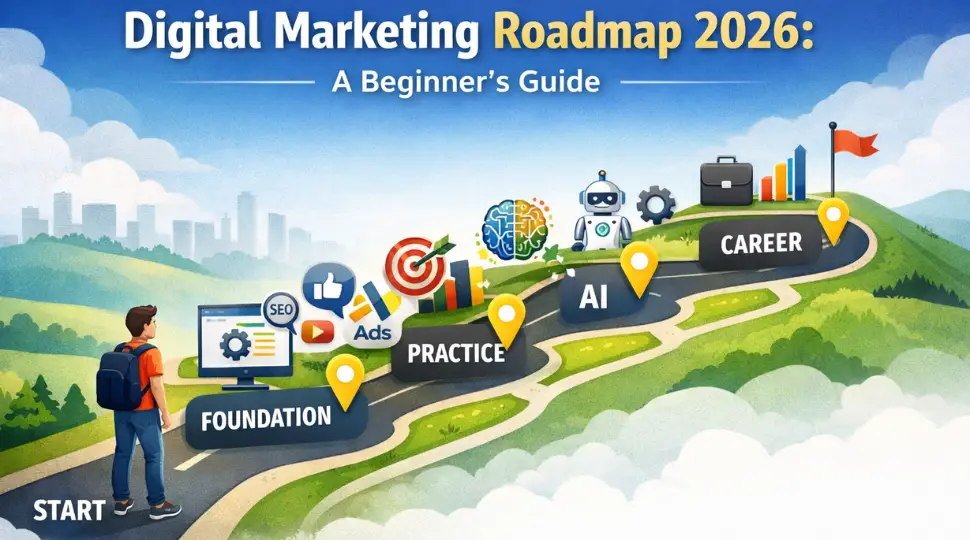
Digital Marketing Learning Roadmap for Beginners (2026)
| Phase | Focus Area | Key Skills | Outcome |
|---|---|---|---|
| Phase 1 | Foundation | Digital marketing basics, funnels, metrics | Concept clarity |
| Phase 2 | Organic Growth | SEO, social media marketing, content creation | Audience building |
| Phase 3 | Paid Ads | Google Ads, Meta Ads | Lead & sales generation |
| Phase 4 | Automation | Email, WhatsApp, CRM, automation tools | Scaling results |
| Phase 5 | AI Support | AI research, AI content, analysis | Speed & efficiency |
The Right Skill Learning Order (2026)
Phase 1: Organic Skills
Start with one:
- SEO (Search Engine Optimization)
- Social Media Marketing (Instagram, LinkedIn, YouTube).
This builds:
- Platform understanding
- Audience psychology
- Content consistency
Phase 2: Paid Advertising
Once basics are clear:
- Google Ads (Search & Display)
- Meta Ads (Facebook & Instagram)
Paid ads enhance existing organically working ads.
Phase 3: Automation & Retention
Finally learn:
- Email marketing
- WhatsApp automation
- CRM tools
Master one skill deeply. Trust comes as a natural consequence.
Step 3: Practice Is Greater Than Theory
Why Theory Alone Never Works
Digital marketing cannot be taught through watching videos.
True learning occurs when you:
- Run ads yourself
- Produce on a regular basis.
- Analyze real data
Theory vs Practical Learning Comparison
| Theory-Based Learning | Practical Learning |
|---|---|
| Watching videos | Running real campaigns |
| Reading blogs | Writing SEO content |
| Memorizing terms | Analyzing GA4 data |
| Passive knowledge | Real-world confidence |
The appearance of Practical Learning.
- Composing SEO blogs and rankings.
- Sharing information on social media and reading.
- Conducting test campaigns on a small budget.
- Analyzing such measurements as CTR, CPC and conversions.
Errors are not failures - they are points.
All the winning digital marketers have been taught by trial and error.
Step 4: Use AI as an Assistant, Not a Shortcut
AI in Digital Marketing 2026
It is now considered deeply embedded in AI:
- Content creation
- Research and analysis
- Ad optimization
- Automation workflows
Nonetheless, AI does not substitute skills.
How Beginners Should Use AI
Use AI for:
- Content ideas
- Drafts and outlines
- Keyword research
- Ad copy variations
Avoid:
- Blind copy-paste
- No human editing
- No strategy
The next generation marketer = Skills + AI intelligence.
Essential Tools Every Beginner Must Learn
Free & Easy to Use Tools.
- Google Search Control (SEO tracker)
- Google Analytics 4 (research and analysis)
- Meta Ads Manager
- Google Ads Dashboard
- Canva (content creation)
These are the industry standards and professionals worldwide use them.
Real Beginner Case Study: From Zero to First Campaign
Scenario:
A novice who has no experience enters the world of social media marketing.
Step-by-Step Progress:
- Month 1: Studies basics of content.
- Month 2: Updates Instagram regularly.
- Month 3: Data analysis of engagement.
- Month 4: Conducts initial Meta Ads campaign.
Result:
- Improved knowledge of the audience behavior.
- Hands-on confidence
- Real portfolio experience
Such is the compounding of practical learning.
Common Mistakes Absolute Beginners Should Avoid
- Going right into paid advertising.
- Ignoring SEO fundamentals
- Replicating the strategies without learning.
- Expecting instant results
- Not tracking data
These mistakes cost months of frustration to be avoided.
Career Paths After Learning Digital Marketing
After training, amateurs may grow to be:
- Online marketing leaders.
- SEO specialists
- Social media managers
- Performance marketers
- The agency owners or freelancers
The digital marketing expertise is not geographically dependent and is forward-looking.
Final Thoughts & Next Steps
It is not impossible to learn digital marketing in 2026 provided that you take the right roadmap and concentrate on practical skills.
In case you are a complete novice and you wish to know:
- Real tools
- Live campaigns
- AI-powered strategies
Take into account organized learning involving practical directions.
If you're comparing learning options, our digital marketing classes in Thane and digital marketing classes in Pune are designed for learners looking for an affordable digital marketing course in Pune without compromising on real-world skills.
FAQs About Digital Marketing for Beginners
Q1. Is there much trouble with digital marketing as a beginner?
No. It is easy-going with a roadmap and practice.
Q2. What is the time frame of learning digital marketing?
3-6 months to basics; this needs regular practice.
Q3. Will AI be compulsory in 2026 digital marketing?
Yes. AI increases performance, efficiency and speed.
Q4. Is it possible to make beginners earn without experience?
Yes, with internships, freelancing, and their entry-level positions.
"AI doesn't replace human intelligence; it amplifies it."
— Satya Nadella, CEO, Microsoft