




Consistent Online Growth: A Practical Framework for Digital Success
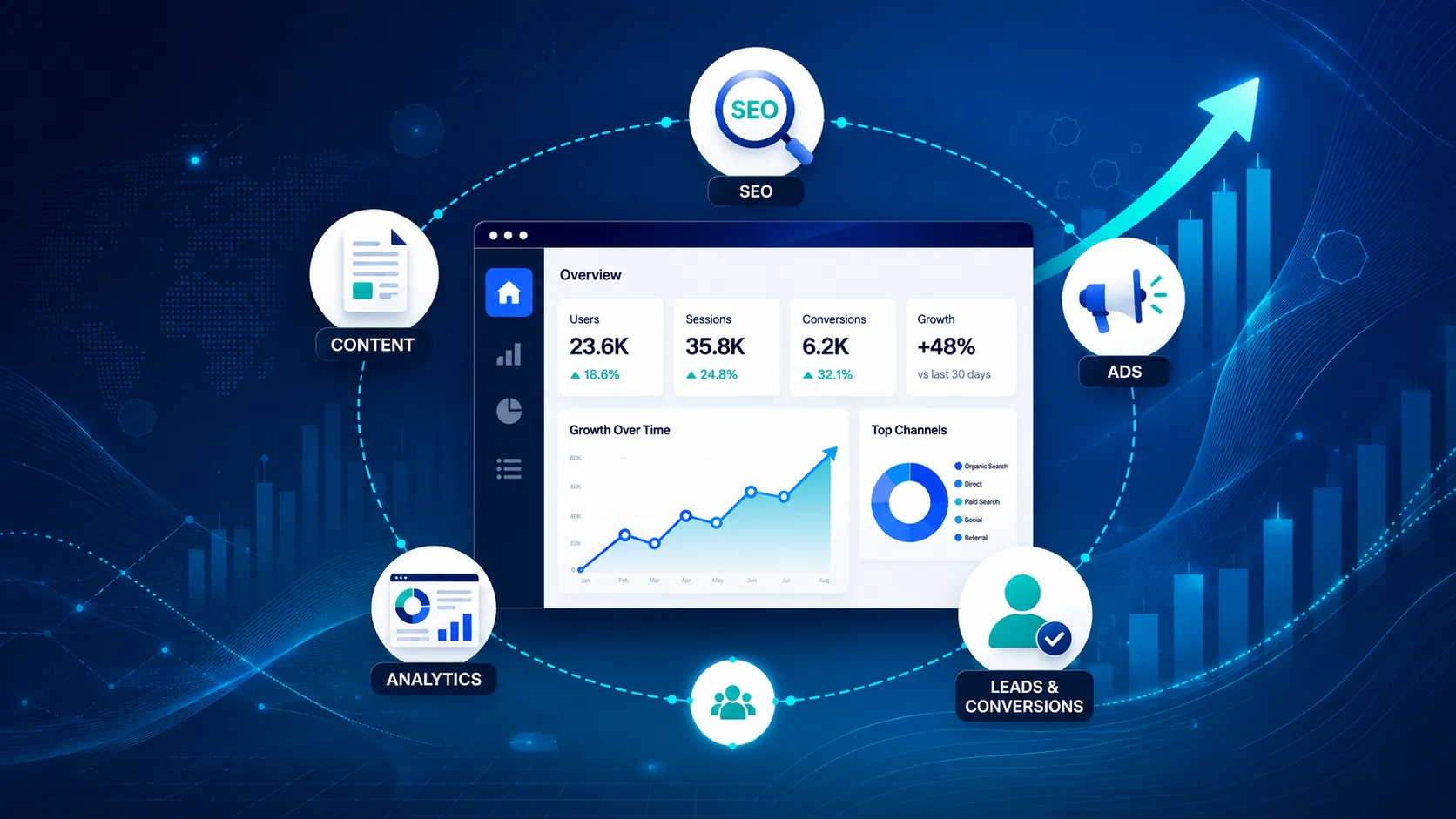
Consistent online growth is rarely the result of one viral post, a temporary advertising push, or publishing more content without a clear direction. It comes from a connected system in which your website, SEO, content, paid campaigns, conversion process, customer experience, and measurement support the same business goal.
Many businesses remain active online but cannot generate predictable enquiries or sales. They post frequently, redesign pages, run advertisements, and experiment with new tools, yet each activity works separately.
The missing element is usually not effort. It is a repeatable digital marketing framework that turns attention into measurable business progress.
To better understand the ideas discussed in consistent online growth, consider strengthening your skills with a practical digital marketing course in pune designed for real-world application.
"Marketing is the generous act of showing up with a true story that helps people get to where they'd like to go."
— Seth Godin
What Consistent Online Growth Really Means
Consistent online growth is the ability to improve meaningful business results through a repeatable digital system. Depending on the business model, these results may include qualified website traffic, enquiries, bookings, purchases, subscriptions, renewals, or repeat orders.
The word "consistent" does not mean that every week will produce identical numbers. Digital performance naturally changes because of seasonality, competition, pricing, customer behaviour, search demand, platform updates, and creative fatigue.
Consistency means that the business understands its marketing system well enough to identify changes, make informed decisions, and maintain long-term momentum.
A healthy online growth strategy connects three levels of performance:
- Attention: Search visibility, reach, impressions, video views, and website visits.
- Engagement: Content interactions, enquiries, email sign-ups, and product consideration.
- Business value: Qualified leads, sales, revenue, retention, and customer lifetime value.
Traffic without conversion creates activity rather than growth. Conversions without retention create constant pressure to acquire new customers. Sustainable digital growth connects acquisition, conversion, and customer relationships.
Why Online Growth Becomes Unpredictable
Most inconsistent growth comes from a fragmented approach.
A business may use different people for social media, paid advertising, SEO, content, design, and sales. However, nobody manages the complete customer journey. Each team reports its own metrics while the business lacks one shared definition of success.
The absence of a documented process also creates waste. Content topics are selected at the last minute, tracking is installed after campaigns launch, advertisements do not match landing pages, and leads receive inconsistent follow-up.
Recent research highlights the importance of strategy. Content Marketing Institute's 2026 B2B study found that 97% of respondents had a content strategy, while 61% reported that its effectiveness had improved. Strategy refinement was the most frequently identified contributor to improvement, ahead of additional budget.
The lesson is simple: better coordination can create more value than simply increasing the number of campaigns, posts, or tools.
The Seven-Part Online Growth Framework
1. Define One Primary Growth Goal
Start with a business outcome rather than a platform metric.
"Increase Instagram followers" is a channel goal. "Generate 100 qualified consultation bookings every month at an acceptable acquisition cost" is a business growth goal.
A useful goal should include:
- A measurable result
- A clearly defined audience
- A target period
- A quality standard
- An acceptable cost or return
Once the primary goal is clear, every channel can be given a specific role.
SEO may capture existing search demand. Social media may build awareness and familiarity. Paid advertising may accelerate reach. Email and WhatsApp may nurture interested prospects.
2. Understand the Audience and Buying Journey
Demographic targeting alone is not enough for consistent online growth.
You need to understand what customers want to achieve, what prevents them from acting, what questions they ask, and what evidence they need before making a decision.
Useful customer insights can come from:
- Customer interviews
- Sales-call notes
- Website search queries
- Google Search Console queries
- Reviews and comments
- Customer-support questions
- Lost-lead reasons
- Frequently repeated objections
Organize these insights into three stages of the customer journey.
Awareness Stage
The customer recognizes a problem but may not know which solution is appropriate.
Useful content includes educational blogs, explainer videos, checklists, beginner guides, social posts, and problem-focused resources.
Consideration Stage
The customer compares providers, prices, methods, features, and possible outcomes.
Case studies, comparison pages, testimonials, demonstrations, webinars, and detailed service pages can support the evaluation process.
Decision Stage
The customer is close to taking action but needs reassurance.
Clear landing pages, FAQs, transparent processes, reviews, consultation options, guarantees where appropriate, and strong calls to action help reduce uncertainty.
3. Strengthen the Website and Conversion Foundation
Your website connects discovery, trust, information, and action. Sending more traffic to a confusing page usually increases waste rather than results.
Every important landing page should quickly answer five questions:
- What is being offered?
- Who is the offer designed for?
- What problem does it solve?
- Why should visitors trust the business?
- What should visitors do next?
Conversion optimization should focus on message clarity, mobile usability, fast loading, simple navigation, short forms, visible calls to action, and authentic trust elements.
Trust elements may include:
- Detailed customer testimonials
- Original screenshots
- Relevant qualifications
- Client results
- Case studies
- Process explanations
- Accurate contact information
- Transparent policies
Google recommends evaluating page experience as a complete experience rather than focusing on one isolated score. Core Web Vitals, secure delivery, mobile display, limited intrusive interruptions, and easy access to the main content all contribute to usability.
4. Build a Search and Content Engine
SEO and content should operate as a connected knowledge system rather than an isolated publishing calendar.
Begin with an important product, service, or customer problem. Build a comprehensive pillar page around that subject and create supporting content covering:
- Definitions
- Costs
- Processes
- Benefits
- Comparisons
- Common mistakes
- Customer questions
- Industry-specific use cases
Link supporting articles to the relevant commercial page. Related articles should also link to one another wherever the connection is genuinely useful.
A balanced content plan includes:
- Evergreen content: Information that remains helpful over time
- Commercial content: Product, service, comparison, and solution pages
- Authority content: Case studies, expert opinions, and original research
- Timely content: Industry developments and platform updates
- Retention content: Onboarding, tutorials, usage tips, and customer education
Google advises website owners to create helpful, reliable, people-first content containing original information, experience, analysis, or insight.
Google's current guidance for generative AI search also recommends unique, non-commodity content, clear page organization, and relevant high-quality visuals. It warns against producing large numbers of pages merely to cover every possible keyword variation.
Quality should therefore guide content frequency. One useful article with expert explanations, original examples, images, and strong internal links may provide more long-term value than several shallow posts.
5. Use Paid Media as an Accelerator
Paid media works best when it accelerates a system that already has clear positioning, strong landing pages, credible proof, and dependable tracking.
It should not be expected to repair a confusing offer or weak customer experience.
Separate campaigns according to their purpose:
- Cold-audience campaigns: Introduce the problem, category, or brand.
- Demand-capture campaigns: Reach people actively searching for a solution.
- Remarketing campaigns: Re-engage website visitors, viewers, and leads.
- Retention campaigns: Encourage repeat purchases, upgrades, and referrals.
Test meaningful variables such as the customer problem, offer, proof, creative angle, landing-page message, and call to action.
Avoid evaluating campaigns only through clicks or inexpensive leads. A campaign with a higher cost per lead may be more profitable when lead quality, conversion rate, order value, and customer retention are stronger.
6. Improve Lead Nurturing and Customer Retention
Most visitors and leads do not convert during their first interaction. A consistent growth framework therefore needs structured follow-up.
Lead-generation businesses should create a follow-up process containing:
- Immediate acknowledgement
- Relevant service information
- Customer proof
- Objection handling
- Timely reminders
- A clear next step
Marketing and sales teams should share the same lead definitions. They should record response time, qualification status, follow-up progress, lost-lead reasons, and final outcomes.
Ecommerce and subscription businesses can improve retention through onboarding, product education, replenishment reminders, loyalty rewards, cross-selling, feedback requests, and win-back campaigns.
Retention also supports customer acquisition. Reviews, referrals, customer stories, and authentic product experiences give future buyers stronger reasons to trust the brand.
7. Measure, Learn, and Improve
Measurement turns marketing activity into a management system.
A practical growth dashboard may include:
- Qualified organic and paid traffic
- Landing-page conversion rate
- Cost per qualified lead
- Lead-to-sale conversion rate
- Revenue by channel
- Customer acquisition cost
- Repeat purchase or renewal rate
- Customer lifetime value
Google Analytics allows important customer actions to be recorded through events and key events. For lead-generation businesses, Google recommends events covering stages such as generating, qualifying, working, and converting a lead.
For ecommerce websites, recommended events include product views, add-to-cart actions, checkout activity, purchases, and refunds.
Use three different review cycles.
Weekly Operational Review
Check campaign delivery, advertising spend, lead flow, tracking, broken pages, form submissions, and urgent sales feedback.
Monthly Performance Review
Compare conversion rates, lead quality, content performance, revenue contribution, and progress toward the primary goal.
Quarterly Strategic Review
Reassess customer needs, offers, positioning, competitive changes, channel mix, budgets, content priorities, and technology requirements.
Do not react to every daily fluctuation. Identify a pattern, form a hypothesis, test one meaningful change, document the result, and apply what was learned.
A Practical 90-Day Online Growth Plan
Days 1–30: Diagnose
- Define the primary business goal and supporting KPIs.
- Audit analytics, conversion tracking, website usability, SEO, content, and campaigns.
- Interview customers and sales representatives.
- Identify major traffic, conversion, and retention gaps.
- Create a basic customer journey map.
Days 31–60: Build
- Improve high-intent landing pages.
- Publish a pillar page and supporting articles.
- Create testimonials, screenshots, and case-study assets.
- Launch focused campaigns for one audience and offer.
- Create lead-nurturing or customer-retention sequences.
- Test forms, events, and key events.
Days 61–90: Optimize
- Compare qualified leads and revenue instead of only traffic.
- Improve underperforming messages, pages, creatives, and follow-up.
- Repurpose successful content into videos, emails, and social posts.
- Move budgets toward proven audiences and offers.
- Document successful workflows.
- Identify the next growth constraint.
Example: Turning Random Marketing Into a Growth System
Professional Training Business Growth Transformation
Consider a hypothetical professional training business.
The company publishes motivational social posts, runs lead advertisements, and occasionally writes blogs. Enquiries arrive, but lead quality changes every week. The sales team also reports that many prospects do not fully understand the programme.
The business changes its primary metric from total leads to qualified counselling bookings.
It segments audiences by career stage, creates curriculum and comparison pages, and publishes useful content covering skills, fees, job roles, expected outcomes, and common doubts.
Paid campaigns now direct each audience to a relevant landing page. Leads receive a structured information sequence, while the sales team records qualification and enrolment outcomes.
Campaigns are compared using qualified bookings and admissions rather than form cost alone.
Performance may still fluctuate, but the business can now identify where prospects arrive, where they leave, and what should be improved next. That is the difference between random marketing and a repeatable online growth strategy.
Common Mistakes That Slow Online Growth
Chasing Every New Platform
Spreading limited resources across too many platforms reduces quality. Focus first on channels that match customer behaviour and business capacity.
Confusing Activity With Progress
Reach, impressions, followers, and clicks can be useful indicators, but they should connect to qualified leads, sales, retention, or another meaningful outcome.
Scaling Before Fixing Conversion
More traffic magnifies a weak offer or landing page. Improve the message, proof, user experience, and follow-up before making a major budget increase.
Changing Too Many Variables
When the audience, offer, creative, landing page, and budget all change together, it becomes difficult to identify what caused the result.
Ignoring Existing Customers
Onboarding, retention, referrals, testimonials, and reviews can strengthen revenue while reducing dependence on continuous customer acquisition.
How to Strengthen E-E-A-T and Trust
E-E-A-T represents experience, expertise, authoritativeness, and trustworthiness. It should be demonstrated through the substance of the page rather than added as an unsupported statement.
Include the following elements where relevant:
- Author name and qualifications
- First-hand observations and examples
- Original screenshots and photographs
- Transparent research methods
- Detailed case studies
- Specific and verifiable reviews
- Publication and update dates
- Citations from authoritative sources
- Accurate company and contact information
- Sponsorship or partnership disclosures
Google's people-first content guidance encourages original value, clear authorship, first-hand expertise, and a satisfying reader experience.
Conclusion
Consistent online growth is not created by one channel or one successful campaign. It comes from aligning a clear business goal with audience understanding, a strong website, useful content, search visibility, paid acceleration, structured follow-up, customer retention, and disciplined measurement.
Begin with the biggest constraint in your current system. It may be weak traffic quality, unclear messaging, low conversion, slow lead response, poor retention, or incomplete tracking.
Solve that constraint, measure the result, document the lesson, and then address the next one. Repeating this process creates sustainable digital growth that is easier to understand, improve, and scale.
Whether you're exploring digital marketing classes in pune, choosing an affordable digital marketing course in pcmc can help you build strong fundamentals without overextending your budget.
FAQs
1. How long does consistent online growth take?
The timeline depends on competition, budget, offer quality, website strength, and sales cycle. Paid campaigns can generate data quickly, while SEO, brand authority, and retention systems generally require sustained effort. A 90-day plan can help identify early performance patterns.
2. Which digital channel is best for online growth?
There is no universally best channel. Search captures existing demand, social media and video can create awareness, email nurtures prospects, and paid media accelerates reach. Select channels according to customer behaviour and the role they play in the buying journey.
3. How often should a business publish content?
Publish at a pace that maintains usefulness, originality, and quality. A realistic schedule that can be sustained is better than high-volume publishing that produces shallow or repetitive pages.
4. What should a small business measure first?
Start with one business outcome, such as qualified enquiries, purchases, bookings, or renewals. Then track the steps leading to that outcome, including traffic source, conversion rate, acquisition cost, sales conversion, and repeat behaviour.
5. Can paid advertising create sustainable online growth?
Yes, when paid advertising is connected to clear positioning, focused landing pages, dependable tracking, follow-up, and customer retention. It becomes less sustainable when a business relies on advertising without building owned assets such as useful content, email lists, and customer relationships.
6. What is the biggest obstacle to consistent online growth?
Fragmentation is one of the biggest obstacles. When channels, teams, data, and customer touchpoints operate separately, the business cannot clearly identify what drives results. A shared goal and measurement framework creates better alignment.