




Autonomous Marketing: How AI Agents Will Reshape Marketing Teams
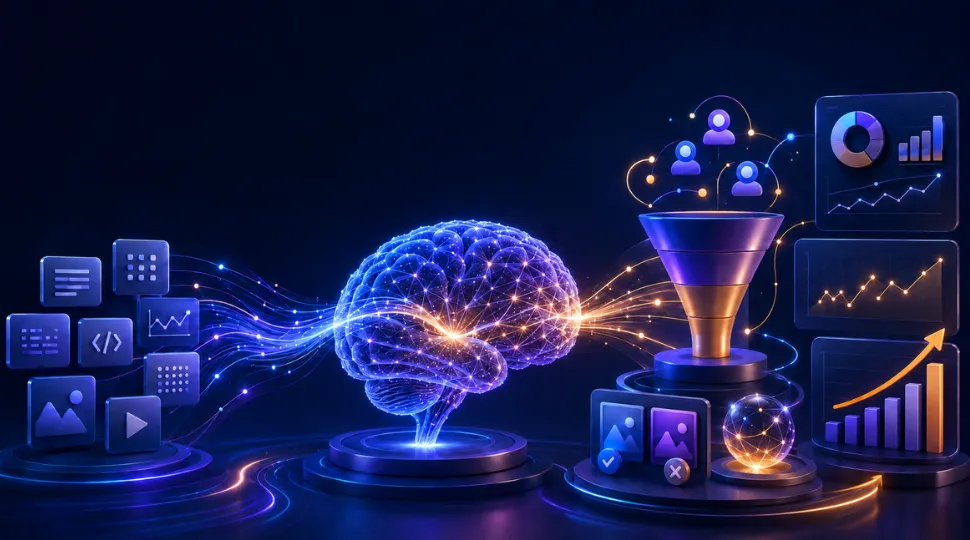
Autonomous marketing describes a new operating model in which AI agents can plan, execute, analyse, and improve marketing tasks within defined boundaries. Unlike conventional automation, these systems do more than follow fixed rules. They can interpret goals, use data, select tools, and decide what action to take next.
This does not mean marketing teams will disappear. It means marketers may spend less time moving data, preparing routine reports, and manually coordinating repetitive workflows. Their attention can shift towards customer understanding, strategy, creative judgment, governance, and business outcomes.
To better understand the ideas discussed in this article, consider strengthening your skills with a practical digital marketing course in Pune designed for real-world application.
What Is Autonomous Marketing?
Autonomous marketing is the use of AI-powered systems that can pursue marketing goals, make limited decisions, and perform connected tasks with reduced human intervention.
A typical AI marketing agent may be able to:
- Receive a goal, such as increasing qualified leads
- Retrieve information from approved data sources
- Break the goal into smaller tasks
- Use marketing and analytics tools
- Evaluate the result of an action
- Adjust its next step based on feedback
- Escalate unusual or high-risk decisions to a person
Google describes AI agents as systems capable of reasoning, making decisions, using tools, and coordinating with other agents. This makes them different from tools that only generate a headline or summarise a report. Google Cloud explains that agents can also process different types of information and facilitate business workflows.
Autonomous does not have to mean unsupervised. In a responsible setup, the system operates inside limits established by the organisation.
How AI Agents Differ From Traditional Automation
Traditional marketing automation remains valuable, but it usually follows predetermined instructions. An AI agent can respond more dynamically when the situation changes.
| Area | Traditional automation | AI agent |
|---|---|---|
| Trigger | Follows a predefined rule | Interprets a goal or event |
| Workflow | Uses a fixed sequence | Can choose among approved actions |
| Data use | Reads specified fields | May analyse several connected sources |
| Adaptation | Requires manual rule changes | Can adjust based on context |
| Output | Sends or updates as instructed | Can plan, act, check, and revise |
| Oversight | Monitored as a workflow | Governed like a limited digital operator |
For example, conventional email automation might send the same follow-up sequence when a person downloads an e-book. An AI agent could review the visitor's industry, previous engagement, purchase stage, and content interests before selecting an approved message and follow-up time.
The second model is more flexible, but it also creates additional risks. Poor customer data, unclear brand rules, or excessive system permissions can produce mistakes at a much greater scale.
How AI Agents Could Work Across Marketing
Customer and Market Research
A research agent could monitor approved sources, group customer questions, analyse review themes, and prepare a daily summary of emerging needs.
It may help a content strategist answer questions such as:
- Which customer problems are increasing?
- What language do prospects use to describe them?
- Which competitor topics are gaining attention?
- Where are customers becoming confused?
Human marketers would still need to validate the findings. Agents can identify patterns quickly, but they may misread sarcasm, cultural context, or the commercial importance of a trend.
Content Planning and Production
An AI content agent could turn an approved strategy into briefs, channel adaptations, metadata, and publishing schedules. It might also check whether a draft follows brand terminology or includes unsupported claims.
In real-world campaigns, one core article may need to become an email, a LinkedIn post, three short videos, sales enablement material, and several ad variations. Agents can coordinate these adaptations while people protect the central idea and creative standard.
Google's analysis of agentic marketing suggests that teams may move from a linear content supply chain towards a model in which people establish the brand framework and agents create channel-specific adaptations. The same analysis stresses that the operational challenge is greater than simply learning better prompts. Source: Think with Google.
Paid Advertising and Campaign Optimisation
An advertising agent could monitor spend, conversion quality, search terms, creative fatigue, tracking anomalies, and landing-page performance. It might recommend changes or automatically perform low-risk actions within approved limits.
For example, a business running Google Ads could allow an agent to:
- Detect a sudden drop in recorded conversions.
- Compare Google Ads, GA4, GTM, and CRM signals.
- Identify whether the issue appears technical or performance-related.
- Pause automated budget increases if tracking looks unreliable.
- Notify the performance marketer with supporting evidence.
This is safer than asking an agent to "increase ROAS" without defining conversion quality, budget limits, attribution rules, and escalation conditions.
Marketers who want deeper practical knowledge of PPC, analytics, conversion tracking, and optimisation can explore an Advanced Performance Marketing Course.
Lead Management and Personalisation
An AI agent connected to a CRM may classify enquiries, enrich permitted data, select approved follow-ups, and alert a salesperson when human involvement is valuable.
A common situation marketers encounter is a high volume of leads but inconsistent follow-up. An agent can improve response consistency, but it must not invent pricing, guarantees, eligibility conditions, or product capabilities. Critical commercial information should come from verified sources.
Marketing Analytics and Reporting
Reporting agents could gather data from advertising platforms, analytics systems, and CRM records before explaining meaningful changes.
Instead of saying, "CPL increased by 18%," a useful agent would investigate whether the change came from:
- A shift in media costs
- Reduced landing-page conversion
- Low-quality search terms
- A tracking problem
- Delayed CRM updates
- A change in lead qualification
The analyst's role then moves from assembling dashboards to testing explanations and deciding what the business should do.
How Autonomous Marketing Will Change Marketing Teams
From Task Ownership to Outcome Ownership
Many current roles are organised around channels: an SEO executive, media buyer, email marketer, content writer, or analyst. AI agents can work across systems, so teams may gradually be organised around outcomes such as acquisition, activation, retention, or customer value.
A person could manage several specialised agents:
- A research agent
- A campaign monitoring agent
- A content adaptation agent
- A reporting agent
- A compliance-checking agent
This does not automatically reduce the importance of specialists. Their platform knowledge is required to determine whether an agent's recommendation is sensible.
New Human Responsibilities
Marketers may increasingly be responsible for:
- Defining goals and success criteria
- Setting budgets and permissions
- Providing reliable brand and product context
- Reviewing high-impact decisions
- Investigating unusual results
- Testing the quality of agent outputs
- Maintaining audit trails
- Coordinating marketing, sales, legal, and IT
Microsoft's 2025 Work Trend Index found that 82% of surveyed leaders expected to use digital labour to expand workforce capacity within 12–18 months. The study included 31,000 workers across 31 markets. This reflects leadership expectations rather than guaranteed adoption, but it shows the scale of organisational interest. Source: Microsoft Work Trend Index.
Microsoft's 2026 research later reported that 66% of surveyed AI users said AI allowed them to spend more time on high-value work, while 58% said they were producing work they could not have produced a year earlier. Source: Microsoft 2026 Work Trend Index.
Benefits for Marketing Teams
- Faster execution — Agents can perform repetitive coordination continuously. This may shorten the time between detecting a problem and investigating it.
- Greater operational consistency — A well-designed agent can check every campaign or asset against the same approved rules. Humans may skip routine checks when workloads become heavy.
- More scalable personalisation — Agents can select from approved messages based on customer context. However, personalisation should remain relevant and respectful rather than intrusive.
- Better use of specialist time — When data preparation and routine monitoring are automated, experienced marketers can focus on experimentation, positioning, creative direction, and decision-making.
- Connected workflows — An agent can potentially connect insights across analytics, CRM, content, and advertising systems. This is important because marketing problems rarely remain inside one platform.
Risks and Limitations
- Incorrect decisions at scale — An agent may act confidently on incomplete data. If it controls several campaigns, a small error can affect a large budget or audience.
- Poor data quality — AI cannot repair every underlying measurement problem. Duplicate leads, incorrect attribution, missing consent records, or broken conversion tracking can lead to misleading actions.
- Brand and factual errors — Agents may produce inconsistent claims, inappropriate language, or inaccurate product details unless grounded in approved information.
- Privacy and security — Marketing agents may require access to customer data, analytics, advertising accounts, and internal documents. Permissions should follow the principle of least privilege: every agent receives only the access needed for its task.
- Optimising the wrong metric — An agent instructed to lower cost per lead may pursue inexpensive but unqualified enquiries. Marketing objectives must connect platform metrics with revenue, retention, or verified lead quality.
Google's agentic-marketing guidance recommends role-based access, defined autonomy boundaries, and controls that limit financial and operational risk. That is a useful reminder that AI agents should be governed with the same seriousness as other business systems. Source: Think with Google.
How to Introduce AI Agents Responsibly
Step 1: Begin with one bounded workflow
Choose a repetitive, measurable, and relatively low-risk task. Daily campaign anomaly detection is a better starting point than handing over an entire advertising budget.
Step 2: Document the current process
Write down the data used, decisions made, exceptions encountered, and people responsible. Automating a poorly understood process usually makes its weaknesses harder to see.
Step 3: Define permissions and limits
Specify:
- Which platforms the agent can access
- Whether access is read-only or allows changes
- Maximum budget or bid adjustments
- Prohibited actions
- Required approvals
- Escalation triggers
Step 4: Give the agent verified context
Provide current brand guidelines, product facts, target audiences, legal restrictions, campaign goals, and measurement definitions. Outdated instructions can make an otherwise capable system unreliable.
Step 5: Test with historical or sandbox data
Compare the agent's recommendations with decisions previously made by experienced marketers. Examine both correct actions and false alarms.
Step 6: Keep humans at critical checkpoints
Require approval for public claims, major budget changes, sensitive customer communication, and decisions with legal or reputational consequences.
Step 7: Review logs and improve the workflow
Every important action should be traceable. Teams need to know what the agent observed, what it changed, and why the change was permitted.
Metrics for Evaluating Autonomous Marketing
Do not judge an agent only by the number of tasks it completes. Evaluate the quality and business effect of its decisions.
| Metric | What it reveals |
|---|---|
| Task success rate | Whether the workflow achieved its defined outcome |
| Human correction rate | How often people had to revise the result |
| Escalation accuracy | Whether uncertain cases reached the right person |
| Error severity | The financial or reputational impact of mistakes |
| Time to insight | How quickly a meaningful issue was detected |
| Qualified lead rate | Whether acquisition quality improved |
| Conversion value or revenue | Whether activity supported business results |
| Cost per approved outcome | Efficiency after quality is considered |
| Compliance rate | Whether actions stayed within established rules |
For performance campaigns, marketers should continue monitoring conversion quality, customer acquisition cost, ROAS, tracking accuracy, and CRM outcomes. Agent activity is an operational measure—not a substitute for commercial performance.
Skills Marketers Will Need
Marketers will not need to become AI engineers, but they will need more than prompt-writing skills.
Useful capabilities include:
- Customer and market understanding
- Campaign strategy
- Analytics and data interpretation
- Conversion tracking fundamentals
- Experiment design
- Brand judgment
- Workflow mapping
- Privacy and responsible data use
- Quality assurance
- Clear communication with technical teams
If you prefer flexible learning from anywhere, an online digital marketing course can help you strengthen practical digital marketing skills while learning at your own pace.
The most valuable professionals will know when to accept an agent's suggestion, when to investigate further, and when human experience should override the system.
"Artificial intelligence is as revolutionary as mobile phones and the Internet."
— Bill Gates
Frequently Asked Questions
1. What is autonomous marketing?
Autonomous marketing uses AI agents to plan and perform connected marketing tasks within defined rules. An agent may analyse data, use approved tools, take a low-risk action, and evaluate the result. Human teams still set objectives, permissions, quality standards, and escalation points.
2. How are AI agents different from generative AI tools?
A generative AI tool normally produces an output after receiving a prompt. An AI agent can pursue a goal through multiple steps, retrieve information, use tools, evaluate progress, and choose its next action. The distinction is between producing content and coordinating action.
3. Will autonomous marketing replace marketing jobs?
It is more likely to change tasks and role design than eliminate every marketing position. Repetitive execution may decrease, while demand grows for strategy, creative judgment, analytics, governance, experimentation, and customer understanding. The effect will vary by company and role.
4. Can small businesses use AI marketing agents?
Yes, but small businesses should begin with a narrow use case such as report preparation, content quality checks, or lead classification. Sensitive communication, customer data, and advertising budgets require clear controls regardless of company size.
5. Can AI agents manage Google Ads or Meta Ads independently?
Technically, agents may monitor and modify campaigns when integrations permit it. Full independence is rarely the safest starting point. Budget changes, tracking failures, conversion quality, platform policies, and attribution require human review and strict spending limits.
6. What is the biggest risk of autonomous marketing?
The biggest risk is scalable action based on the wrong objective, incorrect data, or inadequate context. An agent can efficiently optimise a misleading metric. Businesses therefore need verified data, limited permissions, approval thresholds, and auditable decision logs.
7. How should a company choose its first AI-agent use case?
Start with a frequent, measurable workflow that consumes significant time but has limited downside. Define its inputs, output, owner, success metric, and exceptions. Run the agent in recommendation-only mode before allowing it to make changes.
Conclusion
Autonomous marketing is moving AI from isolated content generation towards coordinated action. Its real impact will come from agents that connect research, content, advertising, analytics, and customer workflows while operating inside clear boundaries.
Marketing teams should first improve their data, document workflows, define meaningful outcomes, and test agents on limited tasks. Human review remains essential wherever decisions affect budgets, customers, brand reputation, privacy, or regulatory compliance.
Professionals developing these capabilities can build practical foundations through a digital marketing course in Pune, digital marketing course in PCMC, or digital marketing course in Surat. Flexible learners can consider an online digital marketing course, while those focusing on paid media, tracking, analytics, and campaign optimisation may benefit from an Advanced Performance Marketing Course.
The strongest marketing teams will combine AI's speed with human judgment, disciplined measurement, and continuous testing.