




Auto-Generated Creative in PPC: Should You Use AI-Generated Ads for Better Performance?
What Is Auto-Generated Creative?
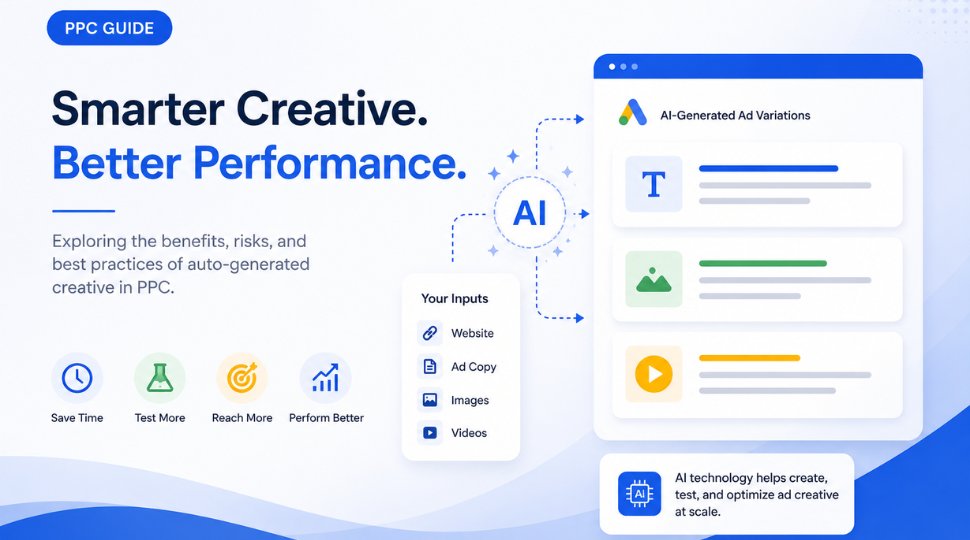
The ad assets that are automatically generated or collated by an ad platform through AI/ML are called auto-generated creative.
Rather than having to enter all the headlines or create all the creative variations, advertisers enter the following:
- Website URLs
- Existing ad copy
- Product feeds
- Images
- Videos
- Brand guidelines
The platform then creates assets for ads to help optimize performance and reach more people.
Examples Include
- Google AI Max text customization
- Responsive Search Ads (RSAs)
- Performance Max campaigns
- Dynamic Search Ads (DSAs)
- Microsoft Advertising AI-generated assets
Types of Auto-Generated Creative
1. Customer-in-the-Loop (CITL)
The platform offers suggested assets, but they need to be approved by the advertiser before posting.
Benefits include:
- Greater control
- Reduced compliance risk
- Faster asset creation
2. Dynamic Composition
The platform brings together existing assets, creates several variations of them, and then provides the combinations which are most likely to perform.
Examples include:
- Responsive Search Ads
- Responsive Display Ads
- Performance Max campaigns
3. Fully Auto-Generated Creative
The system automatically creates new headlines, descriptions, or visuals after campaigns are launched. These assets may be generated from:
- Website content
- Search intent signals
- Historical performance data
- Existing campaign assets
Some platforms allow reporting and removal of generated assets after publication.
Why AI-Generated Ads Are Becoming Popular
Campaigns are now played out across multiple touchpoints, and advertising platforms are increasingly concentrating on automation:
- Multiple devices
- Numerous ad placements
- Various audience segments
- Hundreds of variants to search intent
It is sometimes difficult to make creatively different scenarios by hand. AI can address this challenge by:
- Generating content faster
- Testing more combinations
- Adapting messaging dynamically
- Scaling campaigns efficiently
Industry Insight: In today's day and age, creative is one of the biggest performance drivers in PPC — even more important than bidding optimization, sometimes.
Benefits of Auto-Generated Creative
1. Faster Campaign Launches
Manually creating dozens of variations of the ad is a lot of effort. AI-generated creative can:
- Create assets in mere minutes
- Reduce production bottlenecks
- Accelerate campaign deployment
This is particularly beneficial for ecommerce businesses, seasonal campaigns, and large product catalogs.
2. Increased Testing Opportunities
One of the most significant benefits of AI is its scalability. Instead of testing just 3 headlines and 2 descriptions, AI can evaluate dozens or hundreds of combinations. This is a great way to figure out winning creatives in an accelerated way.
3. Expanded Inventory Reach
Auto-generated creative can adapt to multiple ad placements and formats automatically.
Benefits include:
- More auction eligibility
- Increased impressions
- Greater reach
- Improved campaign scalability
Platforms can customize assets based on placement requirements without manual redesign work.
4. Reduced Human Bias
Marketers often rely on assumptions about what messaging will work. AI focuses on:
- User behavior
- Performance data
- Conversion signals
This allows platforms to discover combinations that humans may never have considered.
5. Continuous Optimization
Unlike static ads, AI-generated creative can evolve over time. Systems continuously learn from:
- Click-through rates
- Conversion rates
- Engagement metrics
- Audience behavior
This creates a dynamic optimization cycle.
Risks and Challenges of Automated Ad Assets
Brand Consistency Concerns
Many businesses have strict branding guidelines covering messaging, tone of voice, visual identity, and compliance requirements. AI-generated assets may occasionally produce content that doesn't align perfectly with established brand standards.
Compliance and Regulatory Issues
Industries such as healthcare, finance, insurance, and legal services often require extensive review processes before ads can be published. In these environments, auto-generated creative may introduce additional compliance challenges.
Loss of Creative Control
Many marketers prefer direct oversight of every advertisement. Concerns include:
- Inaccurate messaging
- Generic content
- Weak value propositions
- Brand dilution
These concerns remain one of the primary reasons advertisers hesitate to fully embrace AI-generated assets.
Generic Ad Copy
AI often relies heavily on website content. If your website contains weak messaging, unclear positioning, or generic language, the generated ads may reflect those weaknesses. This makes landing page quality more important than ever.
When Should You Use Auto-Generated Creative?
Ideal Scenarios
Auto-generated creative works particularly well when:
- Large Product Inventories: Ecommerce businesses often manage thousands of products. AI can generate scalable variations without requiring manual asset creation.
- Limited Marketing Resources: Small businesses and startups can use AI to compete more efficiently without expanding creative teams.
- High-Volume Testing Environments: Organizations focused on experimentation can rapidly test multiple creative concepts.
- Strong Website Content: Businesses with well-optimized websites provide better inputs for AI systems, resulting in stronger generated assets.
When Should You Avoid It?
Situations Requiring Caution
- Strict Regulatory Requirements: Organizations requiring legal review for every ad may prefer manual creative management.
- Highly Specialized Messaging: Industries that depend on nuanced messaging often benefit from human-written copy.
- Premium Luxury Brands: Luxury brands frequently maintain highly curated creative standards that AI may struggle to replicate consistently.
- No Testing Framework: If performance monitoring is limited, auto-generated assets can create unnecessary risks.
The Hybrid Approach: Human + AI Collaboration
For many businesses, the most effective solution is neither full automation nor complete manual control. Instead, they adopt a hybrid model.
How It Works
AI assists with:
- Headline generation
- Creative concepts
- Ad variations
- Testing frameworks
Humans remain responsible for:
- Brand strategy
- Final approvals
- Compliance checks
- Messaging refinement
This approach combines efficiency with quality control.
Real-World Example
A SaaS company may:
- Use AI to generate 20 headline variations
- Review and edit the best options
- Launch approved assets
- Analyze performance
- Refine future campaigns
This process significantly reduces workload while preserving brand integrity.
Using AI Creative as a Diagnostic Tool
An often-overlooked benefit of auto-generated creative is its ability to reveal how advertising platforms interpret your website.
If AI-generated ads consistently misrepresent your products or services, it may indicate issues with:
- Website content
- Landing page clarity
- Product descriptions
- SEO structure
In this way, AI-generated creative becomes a valuable auditing tool rather than simply an advertising feature.
Questions to Ask
- Does the AI understand my core offering?
- Are generated headlines accurate?
- Is messaging aligned with user intent?
- Does the platform correctly identify my target audience?
The answers often uncover valuable optimization opportunities.
Best Practices for Testing Auto-Generated Creative
- Start Small: Begin with limited campaigns before scaling across your account.
- Review Generated Assets Regularly: Monitor headlines, descriptions, images, and videos. Remove poor-performing or off-brand content.
- Establish Brand Guidelines: Provide clear instructions regarding tone, colors, fonts, and messaging priorities.
- Compare Human vs AI Performance: Track CTR, Conversion Rate, CPA, and ROAS. Allow data — not assumptions — to guide decisions.
- Optimize Landing Pages: Because AI relies heavily on website content, stronger landing pages often produce stronger generated assets.
Future of AI-Powered PPC Advertising
The future of PPC is unlikely to be entirely human-driven or fully automated. Instead, we are moving toward intelligent collaboration.
Expected developments include:
- More advanced asset generation
- Real-time personalization
- Automated creative testing
- Predictive messaging optimization
- Brand-aware AI systems
Advertisers who learn how to guide and supervise AI effectively will likely gain a significant competitive advantage.
Key Takeaways
Essential Points to Remember
- Auto-generated creative is not a replacement for human creativity — it's a tool for efficiency and scale.
- AI works best with strong inputs. Well-optimized websites produce better auto-generated assets.
- The hybrid approach wins. Combine AI speed with human oversight for best results.
- Test and monitor continuously. Regular review prevents brand dilution and compliance issues.
- Use AI as a diagnostic tool. Generated assets reveal how platforms interpret your website.
- Data drives decisions. Compare human-written and AI-generated performance before scaling.
Conclusion
Marketers are not replacing creative by automation — it is a way to achieve greater efficiencies, run more tests, and gain important insights.
The best advertisers know that AI is most effective when balanced by good strategy, brand guidelines, and supervisory oversight. Instead of seeing automation as a threat, companies should consider how it can enhance their scalability and creative excellence.
Whether you're exploring a digital marketing course in Thane or comparing digital marketing classes in Pune, choosing an affordable digital marketing course in PCMC can help you build strong fundamentals and master both manual and AI-powered PPC strategies.
"The best marketing doesn't feel like marketing."
— Tom Fishburne
Frequently Asked Questions
1. Does auto-generated creative improve PPC performance?
It can. Performance depends on the quality of your website content, existing assets, and testing strategy. Many advertisers see improved scale and efficiency when using AI-generated variations.
2. Is AI-generated ad copy safe for regulated industries?
Not always. Businesses in highly regulated sectors should review generated assets carefully before deployment.
3. Can I edit auto-generated assets?
Most advertising platforms allow advertisers to review, modify, or remove generated assets.
4. Should small businesses use auto-generated creative?
Yes, especially when resources are limited. AI can help create and test more ad variations efficiently.
5. Is human-written copy still important?
Absolutely. Human creativity remains essential for brand storytelling, emotional messaging, and strategic positioning.